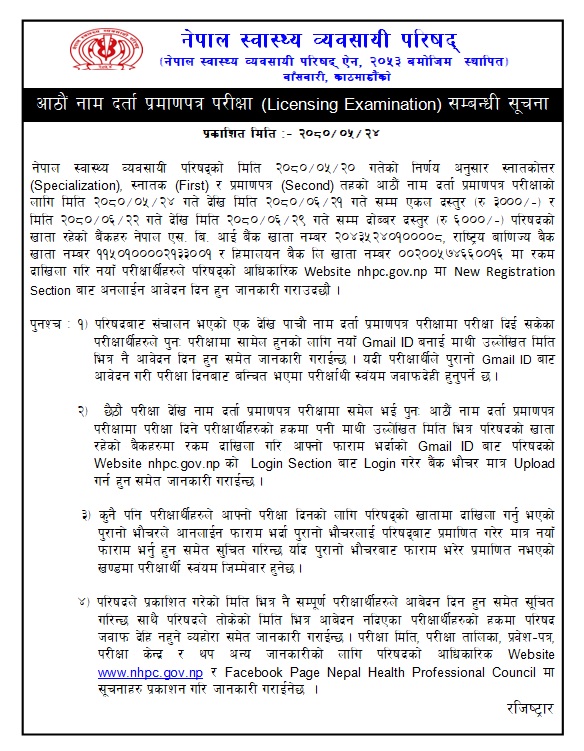
Rabies vaccine dose in nepal 2080: How to give rabies vaccine correctly

Rabies vaccine dose in Nepal 2080- How to give rabies vaccine

Table of Contents (toc)

Introduction

Rabies is a disease with the highest documented case-fatality rate, close to
100%.
Rabies is a vaccine-preventable viral zoonotic disease responsible for an
estimated 59,000 human deaths every year.
Dogs are responsible for up to 99% of human rabies cases in rabies-endemic
regions like Nepal.
Many human rabies cases are not admitted, or patients leave against medical
advice (LAMA) due to no documented good outcome.
There are a couple dozen cases of rabies survivors which died after few months
or years and had very bad neurological sequale due to rabies.
The Rabies Virus (RABV) belongs to the genus Lyssavirus in the family
Rhabdoviridae and order Mononegavirales. 
All Lyssavirus eselicit an acute progressive encephalitis in human
beings. 
There are at least 14 individual Lyssavirus species, subdivided into 2
phylogroups based on genetic distance and serological cross-reactivity.
RABV is an unsegmented, single-stranded, negative-sense, enveloped RNA virus
and belongs to Phylogroup 1.
The genome encodes fi ve proteins; the most important of these from an
immunization perspective is the G glycoprotein, which includes the antigenic
sites targeted by rabies vaccines and passive immunization.

Types of rabies:

  1. Furious form (classsical )
  2. Paralytical form

Consequence of an exposure to RABV (Rabies virus) depends on these factors:

  1. The severity of the wound
  2. The location of the bite on the body
  3. The quantity of virus inoculated into the wound(s), and
  4. The timeliness of post-exposure prophylaxis (PEP)
Without PEP, the average probability of developing rabies following a
bite by a rabid animal to the head is 55%, upper extremity 22%, the
trunk 9% and a lower limb 12%.

Signs and Symptoms of Rabies

Initial Symptoms

  1. Pain or paraesthesia at the wound site
  2. Fever

Later Symptoms

  1. Hyperactivity
  2. Fluctuating consciousness
  3. Hallucinations
  4. Hydrophobia (furious rabies)
  5. Paralysis and coma (paralytic rabies)
  6. Followed by death
RABV infection in rodents is very uncommon. No human rabies cases due to
bites by rodents have been reported. Exposure to domestic rodents,
squirrel, hare and rabbits do not routinely require PEP.

The clinical presentation of the two types of rabies:

Furious Rabies (Classical)

  1. Hydrophobia
  2. Aerophobia and Photophobia
  3. Excitation and confusion
  4. Excessive sweating and salivation
  5. Dehydration
  6. Death in 2-5 days

Paralytic Rabies

  1. Gradual ascending paralysis
  2. Hydrophobia is not seen
  3. Myoedema and piloerection
  4. Stupor, Coma
  5. May resemble Guillain–Barré syndrome
  6. Death in 1-2 weeks
With the exception of hydrophobia, clinical signs of rabies can be
unreliable.

Differential Diagnosis of Rabies

  1. Cerebral malaria
  2. Organophosphate poisoning
  3. Herpes simplex encephalitis
  4. Post-vaccinal encephalitis
  5. Scorpion and snake envenomation
  6. Illicit drug use
  7. Psychiatric disorders

Post Exposure Prophylaxis (PEP)

Rabies in humans can be prevented, after exposure, by PEP.
Proper wound management combined with prompt post-exposure use of Cell
Culture Vaccines and Embryonated Egg-based Vaccines (CCEEVs) and
simultaneous administration of RIG in severe exposures, is close to 100%
effective in preventing rabies.

WHO Classifi cation of Exposures

Category I

Touching or feeding of animals, Animal licks on intact skin (NO EXPOSURE)

Category II

Nibbling of uncovered skin, Minor scratches or abrasions without
bleeding (EXPOSURE)

Category III

  • Single or multiple trans dermal bites or scratches
  • Contamination of mucous membrane or broken skin with saliva from animal
    licks
  • Exposures due to direct contact with bats
  • Bite by all wild animals should be treated as Category III exposure.
         
  (SEVERE EXPOSURE)

PEP by Category of Exposure and immunological status/previous immunization

PEP Components includes:
  1. Local wound treatment
  2. Local wound treatment
  3. Rabies Vaccines
Read table below:
Category I Exposure Category II Exposure Category III Exposure
Immunologically naive individuals of all age groups No PEP required Wound washing and Immediate vaccination Wound washing and Immediate vaccination and RIG administration
Previously immunized individuals of all age groups No PEP required Wound washing and Immediate vaccination RIG is not indicated Wound washing and Immediate vaccination RIG is not indicated
If an individual has a repeat exposure less than 3 month after a previous
exposure, and has already received a complete PEP, only wound treatment is
required; neither vaccine nor RIG is needed.

Persons who cannot document previous pre- or post-exposure prophylaxis,
should be treated as a fresh case and given complete PEP

The only documented cases of human-to-human transmission occurred via
tissue and organ transplants from RABV-infected individuals, and a single
case of likely perinatal RABV transmission via transplant was reported.

Dose of Vaccine

All animal bite victims of Category II and III exposures, irrespective of
age and body
weight, require the same number of injections and dose per injection.

PEP for immunilogically naive case:

0.1 ml on each site, intradermal rute, on days 0, 3, 7 at rate of number
of injections 2-2-2-0-0 in deltoid or lateral thigh while deltid being
preferred.

PEP for immunized case:

0.1 ml on each site, intradermal rute, on days 0, 3 at rate of number of
injections 1-1-0-0-0 in deltoid or lateral thigh while deltid being
preferred.

Note: intramuscular regimen is not used as ID gives same immunity with
technical and financial benefits.

Dose of RIGs

The maximum dose of
• Human RIG -20 IU/kg of body weight
• Equine immunoglobulin and F(ab’)2 products- 40 IU/kg of body weight

Storage of RIGs

RIGs should be stored and transported at a temperature of +2 to 8oC and
should not be frozen.

Pre-Exposure Prophylaxis (PrEP)

WHO recommends PrEP for individuals at high risk of RABV exposure.
PEP may sometimes be necessary for the partners of patients, as close
contact and sexual intercourse in the early stages of the disease
pose a hypothetical risk for transmission (infectious RABV is present in
saliva).
Dose: 0.1 ml each site intradermal on day 0 and 7 2 sites 2-0-2-0-0 in
deltoid or lateral thigh.
Pregnant women are safe for rabies vaccination.
For full text refer to following protocol.

Thank you.

Who needs tetanus Prophylaxis: Theory of tetanus vaccine and Immunoglobulins

Who needs tetanus Prophylaxis: Theory of tetanus vaccine and Immunoglobulins – A complee guide for healthcare workers summarised

Who needs tetanus Prophylaxis: Theory of tetanus vaccine and Immunoglobulins 

Table of Contents (toc)

Introduction

What is tetanus?

How does tetanus occur?

What are signs of symptoms of tetanus?

Is there treatment of tetanustetanus?

How to prevent tetanus?

What is indication tetanus immunoglobulins?

FAQs

1. I have complete immunization previously do i still need vaccine?

2. I have incomplete vaccination do i need vaccine?

3. I do not know about my immunization what should i do?

4. Who needs Immunoglobulins?

Mystic Healthcare – Nepal’s Best Doctor Consultation at Home Facility in Kathmandu

Mystic Healthcare – Best Doctor at Home Facility in Kathmandu is Launched with Home care, online consultation and many more

Table of Contents(toc)

Introduction

Mystic Healthcare: Revolutionizing Healthcare in Nepal

Mystic Healthcare is a healthcare service provider, a clinic based in Nepal.

They have a unique approach to healthcare, providing medical services right at the comfort of your home.

They can be contacted through social media, Whatsapp, viber, messenger, calls and you can order OPD based healthcare at your home. 

But remember, they’re not emergency healthcare provider hence you should seek legal emergency medical providers if you’re in hurry or emergency. 

They’ve also launched a physical clinic where you can visit and get more of healthcare services. 

A New Approach to Healthcare

In a world where everything is just a click away, healthcare should be no different.

Mystic Healthcare understands this and has taken a unique approach to healthcare.

They provide medical services right at your doorstep. 

This not only makes healthcare more accessible but also adds a level of comfort and convenience that is unparalleled.

Services Offered

Mystic Healthcare offers a wide range of services.

 Their main goal is to make healthcare more accessible and convenient for everyone. 

They have a team of qualified and experienced doctors who are ready to provide medical assistance at any time. 

Whether it’s a regular check-up, Mystic Healthcare ensures that you receive the best care right at your home.

  1. Online doctor consultation
  2. Specialist doctor consultation
  3. Geriatric old age care
  4. Disability and injury care at home
  5. Postpartum care at home and monitoring 
  6. Doctor at home
  7. Nurse at home
  8. Minor procedures at home
  9. Dressing at home
  10. Medicine supply at home
  11. Nursing care products supply at home
  12. Physiotherapy at home
  13. Psychological counseling at home/ online
  14. Lab sample and blood test from home
  15. Reports sent at email/whatsapp
  16. Reports interpretation at home/online
  17. Medical instruments and supplies delivery at home
  18. Home x-ray and interpretation
  19. Home portable ultrasound
  20. Home echocardiogram and interpretation
  21. Home ECG and interpretation 
  22. Neutraceuticals and supplements delivery

Popularity Among Locals

Mystic Healthcare has gained popularity among the locals. 

Their Facebook page, “Mystic Healthcare: Doctor at Home Nepal”, has garnered numerous likes and followers. 

This shows the trust and confidence that people have in their services. 

The positive reviews and testimonials on their page further attest to their commitment to providing high-quality care.

Impact on the Community

By bringing healthcare services directly to the homes of patients, Mystic Healthcare is making a significant impact on the community. 

They are making healthcare more accessible, especially for those who may find it difficult to travel to a hospital or clinic. 

This is particularly beneficial for the elderly, people with disabilities, and those living in remote areas.

Social accounts of Mystic Healthcare

You can contact mystic healthcare via one of following:
  1. Facebook 
  2. Instagram
  3. Whatsapp
  4. Viber
  5. Twitter/X
  6. TikTok
  7. Messenger
  8. Threads
  9. Phone number of Mystic Healthcare
  10. Website of Mystic Healthcare 

Contact information of Mystic Healthcare

Phone number: 9861481571
Whatsapp: 9861481571
Contact address for business query: 9861481571

Conclusion

In conclusion, Mystic Healthcare is revolutionizing the way healthcare is delivered in Nepal. 

Their growing popularity is a testament to their commitment to providing high-quality care. 

By making healthcare more accessible and less stressful, they are not only improving individual health outcomes but also contributing to the overall well-being of the community.

They can be contacted via multiple ways for healthcare at your doorstep. 

DDA Nepal Banned These Combination Antibiotics 2024/2081

DDA Nepal Banned These Combination Antibiotics 2023/2080

Drugs banned in nepal 2023

Table of contents(toc)

Introduction

Government of Nepal established Department of Drug Administration (DDA) in
1979 A.D (2036/07/01 B.S.) erstwhile under Ministry of forest & soil
conservation and went under Ministry of Health and population after Poush,
2041 B.S.
DDA is one of the three departments under Ministry of Health &
Population. 

Drug regulation in Nepal

Nepal has promulgated the Drug Act 1978, to prohibit the misuse or abuse of
medicines and allied pharmaceutical products as well as false or misleading
information relating to efficacy and use of drugs and to regulate and
control the production, marketing, distribution, export, import, storage and
utilization of those drugs which are not safe for the public use,
efficacious and of standard quality.
To implement & fulfill the aim and objectives of Drug Act 1978 and
various regulations are made under it.

Government of Nepal Banned combination antibotics

In accordance with the objectives of the National Health Policy, 1991, to improve & manage by establishing co-ordination among governmental, non-governmental & private organizations involved in activities related to medicine production, import, export, storage, supply, sales, distribution, qualitya ssessment, regulatory control, rational use and information flow, the National Drug Policy, 1995 has been implemented. Achieving the aim & objectives of National drug policy is another important area for DDA.

Laws regarding drugs in Nepal (medicinal)

Under the Drug Act 1978, the following rules/regulations & codes have been implemented as supporting tools for the active enforcement of Drugs Act, 1978.
  • Drug advisory committee & consultative council regulation, 2037
  • Drug registration regulation, 2038
  • Inquiry & inspection regulation, 2040
  • Drug standard regulation, 2043
  • Drug donation guidelines have been implemented for the quality assurance of donated drugs
  • Drug sales & distribution codes, 2071
  • Good practice codes for drug production, 2072
  • Medicine registration guidance, 2073
Click the individual link above to read the each law.

{
“@context”: “https://schema.org”,
“@type”: “FAQPage”,
“mainEntity”: {
“@type”: “Question”,
“name”: “What are the Laws regarding drugs in Nepal (medicinal)?”,
“acceptedAnswer”: {
“@type”: “Answer”,
“text”: “Drug advisory committee & consultative council regulation, 2037
Drug registration regulation, 2038
Inquiry & inspection regulation, 2040
Drug standard regulation, 2043
Drug donation guidelines have been implemented for the quality assurance of donated drugs
Drug sales & distribution codes, 2071
Good practice codes for drug production, 2072
Medicine registration guidance, 2073”
}
}
}

Acute Gout Diagnosis and Management 2023

Acute gout diagnosis and management 2023

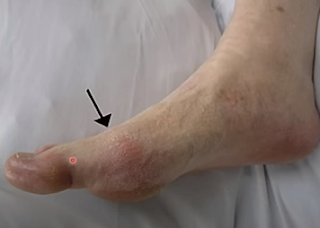
Gout in Right great toe (pic: pixabay)

Table of Contents (toc)

Introduction

It is a crystal arthropathy due to deposit of urate or uric acid crystals.
This is usually seen in acted painful join and patients may come to emergency or OPD.
Caused by precipitation and deposition of uric acid crystals in the joints.

Etiology

Primary Hyperuricemia

Idiopathic
Increased production of uric acid
Decreased excretion of uric acid
Aggravated by the dietary habits

Secondary Hyperuricemia

1. Decreased excretion

Most common cause
Medications like pyrizinamide, aspirin, loop and thazide diuretics, niacin
Chronic renal insufficiency
Ketoacidosis
Post-menopausal age

2. Increased Production

Tumor lysis sundrome
Hemolytic anemia
Lesh Nyhan syndrome
Purine rich diets like red meats, sea foods, calcium poor diet
Obesity

3. Combined effect

Alcohol and diet containing high purine (like in a party with barbeque)
Decreased uric acid excretion

Clicnical features of gout and hyperuricemia

1. Asymptomatic stage 

(may be more than 10 years) – but slowly this stage keeps on affecting the body

2. Acute gouty arthritis

Acute severe pain with overlying erythema, decreased range of motion, swelling and warmth
Mostly occurs at night and patient usually wakes up from sleep due to pain
Pain peaks in 12-24 hours and regressed ver a period of days to weeks
Acute gouty arthritis

3. Chronic gout

Takes several years
Tophi formation

Types of tophi

  1.     Bone tophi
  2.     Soft tissue tophi
Renal complications include Nephrolithiasis and nephropathy.

Trigger of acute gouty arthritis

Here is the list of things or events that ma trigger the gouty arthritis episode.
  • Purine rich meal
  • Alcohol
  • Trauma
  • Surgery
  • Diuresis
  • Dehydration

Inflammation of different joints and their names in gout

1. Podagra:

MTP if the big toe
Occurs at night
Wakes up the patient
Most common site
Podagra

2. Gonagra

Inflammation of the knee
Features similar to other joints

3. Chiragra

Inflammation of the fingers
MTP of the thumb mostly involved

Note: Desquamation of the overlying skin may occur in the secondary phase of the disease.

Diagnosis of Gout

Synovial fluid analysis (Gold Standard)
  1. Cell count
  2. Gram staining and culture sensitivity test
  3. Polarised light microscopy

How to differentiate Gouty arthritis vs Septic arthritis?

  1. Gouty arthritis has less cell cunt (<2000 vs >50000)
  2. There will not be any pus like synovial fluid
  3. No crystal in Polarised light microscopy
  4. No bacteria in culture and sensitivity test

Polarised light microscopy for gout

  1. Yellow colored polarised light is used

  2. Crystalls lie parallel to the axis of polarisation of light

  3. It will show needle shaped monosodium urate crystals that are negatively birefringement.
Urate crystals in microscopy

Use of serum uric acid level inacute gout flair up

It is not useful in acute gout management or check prognosis
It is useful for prevention
it is useful for management and monitoring of chronic gout
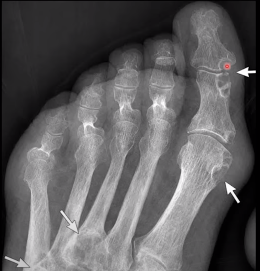
Xray finding: Punched out lytic lesion called rat bite lesion

What to do if synovial fluid vannot be taken?

Synovial fluid analysis is gold standard
No finding in first episode of gout
Finding will be in repeated episode
Can be useful in chronic gout
Initially there might not be any damage that can be seen in the xray.
Xray finding: Punched out lytic lesion called rat bite lesion

Septic arthritis cannot be ruled out.
Rat bite lesion in chronic gout

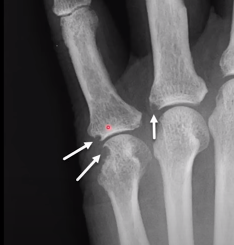
Below is another example of rat bite lesion.

rat bite lesion in chronic gout

Treatment of acute gout

Lifestyle modification

  1. Limit alcohol use (has high purine)
  2. Limit intake of high purine diet like red meat, sea foods, sellfish
  3. Limit high fructose corn syrup like sugary foods, juices and non diet sodas
  4. Weight loss

General measures

Change offending drugs like diuretics to ACEI or ARB
Rest and ice the affected joint

Medical management

First lines

  1. NSAIDS
  2. Glucocorticoids(Drug of choice)
  3. Colcicine (Last choice for example PUD)

Second line

IL-1 inhibitors or ACTH

Third line

Combination above medications
Intrarticular corticosteroids
Do not mix NSAIDs and Gucocorticoids

Choice of corticosteroids

Prednisone (0.5 to 1 mg/kg)
Prednisolone (0.5 mg/kg) upto one week
Methylprednsolone (IV/IM/Inaarticular)

NSAIDs choice in Gout:

Naproxen (750 mg stat then 250 mg TDS)
Selecoxib 
Etoricoxib

Avoid aspirin because it decreases uic acid excretion and even precipates gout. If patient is taking low dose aspirin continue it.

Colchicine is beneficial if taken within 12 hrs of acute gout.

Dose of colchicine

1.2 mg stat then 0.6 mg after one hout. 

Side effects of colchicine

Diarrhea (common)
Myopathy

Contraindication of Colchicine

* CKD patients *

Management of chronic gout

Uric acid lowering drugs

  1. Xanthene oxidase inhibitor: allopurinol 1st line
  2. Uricosuric : Probenecid 2nd line
  3. Recombinant uricase : Pegloticase (uric acid to allantoin) 3rd line
Contraindication: Never start urate loweing therapy in acute gout flare up patient if they’re not taking any already.
Start these drugs after inflammation/acute flare up subsided.
If not other joint will also be involved.

Indication of urate lowering drugs

Damage due to chronic gout
Tophi development
Frequent attacks 

Target of treatment is <6mg/dl

General tips on control gout

 Checklist of Gout management:

  1. Consider other serious illnesses like septic arthritis
  2. Do diagnostic tests (arthosentesis, blood, imaging)
  3. Consult rheumatology if in doubt
  4. Provide analgesia
  5. Rest and ice
  6. Do not discontinue urate lowering therapy, do not start if not taking
  7. Start as early as possible
  8. NSAIDS
  9. Colchicine
  10. Steroids
  11. Combination (do not combine steroids and nsaids)
  12. Follow up and indication of long term urate lowering therapy.

Snakebite Management Protocol Nepal 2023 PDF

(PDF) Snakebite Management Protocol Nepal 2023 Pdf download is here. 

Table of Contents (toc)


Introduction

Snakebite is major public health concern here in Nepal especially in Terai
region and in summer.
 
This is a major challange and governmanet of Nepal has made a protocol to deal
with snake bite.
Government of Nepal Provides Anti Snake-Venom for free in the specialized
settings of Nepal. 
Here is the Pdf of the protocol for Snakebite management in Nepal.
Snakebite is recently decided to be included in NTDs list by WHO.
Please go through the Protocoland LEAVE A COMMENT TO ENCOURAGE ME.

Snakebite Protocol


Here is a powerpoint presentation on bites and stings

Thank you for reading Please feel free to comment and encourage me or just provicec me feedback. Thank you.
Strawberry in Medicine

Strawberry 🍓 in Medicine

Strawberry 🍓 in Medicine

Strawberry in medicine:
  1. 🍓 tongue-Kawasaki disease
  2. 🍓 vagina- Trichomonas
  3. 🍓 Gums Wegners
  4. 🍓 skull- Edwards syndrome
  5. 🍓 gall bladder – Cholesterosis
  6. 🍓 hemangioma- Capillary hemangioma
  7. 🍓 skin- Sarcoidosis
  8. 🍓 nasal mass-Rhinosporidiosis

{

“@context”: “https://schema.org”,

“@type”: “FAQPage”,

“mainEntity”: {

“@type”: “Question”,

“name”: “What are Strawberry in Medicine?”,

“acceptedAnswer”: {

“@type”: “Answer”,

“text”: “1 – 🍓 tongue-Kawasaki disease

2 – 🍓 vagina- Trichomonas

3 – 🍓 Gums Wegners

4- 🍓 skull- Edwards syndrome

5- 🍓 gall bladder – Cholesterosis

6 – 🍓 hemangioma- Capillary hemangioma

7- 🍓 skin- Sarcoidosis

8- 🍓 nasal mass-”

}

}

}

Exit mobile version