20 Common MCQs in The Spleen: Your Body’s Hidden Guardian

Introduction

While most people can easily point to their heart or stomach, the spleen remains a bit of a mystery. Tucked away in the upper left side of your abdomen, this fist-sized organ quietly performs some of the body’s most critical “housekeeping” and security tasks.

Where is it Located?

The spleen is located in the left upper quadrant of the abdomen, shielded by the 9th, 10th, and 11th ribs. It sits just below the diaphragm and behind the stomach. In a healthy adult, it is usually about the size of a small avocado or a clenched fist and cannot be felt through the skin.

What Does the Spleen Actually Do?

Think of your spleen as a multi-purpose facility that serves two primary systems: the immune system and the blood (hematologic) system.

  • The Blood Filter: One of its main jobs is to act as a quality control center for your blood. As blood flows through the spleen, it identifies and removes old, malformed, or damaged red blood cells.
  • Immune Surveillance: It is the largest organ in the lymphatic system. It produces and stores white blood cells (lymphocytes) and antibodies that spring into action to fight off bacteria and viruses.
  • Emergency Reservoir: The spleen acts as a backup tank, storing about one-third of the body’s platelets and a significant reserve of red blood cells. In the event of severe bleeding or physical stress, the spleen can contract to squeeze this extra blood into your circulation.
  • Recycling Center: When it breaks down old red blood cells, it carefully recycles the iron, sending it back to the bone marrow to help create new hemoglobin.

A Tale of Two Pulps

Inside the spleen’s tough outer capsule, there are two distinct types of tissue, each with a specific specialty:

  1. Red Pulp: This makes up about 80% of the organ and is responsible for the filtering and storage of blood.
  2. White Pulp: This tissue is part of the immune system. It produces white blood cells that produce antibodies to target specific infections.

Can You Live Without It?

Yes, you can live without a spleen—a condition known as asplenia. If the spleen is removed (a surgery called a splenectomy), other organs like the liver and bone marrow take over many of its duties. However, because the spleen is so vital for fighting certain types of bacteria, people without one are at a much higher risk for infections and must stay up-to-date on specific vaccinations.

Keeping Your Spleen Healthy

While many spleen issues are secondary to other conditions (like liver disease or certain cancers), you can support yours by:

  • Preventing Injury: Wear protective gear during contact sports to avoid a ruptured spleen, which is a medical emergency.
  • Hydration & Diet: Drinking plenty of water and eating nutrient-rich foods supports the lymphatic system overall.
  • Infection Control: Managing infections like mononucleosis (which can cause the spleen to enlarge, or “splenomegaly”) is key to preventing long-term damage.

Spleen MCQs (NCLEX Style)

Spleen MCQs (NCLEX Style)

1. The spleen is located in:
A. Right hypochondrium
B. Left hypochondrium
C. Epigastrium
D. Umbilical region

Click to view answer

Answer: B. Left hypochondrium
Explanation: The spleen lies in the LUQ under ribs 9–11.


2. The spleen becomes palpable when enlarged to:
A. 1.5 times
B. 2 times
C. 3 times
D. 5 times

Click to view answer

Answer: C. 3 times
Explanation: Clinically palpable when significantly enlarged.


3. Most common cause of splenomegaly worldwide:
A. Leukemia
B. Malaria
C. Cirrhosis
D. TB

Click to view answer

Answer: B. Malaria
Explanation: Very common in endemic regions.


4. Most common cause of splenic rupture:
A. Infection
B. Tumor
C. Trauma
D. Congenital

Click to view answer

Answer: C. Trauma


5. The spleen develops from:
A. Endoderm
B. Mesoderm
C. Ectoderm
D. Neural crest

Click to view answer

Answer: B. Mesoderm


6. Arterial supply of spleen:
A. Hepatic artery
B. SMA
C. Splenic artery
D. IMA

Click to view answer

Answer: C. Splenic artery


7. Splenic artery arises from:
A. Aorta
B. SMA
C. Celiac trunk
D. Renal artery

Click to view answer

Answer: C. Celiac trunk


8. Spleen is attached to kidney by:
A. Gastrosplenic ligament
B. Splenorenal ligament
C. Falciform ligament
D. Coronary ligament

Click to view answer

Answer: B. Splenorenal ligament


9. Which is NOT a function of spleen?
A. RBC destruction
B. Immunity
C. Platelet storage
D. Insulin secretion

Click to view answer

Answer: D. Insulin secretion


10. Spleen stores:
A. Lymphocytes only
B. RBC only
C. Platelets and RBC
D. Plasma

Click to view answer

Answer: C. Platelets and RBC


11. Hypersplenism causes:
A. Leukocytosis
B. Pancytopenia
C. Polycythemia
D. Thrombocytosis

Click to view answer

Answer: B. Pancytopenia


12. Common indication for splenectomy:
A. Iron deficiency anemia
B. ITP
C. Diabetes
D. Hypertension

Click to view answer

Answer: B. ITP


13. Functional asplenia is seen in:
A. Thalassemia
B. Sickle cell disease
C. Leukemia
D. Hemophilia

Click to view answer

Answer: B. Sickle cell disease


14. Most serious complication after splenectomy:
A. Bleeding
B. Thrombosis
C. Infection
D. Anemia

Click to view answer

Answer: C. Infection (OPSI)


15. Most common organism in OPSI:
A. Streptococcus pneumoniae
B. E. coli
C. Pseudomonas
D. Klebsiella

Click to view answer

Answer: A. Streptococcus pneumoniae


16. Essential vaccine before splenectomy:
A. Hep B
B. Rabies
C. Pneumococcal
D. BCG

Click to view answer

Answer: C. Pneumococcal


17. Left shoulder pain in splenic injury is:
A. Murphy sign
B. Cullen sign
C. Kehr sign
D. Rovsing sign

Click to view answer

Answer: C. Kehr sign


18. Most commonly injured organ in blunt trauma:
A. Liver
B. Spleen
C. Kidney
D. Pancreas

Click to view answer

Answer: B. Spleen


19. Howell-Jolly bodies indicate:
A. Liver disease
B. Splenic dysfunction
C. Iron deficiency
D. Infection

Click to view answer

Answer: B. Splenic dysfunction


20. Massive splenomegaly is seen in:
A. Appendicitis
B. CML
C. Asthma
D. Diabetes

Click to view answer

Answer: B. CML

Complete Definition of Acute Liver Failure (According to Nelson)

📘 Standard Pediatric Definition (Nelson Textbook of Pediatrics)

👉 Acute Liver Failure (ALF) is defined as:

Evidence of acute liver injury in a child with no pre-existing chronic liver disease, accompanied by hepatic-based coagulopathy (INR ≥1.5 with encephalopathy OR INR ≥2.0 without encephalopathy), not corrected by vitamin K.


🔑 Key Components to Remember

1. Acute liver injury

  • Elevated transaminases (AST/ALT)
  • Recent onset (days to weeks)

2. No prior chronic liver disease

  • Important to differentiate from acute-on-chronic liver failure

3. Coagulopathy (core criterion)

  • INR ≥1.5 + encephalopathy
    OR
  • INR ≥2.0 without encephalopathy
  • Must be unresponsive to vitamin K

4. Encephalopathy (may be absent in children)

  • Unlike adults, pediatric ALF does NOT require encephalopathy for diagnosis

🧠 Exam Pearls (Very Important)

  • Coagulopathy is mandatory
  • Encephalopathy is NOT mandatory in pediatrics
  • Always mention vitamin K non-correction

🧾 One-line Answer for Exams

👉 “Acute liver failure is acute hepatic injury without prior liver disease, with INR ≥1.5 with encephalopathy or ≥2 without encephalopathy, not corrected by vitamin K.”

Crohn’s Disease — MD-Level Note (based on Harrison’s Principles of Internal Medicine)


Video on Chron’s Disease (sensitizer)

🔬 Overview & Definition

Crohn’s disease (CD) is a chronic, relapsing inflammatory bowel disease (IBD) characterized by:

  • Transmural inflammation
  • Segmental (“skip”) involvement
  • Can affect any part of GI tract (mouth → anus), most commonly:
    • Terminal ileum ± colon

🧬 Etiopathogenesis

1. Genetic Susceptibility

  • Strong association with:
    • NOD2 (CARD15) mutation
  • Other genes: ATG16L1, IL23R
  • Family clustering common

2. Immune Dysregulation

  • Predominantly Th1 and Th17 mediated response
  • ↑ Cytokines:
    • TNF-α, IL-12, IL-23
  • Impaired regulatory T-cell function

3. Microbiome Interaction

  • Dysbiosis with abnormal response to gut flora
  • Loss of tolerance to commensals

4. Environmental Factors

  • Smoking (↑ risk, worse prognosis)
  • NSAIDs, infections, diet

🧠 Pathology

Gross Features

  • Skip lesions
  • Cobblestone appearance
  • Strictures (“string sign”)
  • Creeping fat

Microscopy

  • Transmural inflammation
  • Non-caseating granulomas (not always present)
  • Lymphoid aggregates
  • Fissuring ulcers → fistula formation

📍 Distribution Patterns

  • Ileocolonic (most common)
  • Isolated ileal
  • Isolated colonic
  • Upper GI involvement (rare but important)

⚠️ Clinical Features

Intestinal Symptoms

  • Chronic diarrhea (may be non-bloody)
  • Abdominal pain (RLQ common)
  • Weight loss, malnutrition
  • Fever during flares

Complications

  • Strictures → obstruction
  • Fistulas:
    • Enteroenteric
    • Enterocutaneous
    • Perianal (hallmark)
  • Abscess formation

Extraintestinal Manifestations

  • Joints: peripheral arthritis, ankylosing spondylitis
  • Skin: erythema nodosum, pyoderma gangrenosum
  • Eyes: uveitis, episcleritis
  • Hepatobiliary: PSC (less common than in UC)

🔎 Diagnosis

1. Endoscopy (Gold Standard)

  • Patchy inflammation
  • Aphthous ulcers → deep linear ulcers
  • Cobblestone mucosa

2. Imaging

  • MR enterography preferred
  • CT for complications
  • Barium:
    • String sign

3. Histology

  • Transmural inflammation
  • Granulomas (supportive, not mandatory)

4. Laboratory Findings

  • ↑ CRP, ESR
  • Anemia (iron deficiency, chronic disease)
  • Hypoalbuminemia
  • Fecal calprotectin ↑

🧾 Differential Diagnosis

  • Ulcerative colitis
  • Intestinal tuberculosis (important in Nepal)
  • Infectious enterocolitis
  • Ischemic colitis

🧑‍⚕️ Disease Classification

Montreal Classification

  • Age at diagnosis (A1–A3)
  • Location (L1–L4)
  • Behavior:
    • B1: inflammatory
    • B2: stricturing
    • B3: penetrating

💊 Management (Step-Up vs Top-Down Approach)

1. Induction Therapy

Mild–Moderate

  • Budesonide (ileocecal disease)
  • 5-ASA (limited role in CD)

Moderate–Severe

  • Systemic corticosteroids

2. Maintenance Therapy

  • Thiopurines (azathioprine, 6-MP)
  • Methotrexate
  • Biologics:
    • Anti-TNF:
      • Infliximab
      • Adalimumab
    • Anti-integrin:
      • Vedolizumab
    • Anti-IL-12/23:
      • Ustekinumab

3. Surgical Management

  • Not curative (unlike UC)
  • Indications:
    • Obstruction
    • Fistula
    • Abscess
    • Refractory disease

🚨 Complications

  • Short bowel syndrome
  • Malabsorption (B12 deficiency)
  • Colorectal cancer (less than UC but still increased risk)
  • Osteoporosis (steroid use)

📊 Prognosis

  • Chronic relapsing course
  • Majority require surgery at some point
  • Smoking cessation improves outcomes significantly

🧠 High-Yield Harrison Pearls

  • Transmural + skip lesions = Crohn’s
  • Perianal disease strongly suggests CD
  • Granulomas: specific but not sensitive
  • Surgery is not curative
  • Anti-TNF revolutionized management

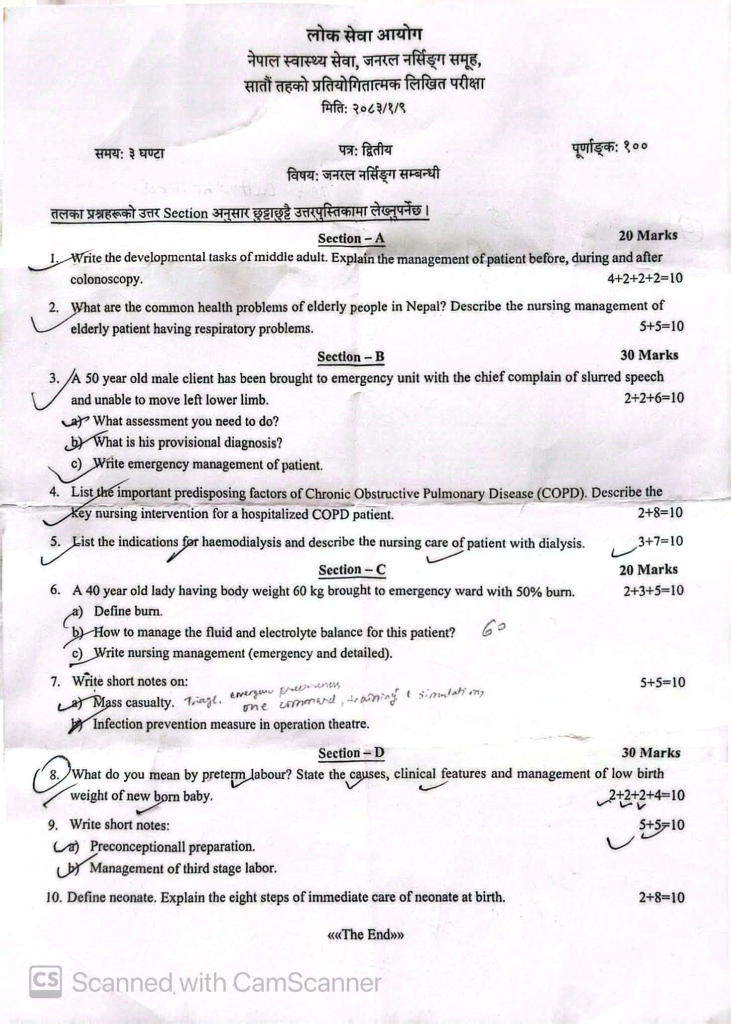
Nepal Nursing 7th level Question 2083 (past nursing officer question)


लोक सेवा आयोग

नेपाल स्वास्थ्य सेवा, जनरल नर्सिङ समूह,

सातौं तहको प्रतियोगितात्मक लिखित परीक्षा

मिति: २०८३/१/९

समय: ३ घण्टा | पत्र: द्वितीय | पूर्णाङ्क: १००

विषय: जनरल नर्सिङ सम्बन्धी

तलका प्रश्नहरूको उत्तर Section अनुसार छुट्टाछुट्टै उत्तरपुस्तिकामा लेख्नुपर्नेछ।

Section – A (20 Marks)

  1. Write the developmental tasks of middle adult. Explain the management of patient before, during and after colonoscopy. (4+2+2+2=10)
  2. What are the common health problems of elderly people in Nepal? Describe the nursing management of elderly patient having respiratory problems. (5+5=10)

Section – B (30 Marks)

  1. A 50 year old male client has been brought to emergency unit with the chief complain of slurred speech and unable to move left lower limb. (2+2+6=10)a) What assessment you need to do?b) What is his provisional diagnosis?c) Write emergency management of patient.
  2. List the important predisposing factors of Chronic Obstructive Pulmonary Disease (COPD). Describe the key nursing intervention for a hospitalized COPD patient. (2+8=10)
  3. List the indications for haemodialysis and describe the nursing care of patient with dialysis. (3+7=10)

Section – C (20 Marks)

  1. A 40 year old lady having body weight 60 kg brought to emergency ward with 50% burn. (2+3+5=10)a) Define burn.b) How to manage the fluid and electrolyte balance for this patient? [Note: ’60’ is written next to this]c) Write nursing management (emergency and detailed).
  2. Write short notes on: (5+5=10)a) Mass casualty. [Handwritten addition: Triage, emergency preparedness, one command, training & simulation]b) Infection prevention measure in operation theatre.

Section – D (30 Marks)

  1. What do you mean by preterm labour? State the causes, clinical features and management of low birth weight of new born baby. (2+2+2+4=10)
  2. Write short notes: (5+5=10)a) Preconceptionall preparation.b) Management of third stage labor.
  3. Define neonate. Explain the eight steps of immediate care of neonate at birth. (2+8=10)

5 Very Important Abdominal (GI) anomalies in Down syndrome

🚻 Genitourinary (GU) anomalies in Down syndrome

Renal / urinary tract anomalies:

  • Hydronephrosis
  • Vesicoureteral reflux (VUR)
  • Posterior urethral valves (PUV) (in males)
  • Structural renal anomalies (less frequent than cardiac/GI)

External genital anomalies:

  • Cryptorchidism (undescended testes)
  • Hypospadias
  • Smaller genitalia (common phenotypic feature, not a malformation)

🧠 Clinical Pearls (Exam gold)

  • If a neonate with Down syndrome has bilious vomiting → think duodenal atresia first
  • If there is delayed meconium → rule out Hirschsprung disease
  • Always screen:
    • Echocardiography (most important—AV canal defects common)
    • Abdominal ultrasound if symptoms suggest GU involvement

🔑 High-yield GI associations:

  • Duodenal atresia
    • Classic “double bubble” sign on X-ray
    • Presents with early bilious vomiting
  • Hirschsprung disease
    • Failure to pass meconium, abdominal distension
    • Due to absence of ganglion cells in distal colon
  • Annular pancreas
    • Can cause duodenal obstruction
  • Imperforate anus (less common than in VACTERL but reported)

⚠️ Pattern to remember

  • Down syndrome = GI obstruction + Hirschsprung risk
  • GU anomalies are less consistent but still clinically relevant
Exit mobile version