Introduction : Zoonotic disease control program Nepal animal human disease transmission
zoonoses and zoonotic diseases
(toc)Table of Contents
Introduction
Zoonotic diseases are illnesses that can be passed between animals and humans. They can be caused by viruses, bacteria, parasites, or fungi that normally live in animals but can jump to people.
This can happen through direct contact with an infected animal, bites, or even through the environment, like contaminated water or food.
Understanding zoonotic diseases is important because they can affect our health, especially as humans and animals increasingly interact in various settings.
By recognizing the risks and knowing how these diseases spread, we can take steps to protect ourselves and prevent outbreaks which keep on happening in modern world of today equally.
Historically zoonotic diseases have taken millions of lives like plague and worms.
Epidemiology and disease burden of Zoonotic disease in modern era
Here are some facts about zoonotic diseases, along with citations from reputable sources:
Prevalence:
Approximately 60% of all infectious diseases in humans are zoonotic. This highlights the significant role that animals play in human health. (Source: World Health Organization [WHO], 2020)
Types of Zoonotic Diseases:
Common zoonotic diseases include rabies, Lyme disease, West Nile virus, and COVID-19. Each has unique transmission routes and impacts. (Source: Centers for Disease Control and Prevention [CDC], 2021)
Transmission:
Zoonotic diseases can be transmitted through various pathways, including direct contact with animals, bites, consumption of contaminated food, and exposure to contaminated environments. (Source: National Institutes of Health [NIH], 2018)
Emerging Threats:
Many new and emerging infectious diseases are zoonotic in nature. The increase in wildlife trafficking, habitat destruction, and climate change is contributing to the rise of these diseases. (Source: EcoHealth Alliance, 2021)
Prevention:
Strategies to prevent zoonotic diseases include improving animal health, promoting safe food practices, and enhancing surveillance of wildlife and livestock health. (Source: WHO, 2020)
These facts illustrate the importance of understanding zoonotic diseases and implementing preventive measures to protect public health.
Examples of zoonoses and zoonotic diseases:
There are several zoonoses and zoonotic disease are spreading throughout the world now but the most important are listed below.
1. Rabies:
A viral disease typically transmitted through the bite of an infected animal, primarily affecting mammals.
2. Lyme Disease:
Caused by bacteria transmitted through tick bites, it can lead to serious long-term health issues if untreated.
3. West Nile Virus:
Transmitted by mosquitoes that have fed on infected birds, this virus can cause severe neurological disease in humans.
4. Salmonella:
Often contracted from contaminated food, particularly raw or undercooked animal products, this bacterial infection can lead to gastrointestinal illness.
5. Brucellosis:
Caused by bacteria from infected animals (often livestock), it can spread through unpasteurized dairy products or direct contact.
6. Hantavirus:
Spread primarily through contact with rodent droppings, urine, or saliva, this virus can cause severe respiratory disease.
7. Zika Virus:
Transmitted primarily by mosquitoes, this virus can also spread through sexual contact and can cause birth defects.
8. Ebola Virus Disease:
Believed to originate from fruit bats, it can be transmitted to humans through contact with infected animals and human bodily fluids.
9. Avian Influenza (Bird Flu):
Caused by influenza viruses that infect birds, it can occasionally infect humans, particularly those in close contact with infected poultry.
10. COVID-19:
Caused by the SARS-CoV-2 virus, it is believed to have originated from bats and may have been transmitted to humans through an intermediate host.
Avoid consuming raw or undercooked animal products, such as milk, eggs, or meat.
Wash fruits and vegetables properly, especially if grown near animals.
5. Wildlife and Pest Control
Limit exposure to wildlife, especially in residential or farming areas.
Implement pest control measures to keep rodents and insects (which can spread diseases) under control.
Avoid keeping wild animals as pets, which can increase the risk of zoonotic infections.
6. Biosecurity Measures on Farms
Separate new animals from the existing herd until they’re deemed disease-free.
Regularly clean and disinfect animal enclosures, feeding areas, and equipment.
Implement strict biosecurity measures for farm workers and visitors to prevent disease spread.
7. Education and Awareness
Educate communities about the risks of zoonotic diseases and methods for prevention.
Train workers who handle animals on safe practices and protective measures.
Inform the public on responsible pet ownership and wildlife interactions.
8. Travel Precautions
Avoid close contact with animals when traveling to areas with known zoonotic outbreaks.
Ensure that food and water consumed in endemic areas are safe and properly prepared.
Follow all travel advisories related to zoonotic diseases.
Taking a suitable approach that combines hygiene, vaccination, environmental control, and awareness can significantly reduce the risk of zoonotic disease and its transmission.
Erectile dysfunction icd 10 : Treatment and solution
erectile dysfunction
(toc) Table of Contents
Introduction of Erectile Dysfunction
Disclaimer: This article may contain texts or images that are not suitable for people below 18 years. If your’re below 18 years leave this article and go to ▶homepage.
Erectile dysfunction is one of the most common male sexual dysfunction in modern world are facing now.
It is the inability to attain or sustain an erection satisfactory for sexual intercourse including sufficient hardship or time.
Most erectile dysfunction is most commonly related to vascular (blood vessels), neurologic(brain or nerves), psychological(thought or mental status), and hormonal disorders(mostly make hormones like testosterone); use of a medication can also be a significant cause.
Evaluation typically includes screening for underlying disorders and measuring testosterone levels in blood.
Treatment options include oral phosphodiesterase inhibitors, intraurethral suppositories, intracavernosal injections, vacuum erection devices, and surgical implants.
These topics will be discussed separately below.
Causes of erectile dysfunction
There are basically two types of erectile dysfunction:
Primary erectile Dysfunction: a man has never been able to attain or sustain erection
Secondary erectile dysfunction: a man has previously been able to attain or sustain erection but now he is unable to do so.
Based upon the above types, the causes of ED can be listed as below:
Vascular causes/disorders
Neurologic causees/disorders
Hormonal causes
Psychological/Psychiatric causes
Systemic illness related causes
Vascular cause of erectile dysfunction:
Out of these, Vascular cause is the most common cause of erectile dysfuntion.
Atherosclerosis, is the major vascular cause to be noted. Other include smoking, endothelial dysfunction, diabetes and autoimmune vasculitis.
Age is the important factor that plays great role side by side on this.
Generally low testosteone level from other hormonal dysorder also causes penile vascular abnormality and hence ED.
Neurological causes of erectile dysfunction include:
Hormonal disorders of erectile dysfunction include :
primary hypogonadism
secondary hypogonadism
medicaltion like anti andogens
Other causes of erectile dysfunction:
Pelvic radiation
Structural disorders of penis like pyronie disease
prolonged perineal pressure
Perineal trauma
sickle cell disease
Medication
Medication like cocaine use, alcohol, trazodone and inta cavernous injection of multiple injection may also c a use penile tissue destruction and the erectile dysfuncton.
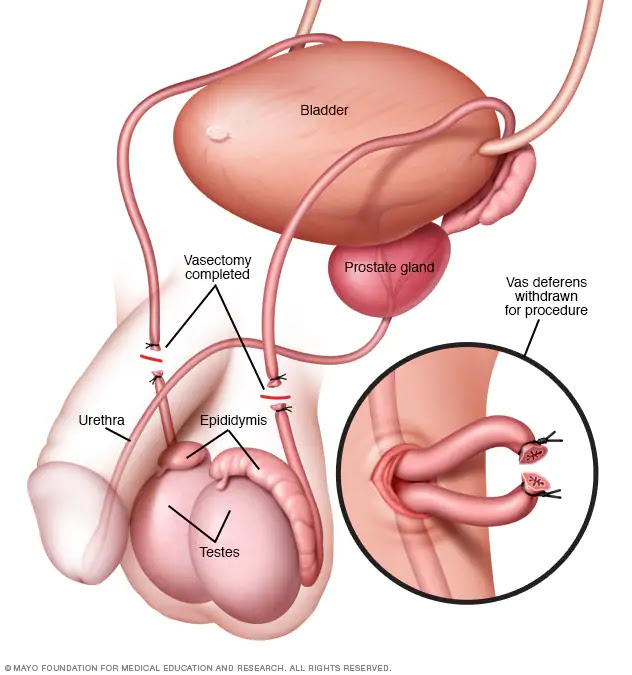
Vasectomy (copyright: mayoclinic)
Can Vasectomy and permanent male sterilization cause erectile dysfunction ?
No, vasectomy cannot cause erectile dysfunction. The explanation is: it blocks the way from which sperms come out by mixing with semen but it doen not reduce serum testosterone level.
The testosterone that is produced in testicles is released into the blood but not into the semen. Hence this will have no effect on serum testosterone level hence in sexual function as well.
Diagnosis of Erectile Dysfunction
Diagnosis of erectle dysfunction is done clinically. For further confirmation and to rule out other causes further tests cn be done on the basis of clinical judgement.
Clinical evaluation
Screening for depression and mental illnesse
Serum testosterone level
Patient can also be evaluated for the vascular, neurological and systemic illnesses as well.
Sometimes partner sexual dusfunction can also be takie ninto account to rule out the cause related to partner compliance.
Examination is also focused to pelvic, genital and systemic evluation based on history given by the patient.
Patient should be throughly evaluated for hypogonadism and pyronie disease.
Laboratory testing can be done from testosterone level to LH and prolactin as well.
Screening should be done for occult diabetes, dyslipidemia, hyperprolactinemia, thyroid disorders, cushing syndrome as well.
Penile vascular study can be done using vaoactive agents and ultrasound.
Nocturnal penile erection episode can also be measured/monitored to rule out the disgnosis.
Treatment options for Erectile Dysfunctions
Various treatment approaches can be taken to treat erectile dysfunction. the approach can be summarised as below.
Treatment of underlying cause
Drugs
Psychotherapy
vaccum devices
Self injectable drugs
penile prosthesis
If the patient has any of the following underlying systemic illnesses like diabetes, prolactinsecreting pituitary tumor, hypogonalism, pyronie disease appropriate treatment should be started immediately. Thyroid disease, dislipidemia, cushing syndrome should also be treated appropriately.
Several vitamins and herbal medicine are claimed to be effective for erectile dysfunction but are not proven yet to be effective.
indian implant for erectile dysfunction
The most common drugs used to treat are 5-phosphodiasterase inhibitors like sildenafil, tadalafil etc. These drugs are available over the counter in several countries. These medications are taken orally.
If these treatment are not working, intracavernous or intraurethral prostaglandin E1, vaccum device, surgical implantation or penile prosthesis can be tried and are the final line of the treatment in case of erectile dysfunction.
Respiratory Fluoroquinolones: Introduction, Uses and Side Effects
Respiratory fluoroquinolone are a class of antibiotics that are used to treat various kind of the bacterial infections, including those affecting the respiratory system.
These medications work by mechanism of inhibiting the growth of bacteria, ultimately leading to their death.
Structure of ciprofloxacin
What are the Fluoroquinolones?
Fluoroquinolones are a group of synthetic antibiotics that were first developed in the 1960s. These antibiotics are widely used now a days to treat various kind of infections.
They have a broad spectrum of activity, which means they can target a wide range of bacteria of different groups. This makes them highly valuable in treating infections caused by both gram-positive and gram-negative bacteria.
With widespread use, antimicrobial resistance to fluoroquinolones has grown.
What Respiratory Infections are Treated with Fluoroquinolone?
Respiratory fluoroquinolone are commonly prescribed to treat a variety of respiratory infections, including:
Pneumonia: A lunginfection that can be caused by bacteria, viruses, or fungi. If it is bacterial fluoroquinolone can be used.
Chronic bronchitis: A condition characterized by persistent cough with mucus production.
Sinusitis: Inflammation of the sinuses, often caused by bacterial infection.
Community-acquired pneumonia (CAP): Pneumonia acquired outside of a healthcare setting.
Hospital-acquired pneumonia (HAP): Pneumonia that develops during a hospital stay.
Ventilator-associated pneumonia (VAP): Pneumonia that develops in patients who are on a ventilator.
How do Fluoroquinolones Work?
Fluoroquinolones interfere with the DNA replication of bacteria. They target enzymes called DNA gyrases and topoisomerases, which are essential for bacterial growth and survival. By inhibiting these enzymes, fluoroquinolones prevent bacteria from replicating their DNA and ultimately cause them to die.
Common Respiratory Fluoroquinolones
Several fluoroquinolones are commonly used to treat respiratory infections while others are less useful for bacteria that acauses upper and lower respiratory tract infection. Some of the most well-known examples include:
Ciprofloxacin
DOSE is 500 mg orally twice daily or 400 mg iv twice daily for adults
Levofloxacin
Dose is 500-750 mg orally or iv daily
Moxifloxacin
Dose is 400 mg daily for 5-10 days
Gemifloxacin
320 mg once daily for 5 days
Ofloxacin
200 mg once dailt for uti and 400 mg once dailly for pneumonia / respiratory infections
Benefits of Fluoroquinolones over other antibiotics
Fluoroquinolones offer several benefits, including:
Broad-spectrum activity: They can target a wide range of bacteria.
High bioavailability: They are well-absorbed by the body.
Long half-life: They remain in the body for a long time, allowing for once-daily dosing.
Effective against resistant bacteria: They can be effective against some antibiotic-resistant bacteria. For example levofloxacin has great antipseudomonal activity where pseudomonas is highly resistant gram negative anaerobe which is resistant to most of the penicillins and cephalosporing.
Note: Other antipsuedomonal antibiotics include: Piperacillin + tazobactum, third /forth generation cephalosporin like cefepime or ceftazidime, fluoroquinolones like levofloxacin, carbapenems, and monobactams.
Fluoroquinolones are also particularly inportant to use in case of cartilage infections like chondritis or malignant otitis externa especially ciprofloxacin as this antibiotic has good cartilage penetration the cartilage to reach the target site.
Potential Side Effects of fluoroquinolone group of drugs
While fluoroquinolones are generally well-tolerated, they can cause some side effects. These may include:
Gastrointestinal disturbances:Diarrhea, nausea, and vomiting.
Nervous system effects: Headache, dizziness, and insomnia.
Joint pain: Tendinitis and tendon rupture. Achilles tendon rupture is most common
Allergic reactions: Rash, itching, and difficulty breathing.
Important Considerations for giving Fluoroquinolone
It’s important to note that fluoroquinolones should only be used under the guidance of a healthcare professional.
They should not be self-medicated. Additionally, overuse of fluoroquinolones can contribute to antibiotic resistance, making it more difficult to treat infections in the future.
As resoiratory fluoroquinolones are also the second line antitubercular drugs they should be cautiously used in part of the world where tuberculosis is common.
Also the possibility of tuberculosis should be ruled out beforehand either by sputum Acid fast staining (AFB staining) or Gen-eXpert whichever modality is available in high risk patients.
Conclusion
Respiratory fluoroquinolones are valuable medications for treating various bacterial infections of the respiratory system.
Fluoroquinolones act by inhibiting DNA dependent RNA synthesis in the bacterial cells.
They offer several benefits, including broad-spectrum activity and effectiveness against resistant bacteria. However, it’s essential to use them appropriately and under medical supervision to minimize side effects and prevent the development of antibiotic resistance.