


Erb’s Palsy:
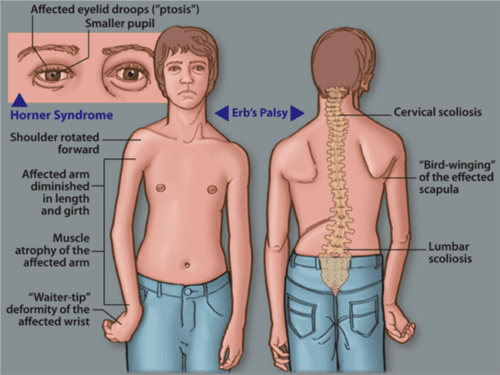 |
| erbs palsy |
Question
a. Occurs typically usually after breech delivery of smaller babies
b. Is due to injury of C5 and C6 nerve roots
c. All fingers muscles are paralysed
d. There may be unilateral Horner’s syndrome
Ans: ‘b’
Solution
Injury to upper trunk of Brachial plexus (C5, C6, C7) leads t60 Erb’s palsy.
Erb’s palsy
Brachial plexus may be injured when person falls from a height on the side of
head and shoulder whereby the nerves of the plexus are violently stretched.
(upper trunk of the plexus injured).
head and shoulder whereby the nerves of the plexus are violently stretched.
(upper trunk of the plexus injured).
Paralysis of Ms Deltoid, biceps, brachialis, intraspinatus and spinator.
The position of limb is characteristic i.e., the arm hanges by the side
medially rotated and the forearm is extended and pronated (Policeman’s lip).
medially rotated and the forearm is extended and pronated (Policeman’s lip).
Klumpke’s paralysis

Caused by injury in lower trunk of brachial plexus (CB, T₁) characterized by
paralysis of intrinsic hand Ms & CB/T1 dermatome distribution numbness.
paralysis of intrinsic hand Ms & CB/T1 dermatome distribution numbness.
Comparing Erb’s Palsy and Klumpke’s Palsy
Here’s a table comparing Erb’s Palsy and Klumpke’s Palsy
| Feature | Erb’s Palsy | Klumpke’s Palsy |
|---|---|---|
| Nerve Roots Affected | C5-C6 (sometimes C7) | C8-T1 |
| Cause |
Excessive traction on the neck during delivery or trauma (e.g., shoulder dystocia, fall on the shoulder) |
Hyperabduction of the arm (e.g., breech delivery, catching oneself while falling from a height) |
| Paralyzed Muscles | Deltoid, supraspinatus, infraspinatus, biceps brachii, brachialis |
Intrinsic muscles of the hand (lumbricals, interossei), flexors of the wrist and fingers |
| Clinical Presentation |
“Waiter’s Tip” posture (arm adducted, internally rotated, elbow extended, forearm pronated, wrist flexed) |
“Claw Hand” deformity (hyperextension at MCP joints, flexion at PIP & DIP joints) |
| Sensory Loss | Lateral arm and forearm (C5-C6 dermatome) | Medial forearm and hand (C8-T1 dermatome) |
| Reflexes Affected | Absent biceps and brachioradialis reflex | Intact biceps reflex, but absent grasp reflex |
| Associated Syndrome | – |
Horner’s Syndrome (if sympathetic fibers of T1 are affected: ptosis, miosis, anhidrosis) |
| Prognosis | Good with early physiotherapy, mild cases recover within months |
Poorer prognosis if there is nerve root avulsion; may require nerve grafting |