


Table of Contents
Introduction
Severe acute malnutrition (SAM) complicates fluid and electrolyte balance, necessitating a specialized rehydration solution. ReSoMal—short for Rehydration Solution for Malnutrition—has lower sodium and higher potassium, plus added minerals like magnesium, zinc, and copper, making it safer for rehydration in SAM cases. It must be administered under medical supervision in therapeutic centers and is not for general use or for children with cholera.
Composition of WHO low osmolarity ORS
| Component | Amount per Liter (g) | Concentration (mmol/L) | Osmolarity Contribution (mOsm/L) |
|---|---|---|---|
| Sodium chloride | 2.6 g | Na⁺ 75 mmol Cl⁻ 65 mmol | 75 + 65 = 140 |
| Glucose anhydrous | 13.5 g | 75 mmol | 75 |
| Potassium chloride | 1.5 g | K⁺ 20 mmol Cl⁻ 20 mmol | 20 + 20 = 40 |
| Trisodium citrate dihydrate | 2.9 g | Citrate³⁻ 10 mmol Na⁺ 30 mmol | 10 + 30 = 40 |
| Total Osmolarity | 21.5 g | – | 245 mOsm/L |
 |
| WHO low osmolarity ORS |

Step-by-Step Guide: Preparing ReSoMal from Regular WHO ORS
Ingredients Needed (per 2 liters):
Boiled & cooled water: 2 liters
1 packet of WHO low-osmolar ORS (approx. 1-liter packet)
Sucrose (table sugar): 50 g
Concentrated electrolyte/mineral solution: 40 ml (optional; else use potassium chloride stock)
Preparation Instructions:
Mix the Water & ORS Packet
Dissolve one WHO low-osmolar ORS packet in ~2 liters of clean, cooled water.Add Sugar
Stir in 50 g of sucrose (about 2 heaped tablespoons) to increase energy and glucose content.Add Mineral Solution (if available)
Ideally, add 40 ml of electrolyte/mineral solution—it contains potassium, magnesium, zinc, copper, and other trace minerals.
If unavailable, substitute with 45 ml of potassium chloride (KCl) stock—prepared by dissolving 100 g KCl in 1 liter of water.
Administer with Caution
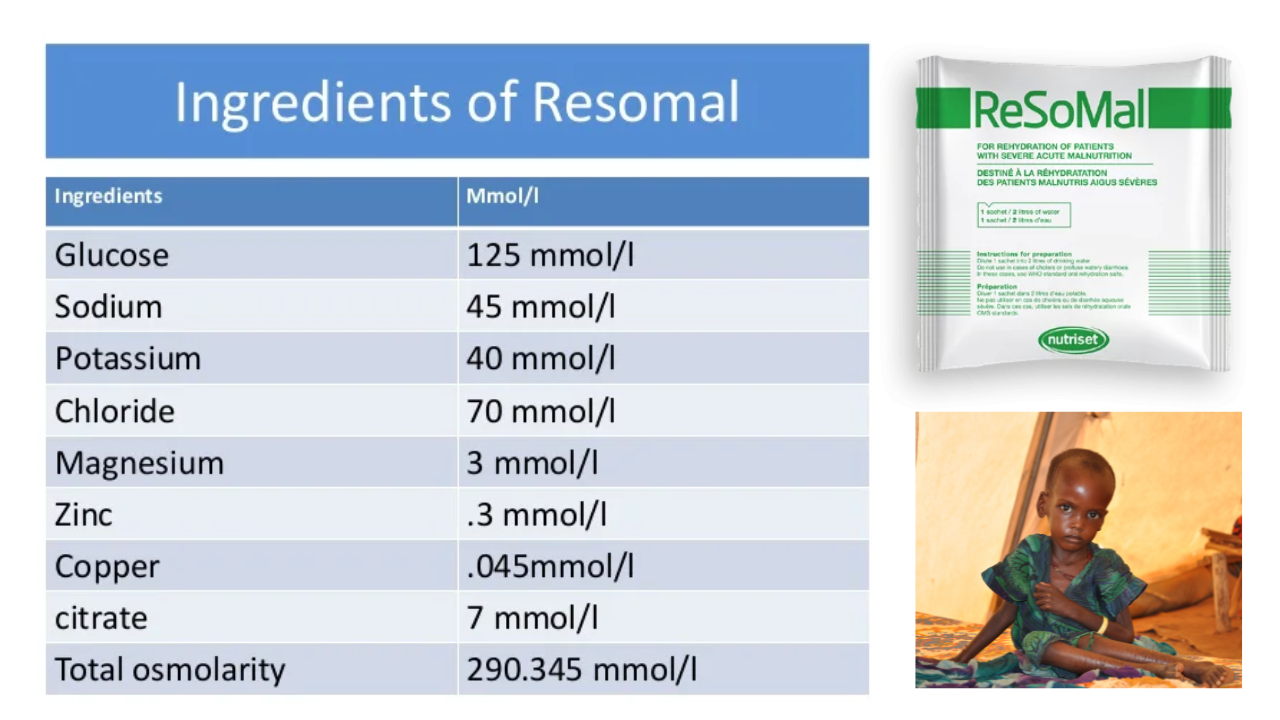
ReSoMal contains approximately 45 mmol sodium, 40 mmol potassium, and 3 mmol magnesium per liter.
Follow medical protocols: typical administration is around 5–10 ml per kg per hour, depending on the child’s condition.
Monitor closely for signs of overhydration—rapid weight gain, elevated respiratory or pulse rates, or peripheral edema—and pause treatment if they appear.
Why not use regular ORS?
Standard ORS has higher sodium and insufficient potassium for SAM, potentially risking fluid overload and undercorrected hypokalemia.
ReSoMal is tailored to reduce these risks—but it may still cause hyponatremia, so careful monitoring is essential.
It’s contraindicated in cases of cholera or profuse watery diarrhea, where standard WHO ORS is recommended instead.
Composition of ReSoMal (WHO formulation for severe malnutrition)
| Component | Amount per Liter (g) | Concentration (mmol/L) | Osmolarity Contribution (mOsm/L) |
|---|---|---|---|
| Sodium chloride | 1.5 g | Na⁺ 45 mmol Cl⁻ 37 mmol | 45 + 37 = 82 |
| Glucose anhydrous | 25 g | 139 mmol | 139 |
| Potassium chloride | 3.5 g | K⁺ 40 mmol Cl⁻ 40 mmol | 40 + 40 = 80 |
| Magnesium chloride | 0.3 g | Mg²⁺ 3 mmol Cl⁻ 6 mmol | 3 + 6 = 9 |
| Zinc acetate | 0.03 g | Zn²⁺ 0.3 mmol | 0.3 |
| Copper sulphate | 0.003 g | Cu²⁺ 0.05 mmol | 0.05 |
| Trisodium citrate dihydrate | 0.6 g | Citrate³⁻ 7 mmol Na⁺ 21 mmol | 7 + 21 = 28 |
| Total Osmolarity | – | – | 300 mOsm/L |
 |
| WHO recommended ReSoMal |

Summary Table
| Item | Details |
|---|---|
| Purpose | Rehydration for children with severe acute malnutrition (SAM) |
| Base Ingredients | WHO ORS packet, water, sugar, optional electrolyte solution |
| Substitution Option | Use KCl stock if mineral blend isn’t available |
| Administration | Slow and monitored—5-10 ml/kg/hour or as per protocol |
| Key Warnings | Not for cholera; risk of overhydration and hyponatremia |
Summary and Conclusion
ReSoMal is a life-saving adaptation of ORS for malnourished children—but it’s delicate medicine. Always follow WHO protocols and local medical guidelines, and never administer without proper training and monitoring.