National immunization schedule of Nepal latest 2081 नेपालको राष्ट्रिय खोप तालिका लेटेस्ट २०८१

नेपालको राष्ट्रिय खोप तालिका २०८१: परिमार्जित खोप तालिका Latest vaccine schedule of Nepal: Nepal National Immunization Schedule (NIP)

बालबालिकालाइ बिभिन्न किसिमका सरुवारोगहरुबाट जोगाउन बच्चा जन्मेदेखि दुई वर्ष नपुगेसम्म बिभिन्न खोपहरु निम्नानुसार लगाउनु पर्दछ।

Table of Contents(toc)
तल पढनुहोस
How to verufy covid Vaccine QR code card

राष्ट्रिय खोप तालिका  (Rastriya Khop talika) 2081 update

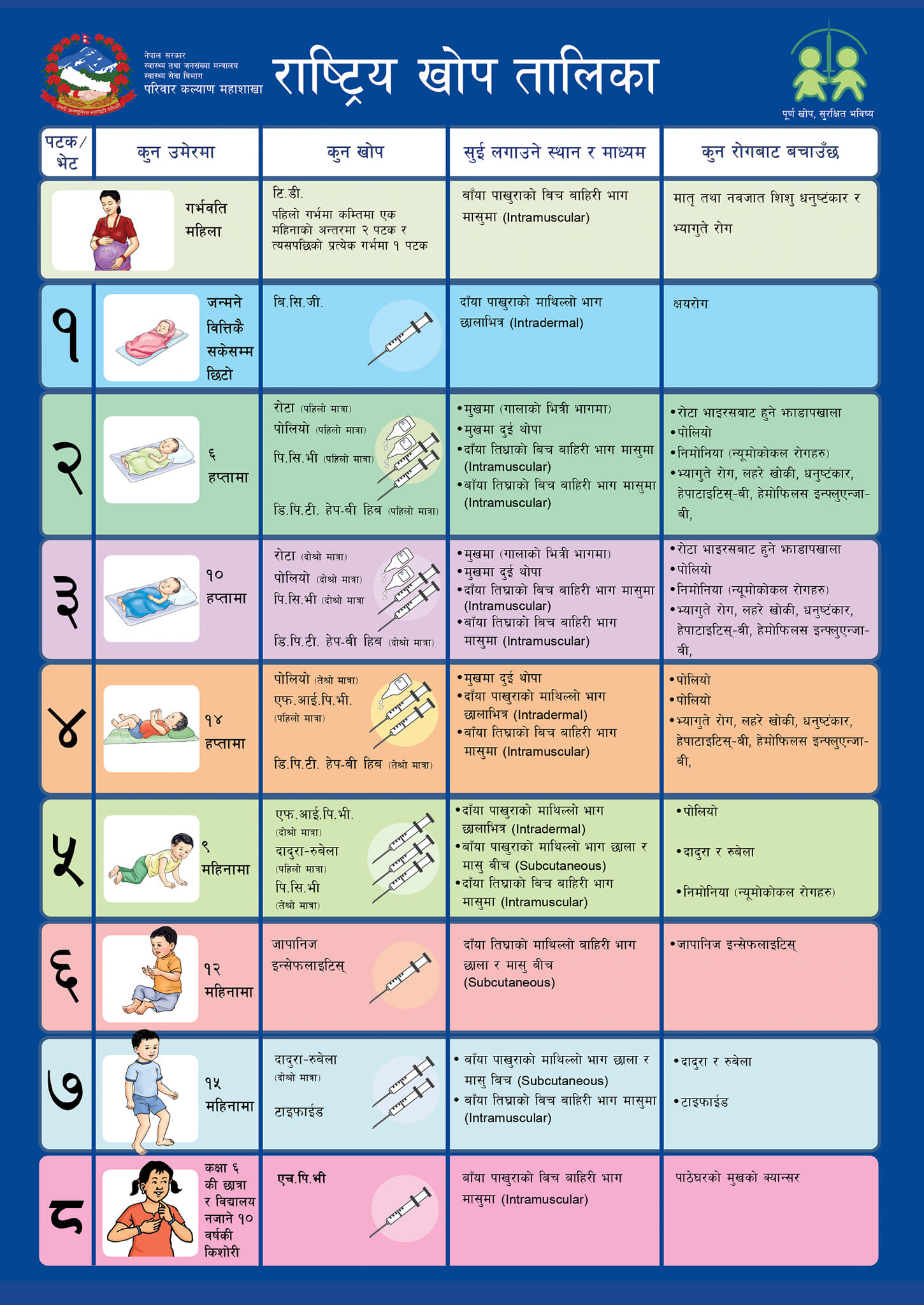
  1. जन्मिने बित्तिकै : बि सि जि
  2. ६ हप्तामा: रोटा, पोलियो, पि सि भि, डि पि  टि, हेप बि, हिब ( पेन्टा भ्यालेन्ट)
  3. १० हप्तामा: रोटा, पोलियो, पि सि भि, डि पि  टि, हेप बि, हिब
  4. १४ हप्तामा: पोलियो, एफ आइ पि भि, डि पि  टि, हेप बि, हिब
  5. ९ महिनामा: एफ आइ पि भि, पि सि, भि, दादुरा-रुबेला
  6. १२ महिनामा: जापानिज इन्सेफ्लाइटिस
  7. १५ महिनामा: दादुरा-रुबेला, टाइफाईड
  8. 10 years girl or class 6 girl : HPV

Rastriya Khop Talika 2081 update

  1. At birth: BCG
  2. 6 weeks: Rota, PCV, Polio, DPT Hep B Hib (pentavalent)
  3. 10 weeks: Rota, polio, PCV, DPT Hep B Hib
  4. 14 weeks Polio, FIPV, DPT Hep B Hib
  5. 9 months: FIPV, PCV, MR
  6. 12 months JE
  7. 15 months: MR, Typhoid
  8. HPV : class 6 girl or 10 years age girl
All vaccines in above list are free of cost in government  institutions on Nepal. 

खोप सुरक्षित छ।

खोप लगाउनु भनेको व्यक्तिको शारीरिर सुरक्षा बढाउने कामहो जसले खतरनाक रोगहरूबाट बचाउँदछ।

खोप नि:शुल्क पाइन्छ।

नेपालको सरकारले विभिन्न रुपका आधारमा नागरिकहरूलाई खोप नि:शुल्क रूपमा प्रदान गर्छ।

खोपले जीवन रक्षा गर्छ।

खोपले मानव जीवन रक्षा गर्दछ भन्ने कुरा वैज्ञानिक दृष्टिमा पनि प्रमाणित छ। खोपको प्रमुख कार्य रोगजन्य किटाणुका विरुद्ध लडाइ हो। जब मानवहरू खोपको प्रयोग गर्दछन्, रोगको प्रसार रोकिन्छ जसले विभिन्न जीवनमा राम्रो प्रभाव पार्दछ। यसले प्राणघातक रोग लाग्नबाट बचाएर मोर्बिडिटि र मोर्टालिटि हुन बाट जोगाउछ।

Vaccine allergies and AEFI Nepal राष्ट्रिय खोप तालिका:

They are not so common and most of them if occured any are minor. Anything big like anaphylaxis rarely occur.

Side effects of vaccine in nepali:

  • खोप लगाएको ठाउमा रातो हुने
  • बिमिरा आउने
  • हल्का जरो आउने
  • कन्ने
  • खान नमान्ने
  • रुने
  • एलर्जि र एनाफाइल्याक्सिस (कडा तर  एकदम बिरलै हुने प्रतिक्रिया)
माथिका समस्या प्राय आफै निको भएर जान्छन। एलर्जि र एनाफाइल्याक्सिस बाहेक अन्यमा सामान्य रुपमा पारासिटामोल खाएमा सन्चो भएर आउछ।

Khop lagaune tarika खोप लगाउने तरिका र डोज नेपालीमा Route of administration of vaccines and dose

Vaccine route of administration and dose in nepali

Typhoid vaccine included in Nepal Guideline Since When

Typhoid vaccine guideine

खोपको डोज छुटेको छ? कि ढिला भएको छ? के गर्ने भनेर जान्न हामिलाई सोध्नुहोस। च्याटबक्स इमेल email : mail@chaitanya.com.np मा सम्पर्क गर्नुहोस्।

BPH License Exam Model Question (NHPC ) Nepal Health Professional Council License Exam 2081

Bachelor of Public Health (BPH) Nepal Health Professional Council (NHPC) License Exam 2081 Model Set

Table of Contents(toc)


Here are 20 model questions for the Bachelor of Public Health (BPH) Nepal Health Professional Council (NHPC) License Exam:

Public Health & Epidemiology

  1. What is the incubation period of Hepatitis A?
    a) 7–14 days
    b) 15–50 days
    c) 30–90 days
    d) 90–180 days

  2. Which of the following is a key feature of descriptive epidemiology?
    a) Hypothesis testing
    b) Randomized control trials
    c) Distribution of disease in terms of person, place, and time
    d) Use of meta-analysis

  3. The Basic Reproduction Number (R₀) of a disease refers to:
    a) The percentage of immune individuals in a population
    b) The average number of secondary cases generated by one case
    c) The number of deaths caused by the disease
    d) The incubation period of the disease

Biostatistics & Research Methodology

  1. In biostatistics, p-value less than 0.05 indicates:
    a) The hypothesis is rejected
    b) The hypothesis is accepted
    c) No association between variables
    d) The study is invalid

  2. Which sampling method ensures each individual has an equal chance of being selected?
    a) Stratified sampling
    b) Simple random sampling
    c) Snowball sampling
    d) Convenience sampling

Health Policy, Management & Health System

  1. Nepal’s National Health Policy was first introduced in:
    a) 1991
    b) 2004
    c) 2015
    d) 2018

  2. The Primary Health Care (PHC) approach was officially introduced globally after:
    a) The Ottawa Charter
    b) The Alma-Ata Declaration
    c) The Sustainable Development Goals
    d) The Millennium Development Goals

  3. Which of the following is not an indicator of health system performance?
    a) Infant mortality rate
    b) Number of medical colleges
    c) Life expectancy
    d) Maternal mortality ratio

Environmental & Occupational Health

  1. The presence of arsenic in groundwater mainly leads to:
    a) Methemoglobinemia
    b) Fluorosis
    c) Skin cancer
    d) Itai-Itai disease

  2. The main cause of indoor air pollution in rural Nepal is:
    a) Vehicular emissions
    b) Industrial waste
    c) Biomass fuel burning
    d) Ozone depletion

Communicable & Non-Communicable Diseases

  1. The first case of COVID-19 in Nepal was reported in:
    a) December 2019
    b) January 2020
    c) March 2020
    d) May 2020

  2. Which of the following is not a risk factor for cardiovascular diseases?
    a) High blood pressure
    b) Tobacco use
    c) Physical activity
    d) Obesity

Reproductive, Maternal & Child Health

  1. Which of the following is a leading cause of maternal mortality in Nepal?
    a) Road traffic accidents
    b) Postpartum hemorrhage
    c) HIV/AIDS
    d) Thyroid disorders

  2. Exclusive breastfeeding is recommended for the first:
    a) 3 months
    b) 6 months
    c) 9 months
    d) 12 months

Nutrition & Food Safety

  1. A deficiency of iodine during pregnancy can lead to:
    a) Night blindness
    b) Beriberi
    c) Cretinism
    d) Pellagra

  2. Mid-upper arm circumference (MUAC) is used to assess:
    a) Vitamin A deficiency
    b) Malnutrition
    c) Water intake
    d) Physical activity level

Disaster & Emergency Health Management

  1. The first step in disaster risk management is:
    a) Response and recovery
    b) Risk assessment and mitigation
    c) Providing immediate aid
    d) Media coverage

  2. In Nepal, a public health emergency is declared when:
    a) At least 50 cases of an outbreak occur
    b) There is a sudden rise in disease cases that affects public safety
    c) The WHO issues a global alert
    d) The Ministry of Health and Population issues a statement

Mental Health & Community Interventions

  1. Which of the following is a key symptom of major depressive disorder?
    a) Increased social interaction
    b) Decreased need for sleep
    c) Persistent low mood and loss of interest
    d) Excessive physical energy

  2. The Mental Health Policy of Nepal (1996) emphasizes:
    a) The establishment of mental hospitals in each province
    b) Integrating mental health services into primary health care
    c) Mental health services should only be provided in urban areas
    d) Restricting the use of psychotropic medications

Continue reading BPH License Exam Model Question (NHPC ) Nepal Health Professional Council License Exam 2081

First Dose of Amiodarone in ACLS: Guidelines, Dosage, and Administration 2025 Guideline

First Dose of Amiodarone in ACLS: Guidelines, Dosage, and Administration

Table of Contents(toc)

Amiodarone is a critical antiarrhythmic medication used in Advanced Cardiovascular Life Support (ACLS) for managing life-threatening cardiac arrhythmias. Understanding the first dose of amiodarone in ACLS is essential for healthcare providers to ensure proper resuscitation and improve patient outcomes.

When to Use Amiodarone in ACLS

The American Heart Association (AHA) recommends amiodarone in ACLS for:

  • Pulseless Ventricular Tachycardia (pVT)
  • Ventricular Fibrillation (VF)
  • Recurrent or refractory ventricular arrhythmias

It is considered when shockable rhythms persist despite defibrillation and epinephrine administration.

First Dose of Amiodarone in ACLS

According to the ACLS guidelines, the initial dose of amiodarone in cardiac arrest is:

  • First dose: 300 mg IV/IO push
  • Second dose (if needed): 150 mg IV/IO push

The first dose of amiodarone should be administered as soon as possible after the second unsuccessful defibrillation attempt for VF or pulseless VT.

How to Administer Amiodarone in ACLS

  • Administer the first dose of amiodarone (300 mg) as a rapid IV push.
  • If the arrhythmia persists, give a second dose of 150 mg after 3-5 minutes.
  • Always flush with at least 20 mL of normal saline after administration.
  • Continuous cardiac monitoring is required to assess response and detect potential complications.

Post-Resuscitation Amiodarone Infusion

If the patient achieves Return of Spontaneous Circulation (ROSC) but is still at risk of arrhythmias, a maintenance infusion is recommended:

  • Loading dose: 150 mg over 10 minutes
  • Maintenance infusion: 1 mg/min for 6 hours, then 0.5 mg/min for 18 hours

Precautions and Side Effects

  • Hypotension – Can be minimized by slowing the infusion rate.
  • Bradycardia – May require temporary pacing or atropine.
  • QT prolongation – Risk of torsades de pointes, so continuous ECG monitoring is necessary.

Amiodarone vs. Lidocaine in ACLS

Although amiodarone is the preferred antiarrhythmic, lidocaine can be an alternative if amiodarone is unavailable. The first dose of lidocaine in ACLS is 1-1.5 mg/kg IV/IO, followed by additional doses if needed.

Conclusion

The first dose of amiodarone in ACLS is 300 mg IV push, followed by 150 mg if necessary. Proper administration of amiodarone can improve survival in patients with refractory ventricular fibrillation or pulseless ventricular tachycardia. Healthcare providers must be familiar with ACLS protocols to optimize patient outcomes in cardiac arrest situations.

By following evidence-based ACLS guidelines, clinicians can enhance the effectiveness of resuscitation efforts and increase the chances of a successful outcome.

ACLS Precourse Self-Assessment questions to test your understanding of key concepts 2025

ACLS Precourse Self-Assessment questions to test your understanding of key concepts 2025

Table of Contents(toc)

Rhythm Recognition

  1. Identify the following rhythm on an ECG strip: Wide QRS, irregular, no P waves.
    A) Atrial fibrillation
    B) Ventricular fibrillation
    C) Torsades de pointes
    D) Sinus tachycardia

  2. Which rhythm requires immediate defibrillation?
    A) Asystole
    B) Pulseless electrical activity (PEA)
    C) Ventricular tachycardia with a pulse
    D) Pulseless ventricular fibrillation

  3. What is the first-line drug for stable narrow-complex supraventricular tachycardia (SVT)?
    A) Epinephrine
    B) Adenosine
    C) Amiodarone
    D) Atropine

Pharmacology

  1. What is the recommended first dose of epinephrine during cardiac arrest?
    A) 0.5 mg IV
    B) 1 mg IV
    C) 2 mg IV
    D) 5 mg IV

  2. Which medication is preferred for persistent ventricular tachycardia with a pulse?
    A) Adenosine
    B) Amiodarone
    C) Atropine
    D) Magnesium sulfate

Acute Coronary Syndrome (ACS)

  1. A patient with chest pain has ST-segment elevation in leads II, III, and aVF. What type of myocardial infarction is most likely?
    A) Anterior MI
    B) Inferior MI
    C) Lateral MI
    D) Posterior MI

  2. What is the first-line treatment for a suspected STEMI within 12 hours of symptom onset?
    A) Aspirin and nitroglycerin
    B) Fibrinolysis or PCI
    C) Beta-blockers and statins
    D) Morphine and oxygen

Bradycardia & Tachycardia Management

  1. A patient presents with symptomatic bradycardia and a heart rate of 35 bpm. What is the first drug to administer?
    A) Epinephrine 1 mg IV
    B) Atropine 1 mg IV
    C) Amiodarone 300 mg IV
    D) Adenosine 6 mg IV

  2. Which intervention is indicated for unstable monomorphic ventricular tachycardia with a pulse?
    A) Defibrillation
    B) Synchronized cardioversion
    C) Epinephrine push
    D) Amiodarone infusion

Post-Cardiac Arrest Care

  1. After achieving return of spontaneous circulation (ROSC), what is the target range for oxygen saturation (SpO₂)?
    A) 85-90%
    B) 90-94%
    C) 94-99%
    D) 100%

  2. What is the recommended target temperature range for post-cardiac arrest hypothermia management?
    A) 28-30°C
    B) 31-33°C
    C) 32-36°C
    D) 36-38°C

Answer keys for the ACLS Precourse Self-Assessment questions

Topic wise answers are given below.

Rhythm Recognition

  1. C) Torsades de pointes
  2. D) Pulseless ventricular fibrillation
  3. B) Adenosine

Pharmacology

  1. B) 1 mg IV
  2. B) Amiodarone

Acute Coronary Syndrome (ACS)

  1. B) Inferior MI
  2. B) Fibrinolysis or PCI

Bradycardia & Tachycardia Management

  1. B) Atropine 1 mg IV
  2. B) Synchronized cardioversion

Post-Cardiac Arrest Care

  1. B) 90-94%
  2. C) 32-36°C

PCL Physiotherapy License Exam Model Questions (NHPC) 2081

PCL Physiotherapy License Exam Model Questions (NHPC) Set 3


Table of Contents(toc)

1. Which of the following is NOT a component of evidence-based physiotherapy practice?

a) Clinical expertise
b) Patient values
c) Research evidence
d) Personal opinions

2. The normal range of motion (ROM) for knee flexion is approximately:

a) 90°
b) 110°
c) 135°
d) 160°

3. The Glasgow Coma Scale (GCS) is used to assess:

a) Muscle strength
b) Cognitive function
c) Level of consciousness
d) Joint mobility

4. In which condition is McMurray’s test used for diagnosis?

a) ACL injury
b) Meniscal tear
c) Rotator cuff injury
d) Plantar fasciitis

5. The primary goal of physiotherapy in stroke rehabilitation is:

a) Complete muscle hypertrophy
b) Prevent contractures and improve functional mobility
c) Increase patient dependence
d) Immobilization of affected limbs

6. Which of the following gait patterns is commonly seen in patients with Parkinson’s disease?

a) Trendelenburg gait
b) Festinating gait
c) Steppage gait
d) Waddling gait

7. Which of the following is the primary function of the rotator cuff muscles?

a) Internal rotation of the elbow
b) Stabilization of the shoulder joint
c) Flexion of the wrist
d) Knee extension

8. The Babinski sign is indicative of:

a) Lower motor neuron lesion
b) Upper motor neuron lesion
c) Peripheral nerve injury
d) Normal plantar reflex

9. Which of the following electrotherapy modalities is most commonly used for pain relief?

a) Ultrasound
b) Transcutaneous Electrical Nerve Stimulation (TENS)
c) Shortwave diathermy
d) Cryotherapy

10. The primary muscle responsible for hip abduction is:

a) Gluteus maximus
b) Gluteus medius
c) Rectus femoris
d) Iliopsoas

11. Which of the following tests is used to assess anterior cruciate ligament (ACL) integrity?

a) Lachman test
b) Finkelstein test
c) Thomas test
d) Phalen’s test

12. The Cobb angle is used to measure the severity of:

a) Kyphosis
b) Scoliosis
c) Lordosis
d) Osteoporosis

13. Which of the following is an absolute contraindication for manual therapy?

a) Muscle strain
b) Acute fractures
c) Joint stiffness
d) Postural imbalance

14. Which condition is characterized by progressive degeneration of the myelin sheath?

a) Muscular dystrophy
b) Multiple sclerosis
c) Myasthenia gravis
d) Rheumatoid arthritis

15. A patient with a foot drop will likely require which assistive device?

a) Axillary crutches
b) Ankle-foot orthosis (AFO)
c) Knee brace
d) Cane

16. In which condition is cardiac rehabilitation MOST commonly indicated?

a) Osteoarthritis
b) Myocardial infarction
c) Frozen shoulder
d) Fibromyalgia

17. The Thomas test is used to assess:

a) Hamstring tightness
b) Hip flexor tightness
c) ACL integrity
d) Shoulder impingement

18. Which of the following is NOT a benefit of hydrotherapy?

a) Decreased joint stress
b) Improved circulation
c) Increased body weight
d) Relaxation of muscles

19. Which exercise is MOST effective for strengthening the quadriceps muscle?

a) Hamstring curls
b) Straight leg raises
c) Calf raises
d) Shoulder press

20. The RICE protocol for acute injury management includes all EXCEPT:

a) Rest
b) Ice
c) Compression
d) Exercise


Answer Keys

  1. d) Personal opinions – Evidence-based practice is based on clinical expertise, patient values, and research evidence, not personal opinions.
  2. c) 135° – The normal knee flexion ROM is approximately 135°.
  3. c) Level of consciousness – The GCS assesses a patient’s consciousness level based on eye, verbal, and motor responses.
  4. b) Meniscal tear – McMurray’s test is used to assess meniscal injuries in the knee.
  5. b) Prevent contractures and improve functional mobility – Stroke rehabilitation focuses on restoring mobility and preventing complications.
  6. b) Festinating gait – Parkinson’s patients exhibit a festinating (shuffling) gait.
  7. b) Stabilization of the shoulder joint – The rotator cuff muscles provide shoulder joint stability.
  8. b) Upper motor neuron lesion – A positive Babinski sign indicates an upper motor neuron lesion.
  9. b) Transcutaneous Electrical Nerve Stimulation (TENS) – TENS is widely used for pain relief.
  10. b) Gluteus medius – The primary muscle responsible for hip abduction is the gluteus medius.
  11. a) Lachman test – The Lachman test is used to assess ACL integrity.
  12. b) Scoliosis – The Cobb angle is used to measure the degree of scoliosis.
  13. b) Acute fractures – Manual therapy is contraindicated in acute fractures to prevent further injury.
  14. b) Multiple sclerosis – MS is a condition characterized by demyelination in the central nervous system.
  15. b) Ankle-foot orthosis (AFO) – An AFO helps support foot drop by maintaining dorsiflexion.
  16. b) Myocardial infarction – Cardiac rehabilitation is most commonly prescribed after a heart attack.
  17. b) Hip flexor tightness – The Thomas test assesses hip flexor tightness.
  18. c) Increased body weight – Hydrotherapy reduces the weight-bearing effect on joints.
  19. b) Straight leg raises – This exercise is effective for quadriceps strengthening.
  20. d) Exercise – The RICE protocol consists of Rest, Ice, Compression, and Elevation, not Exercise.

PCL Physiotherapy License Exam NHPC– Model Questions Set 2

PCL Physiotherapy License Exam – Model Questions Set 2


Table of Contents(toc)

1. Which of the following is the primary function of the rotator cuff muscles?

a) Stabilization of the shoulder joint
b) Flexion of the shoulder
c) Extension of the elbow
d) Supination of the forearm

2. What is the normal range of motion (ROM) for knee flexion?

a) 90°
b) 120°
c) 135°
d) 150°

3. Which nerve is commonly affected in carpal tunnel syndrome?

a) Ulnar nerve
b) Radial nerve
c) Median nerve
d) Musculocutaneous nerve

4. The McMurray test is used to assess which structure in the knee?

a) Anterior cruciate ligament (ACL)
b) Medial collateral ligament (MCL)
c) Meniscus
d) Patellar tendon

5. Which of the following is NOT a contraindication for ultrasound therapy?

a) Over a pregnant uterus
b) Over a metal implant
c) Over open wounds
d) Over a fracture site

6. In which condition is the Trendelenburg sign positive?

a) Plantar fasciitis
b) Hip abductor weakness
c) Ankle sprain
d) Biceps tendon rupture

7. Which gait pattern is commonly seen in patients with Parkinson’s disease?

a) Scissoring gait
b) Ataxic gait
c) Festinating gait
d) Trendelenburg gait

8. What is the primary purpose of proprioceptive neuromuscular facilitation (PNF)?

a) Improve endurance
b) Enhance flexibility and strength
c) Increase cardiovascular fitness
d) Improve bone density

9. Which of the following is an open-chain exercise?

a) Squats
b) Leg press
c) Seated knee extension
d) Push-ups

10. Which muscle is responsible for dorsiflexion of the foot?

a) Tibialis anterior
b) Gastrocnemius
c) Soleus
d) Peroneus longus

11. The Glasgow Coma Scale (GCS) is used to assess:

a) Respiratory function
b) Muscle strength
c) Level of consciousness
d) Range of motion

12. What is the primary cause of foot drop?

a) Radial nerve injury
b) Sciatic nerve injury
c) Peroneal nerve injury
d) Femoral nerve injury

13. The main goal of passive range of motion (PROM) exercises is to:

a) Strengthen muscles
b) Improve joint mobility
c) Increase cardiovascular endurance
d) Enhance proprioception

14. Which test is used to assess an Achilles tendon rupture?

a) Lachman test
b) Thompson test
c) Yergason test
d) Finkelstein test

15. Which muscle is the prime mover in elbow flexion?

a) Biceps brachii
b) Triceps brachii
c) Deltoid
d) Brachioradialis

16. Which modality is most effective for reducing acute inflammation?

a) Moist heat
b) Electrical stimulation
c) Ice therapy (cryotherapy)
d) Ultrasound therapy

17. Which spinal nerve root is tested by the patellar reflex?

a) L2-L3
b) L3-L4
c) L4-L5
d) S1-S2

18. What is the primary benefit of aquatic therapy?

a) Increases muscle fatigue
b) Reduces joint stress and enhances mobility
c) Decreases blood circulation
d) Increases joint stiffness

19. Which condition is characterized by lateral curvature of the spine?

a) Kyphosis
b) Lordosis
c) Scoliosis
d) Spinal stenosis

20. Which exercise is best for strengthening the quadriceps muscle?

a) Seated leg curls
b) Standing calf raises
c) Leg extensions
d) Hip abduction

Answer Keys

  1. a) Stabilization of the shoulder joint
  2. c) 135°
  3. c) Median nerve
  4. c) Meniscus
  5. d) Over a fracture site
  6. b) Hip abductor weakness
  7. c) Festinating gait
  8. b) Enhance flexibility and strength
  9. c) Seated knee extension
  10. a) Tibialis anterior
  11. c) Level of consciousness
  12. c) Peroneal nerve injury
  13. b) Improve joint mobility
  14. b) Thompson test
  15. a) Biceps brachii
  16. c) Ice therapy (cryotherapy)
  17. b) L3-L4
  18. b) Reduces joint stress and enhances mobility
  19. c) Scoliosis
  20. c) Leg extensions

NHPC PCL Physiotherapy License Exam Model Questions 2025

NHPC PCL Physiotherapy License Exam Model Questions Free Practice

Table of Contents(toc)

1. Which of the following is the primary function of a physiotherapist?

a) Prescribing medications
b) Diagnosing diseases
c) Preventing and treating movement disorders
d) Performing surgeries

2. Which plane divides the body into left and right halves?

a) Coronal plane
b) Transverse plane
c) Sagittal plane
d) Frontal plane

3. The Glasgow Coma Scale (GCS) is used to assess:

a) Joint mobility
b) Muscle strength
c) Consciousness level
d) Pain intensity

4. Which of the following is NOT a component of Proprioceptive Neuromuscular Facilitation (PNF)?

a) Rhythmic initiation
b) Alternating isometrics
c) Contract-relax technique
d) Isometric stretching

5. Which nerve is commonly compressed in Carpal Tunnel Syndrome?

a) Ulnar nerve
b) Radial nerve
c) Median nerve
d) Musculocutaneous nerve

6. The primary goal of passive range of motion (PROM) exercises is to:

a) Increase muscle strength
b) Improve joint mobility
c) Enhance cardiovascular endurance
d) Improve proprioception

7. Which of the following is a contraindication for ultrasound therapy?

a) Muscle spasm
b) Joint stiffness
c) Open wounds
d) Chronic pain

8. Which test is used to assess anterior cruciate ligament (ACL) injury?

a) McMurray’s test
b) Lachman’s test
c) Thomas test
d) Ober’s test

9. The term “paresis” refers to:

a) Complete paralysis
b) Partial loss of muscle function
c) Increased muscle tone
d) Involuntary muscle contraction

10. Which of the following is an example of an open-chain exercise?

a) Squats
b) Push-ups
c) Leg extension
d) Lunges

11. Which energy system is primarily used during a 100-meter sprint?

a) Aerobic system
b) Anaerobic glycolysis
c) Phosphagen system
d) Oxidative phosphorylation

12. Which condition is characterized by progressive degeneration of motor neurons?

a) Multiple sclerosis
b) Parkinson’s disease
c) Amyotrophic lateral sclerosis (ALS)
d) Guillain-Barré syndrome

13. The Modified Ashworth Scale is used to assess:

a) Pain levels
b) Muscle spasticity
c) Joint instability
d) Coordination

14. Which exercise is recommended for a patient with osteoporosis?

a) Swimming
b) Weight-bearing exercises
c) Prolonged bed rest
d) Passive stretching

15. A patient with hemiplegia from a stroke typically presents with:

a) Weakness in both legs
b) Weakness on one side of the body
c) Decreased deep tendon reflexes bilaterally
d) Bilateral loss of sensation

16. Which of the following is a primary role of the rotator cuff muscles?

a) Knee stabilization
b) Shoulder stabilization
c) Ankle dorsiflexion
d) Wrist flexion

17. Which technique is commonly used to relieve pain in trigger points?

a) Cryotherapy
b) Myofascial release
c) Whirlpool therapy
d) Compression bandaging

18. A Trendelenburg gait is caused by weakness in which muscle?

a) Rectus femoris
b) Tibialis anterior
c) Gluteus medius
d) Gastrocnemius

19. Which modality is most suitable for treating chronic low back pain?

a) Shortwave diathermy
b) Cryotherapy
c) TENS (Transcutaneous Electrical Nerve Stimulation)
d) Hydrotherapy

20. What is the primary purpose of pulmonary rehabilitation in patients with COPD?

a) Increase lung compliance
b) Improve respiratory muscle strength and endurance
c) Reduce airway resistance
d) Completely cure the disease

Answer Keys

  1. c) Preventing and treating movement disorders
  2. c) Sagittal plane
  3. c) Consciousness level
  4. d) Isometric stretching
  5. c) Median nerve
  6. b) Improve joint mobility
  7. c) Open wounds
  8. b) Lachman’s test
  9. b) Partial loss of muscle function
  10. c) Leg extension
  11. c) Phosphagen system
  12. c) Amyotrophic lateral sclerosis (ALS)
  13. b) Muscle spasticity
  14. b) Weight-bearing exercises
  15. b) Weakness on one side of the body
  16. b) Shoulder stabilization
  17. b) Myofascial release
  18. c) Gluteus medius
  19. c) TENS (Transcutaneous Electrical Nerve Stimulation)
  20. b) Improve respiratory muscle strength and endurance

Nepal Pharmacy Council Model Questions with answer and explanation 2081

Nepal Pharmacy Council Model Questions With answer and explanation

Table of Contents(toc)


General Pharmacy and Pharmacology

  1. Which of the following is NOT a part of Good Pharmacy Practice (GPP)?
    a) Patient counseling
    b) Ethical dispensing
    c) Unregulated sale of drugs
    d) Pharmacovigilance

  2. Which phase of clinical trials determines the therapeutic efficacy of a drug?
    a) Phase I
    b) Phase II
    c) Phase III
    d) Phase IV

  3. The primary site of drug metabolism in the body is:
    a) Kidney
    b) Liver
    c) Lungs
    d) Blood

  4. The mechanism of action of beta-lactam antibiotics is:
    a) Inhibition of protein synthesis
    b) Inhibition of DNA replication
    c) Inhibition of cell wall synthesis
    d) Inhibition of folic acid synthesis

  5. Which of the following is an example of a prodrug?
    a) Paracetamol
    b) Enalapril
    c) Ibuprofen
    d) Ranitidine

Pharmaceutical Chemistry and Analysis

  1. The pH of a buffer solution is determined by:
    a) Henderson-Hasselbalch equation
    b) Nernst equation
    c) Arrhenius equation
    d) Michaelis-Menten equation

  2. The functional group present in aspirin is:
    a) Amide
    b) Ester
    c) Ketone
    d) Aldehyde

  3. The instrument used to measure the optical activity of a compound is:
    a) Spectrophotometer
    b) Polarimeter
    c) Potentiometer
    d) Colorimeter

  4. Which of the following techniques is used for the separation of volatile compounds?
    a) High-Performance Liquid Chromatography (HPLC)
    b) Gas Chromatography (GC)
    c) Paper Chromatography
    d) Thin Layer Chromatography (TLC)

  5. The Beer-Lambert law is used to determine:
    a) Molecular weight
    b) Concentration of a solution
    c) Melting point
    d) Boiling point

Pharmaceutics and Dosage Forms

  1. The bioavailability of a drug is highest when administered via:
    a) Oral route
    b) Intravenous route
    c) Intramuscular route
    d) Subcutaneous route

  2. Enteric-coated tablets are designed to:
    a) Release the drug rapidly
    b) Protect the drug from stomach acid
    c) Increase drug solubility
    d) Reduce side effects

  3. The major advantage of controlled-release drug formulations is:
    a) Reduced drug potency
    b) Increased frequency of administration
    c) Prolonged drug action
    d) Higher chances of drug toxicity

  4. The preservative commonly used in ophthalmic preparations is:
    a) Sodium benzoate
    b) Benzalkonium chloride
    c) Sorbic acid
    d) Propyl gallate

  5. The main advantage of transdermal drug delivery systems is:
    a) Immediate drug absorption
    b) Avoidance of first-pass metabolism
    c) Increased renal excretion
    d) Increased systemic toxicity

Pharmacognosy and Natural Products

  1. Which of the following alkaloids is derived from Cinchona bark?
    a) Morphine
    b) Quinine
    c) Atropine
    d) Ephedrine

  2. Sennosides, used as laxatives, are obtained from:
    a) Digitalis
    b) Senna
    c) Belladonna
    d) Cinchona

  3. The main active constituent of opium is:
    a) Caffeine
    b) Theobromine
    c) Morphine
    d) Nicotine

  4. The main function of flavonoids in plants is:
    a) Protection against UV radiation
    b) Protein synthesis
    c) Cell wall formation
    d) Energy production

  5. Glycyrrhizin, a sweetening agent, is obtained from:
    a) Aloe vera
    b) Liquorice
    c) Cinnamon
    d) Clove

Pharmacy Law and Ethics

  1. The governing body for pharmacy professionals in Nepal is:
    a) Nepal Medical Council
    b) Nepal Pharmacy Council
    c) Nepal Drug Administration
    d) World Health Organization

  2. The Drug Act of Nepal was enacted in:
    a) 1978
    b) 1980
    c) 1972
    d) 1995

  3. The maximum penalty for selling counterfeit drugs in Nepal includes:
    a) Fine only
    b) Imprisonment only
    c) Both fine and imprisonment
    d) Suspension of pharmacy license

  4. The legal document required for the retail sale of drugs in Nepal is:
    a) Drug Manufacturing License
    b) Drug Import License
    c) Drug Retail License
    d) Drug Registration Certificate

  5. Informed consent is essential in:
    a) Marketing authorization
    b) Clinical trials
    c) Drug dispensing
    d) Pharmacovigilance

Hospital and Clinical Pharmacy

  1. The term “therapeutic drug monitoring” refers to:
    a) Measuring drug levels in the blood
    b) Observing patient compliance
    c) Studying drug interactions
    d) Reporting adverse effects

  2. The safest category of drugs in pregnancy is:
    a) Category A
    b) Category B
    c) Category C
    d) Category X

  3. Which of the following drugs is used as an antidote for organophosphate poisoning?
    a) Naloxone
    b) Atropine
    c) Flumazenil
    d) Vitamin K

  4. The primary role of a clinical pharmacist in a hospital setting is to:
    a) Dispense medications
    b) Perform surgeries
    c) Provide drug therapy management
    d) Conduct laboratory tests

  5. Adverse Drug Reactions (ADRs) are best monitored through:
    a) Pharmacovigilance programs
    b) Drug marketing surveys
    c) Drug advertisements
    d) Patient self-reports

Answers and explanation

General Pharmacy and Pharmacology

  1. c) Unregulated sale of drugs
    Explanation: Good Pharmacy Practice (GPP) ensures the safe, effective, and ethical use of medicines. Unregulated drug sales violate GPP principles.

  2. c) Phase III
    Explanation: Phase III clinical trials assess the drug’s therapeutic efficacy on a larger patient population before approval.

  3. b) Liver
    Explanation: The liver is the primary site of drug metabolism, mainly through enzymes like cytochrome P450.

  4. c) Inhibition of cell wall synthesis
    Explanation: Beta-lactam antibiotics (e.g., penicillins) inhibit bacterial cell wall formation by targeting peptidoglycan synthesis.

  5. b) Enalapril
    Explanation: Enalapril is a prodrug that is converted into its active form, enalaprilat, in the body.


Pharmaceutical Chemistry and Analysis

  1. a) Henderson-Hasselbalch equation
    Explanation: This equation helps determine the pH of buffer solutions based on acid/base concentrations.

  2. b) Ester
    Explanation: Aspirin (acetylsalicylic acid) contains an ester functional group responsible for its analgesic and anti-inflammatory effects.

  3. b) Polarimeter
    Explanation: A polarimeter measures optical activity, which helps determine the chirality of a compound.

  4. b) Gas Chromatography (GC)
    Explanation: GC is used for the separation and analysis of volatile compounds, especially in drug testing.

  5. b) Concentration of a solution
    Explanation: The Beer-Lambert law states that absorbance is directly proportional to the concentration of a solution.


Pharmaceutics and Dosage Forms

  1. b) Intravenous route
    Explanation: IV administration provides 100% bioavailability as the drug enters directly into systemic circulation.

  2. b) Protect the drug from stomach acid
    Explanation: Enteric-coated tablets prevent drug degradation in stomach acid and ensure release in the intestine.

  3. c) Prolonged drug action
    Explanation: Controlled-release formulations release the drug slowly over time, reducing dosing frequency.

  4. b) Benzalkonium chloride
    Explanation: This preservative is commonly used in ophthalmic preparations to prevent microbial growth.

  5. b) Avoidance of first-pass metabolism
    Explanation: Transdermal patches allow drug absorption through the skin, bypassing liver metabolism.


Pharmacognosy and Natural Products

  1. b) Quinine
    Explanation: Quinine, used for malaria treatment, is extracted from the bark of the Cinchona tree.

  2. b) Senna
    Explanation: Sennosides, natural laxatives, are derived from Senna leaves.

  3. c) Morphine
    Explanation: Morphine, a potent opioid analgesic, is obtained from opium poppy (Papaver somniferum).

  4. a) Protection against UV radiation
    Explanation: Flavonoids in plants act as antioxidants and protect against harmful UV radiation.

  5. b) Liquorice
    Explanation: Glycyrrhizin, a natural sweetener and anti-inflammatory agent, is found in liquorice root.


Pharmacy Law and Ethics

  1. b) Nepal Pharmacy Council
    Explanation: The Nepal Pharmacy Council (NPC) regulates pharmacy education and practice in Nepal.

  2. c) 1972
    Explanation: The Nepal Drug Act was enacted in 1972 to regulate drug production, distribution, and safety.

  3. c) Both fine and imprisonment
    Explanation: Selling counterfeit drugs is a serious offense under Nepal’s Drug Act, leading to fines and/or imprisonment.

  4. c) Drug Retail License
    Explanation: A Drug Retail License is mandatory for selling medicines in Nepal.

  5. b) Clinical trials
    Explanation: Informed consent ensures that patients voluntarily participate in clinical research with full knowledge of risks and benefits.


Hospital and Clinical Pharmacy

  1. a) Measuring drug levels in the blood
    Explanation: Therapeutic drug monitoring ensures optimal drug dosing by measuring plasma drug levels.

  2. a) Category A
    Explanation: Category A drugs are considered safe for use during pregnancy, with no known fetal harm.

  3. b) Atropine
    Explanation: Atropine is an antidote for organophosphate poisoning as it blocks excessive acetylcholine effects.

  4. c) Provide drug therapy management
    Explanation: Clinical pharmacists optimize medication use, ensuring safety and efficacy in hospitals.

  5. a) Pharmacovigilance programs
    Explanation: Pharmacovigilance monitors adverse drug reactions (ADRs) to ensure patient safety.

Nepal Nursing Council (NNC) License Examination with keys and explanation

Nepal Nursing Council (NNC) License Examination-New Set

Table of Contents(Toc)

Here are 10 multiple-choice questions (MCQs) with answers and explanations for the Nepal Nursing Council (NNC) License Examination:

1. Which of the following is the normal range of hemoglobin (Hb) for an adult female?

a) 8-10 g/dL

b) 10-12 g/dL

c) 12-16 g/dL

d) 16-18 g/dL

Answer: c) 12-16 g/dL

Explanation: The normal hemoglobin level for an adult female is 12-16 g/dL. Levels below this indicate anemia, while higher levels may be seen in conditions like polycythemia.

2. A nurse is monitoring a patient who has received spinal anesthesia. Which of the following complications should be monitored closely?

a) Hypertension

b) Hypotension

c) Tachycardia

d) Hyperkalemia

Answer: b) Hypotension

Explanation: Spinal anesthesia can cause vasodilation and pooling of blood in the lower extremities, leading to hypotension due to decreased venous return to the heart.

3. What is the primary mode of transmission for hepatitis B virus (HBV)?

a) Airborne droplets

b) Contaminated food and water

c) Blood and body fluids

d) Fecal-oral route

Answer: c) Blood and body fluids

Explanation: Hepatitis B is transmitted through contact with infected blood, semen, vaginal fluids, or other body fluids. Healthcare workers are at higher risk due to needle-stick injuries.

4. Which vitamin deficiency is most commonly associated with night blindness?

a) Vitamin A

b) Vitamin B1

c) Vitamin C

d) Vitamin D

Answer: a) Vitamin A

Explanation: Vitamin A is essential for maintaining healthy vision. Its deficiency leads to night blindness (nyctalopia) and, in severe cases, complete blindness.

5. Which of the following medications is classified as a loop diuretic?

a) Hydrochlorothiazide

b) Spironolactone

c) Furosemide

d) Mannitol

Answer: c) Furosemide

Explanation: Furosemide is a loop diuretic that works on the loop of Henle in the kidney to inhibit sodium and water reabsorption, leading to increased urine output.

6. A patient with chronic obstructive pulmonary disease (COPD) is experiencing difficulty breathing. What is the best position to help improve their breathing?

a) Supine

b) High Fowler’s

c) Prone

d) Trendelenburg

Answer: b) High Fowler’s

Explanation: High Fowler’s position (sitting upright at 90 degrees) helps patients with COPD by allowing better lung expansion and improving oxygenation.

7. Which of the following is the primary function of insulin?

a) Increase blood glucose levels

b) Stimulate glycogenolysis

c) Transport glucose into cells

d) Inhibit protein synthesis

Answer: c) Transport glucose into cells

Explanation: Insulin is a hormone produced by the pancreas that facilitates the uptake of glucose into cells, helping to lower blood sugar levels.

8. A nurse is assessing a patient with dehydration. Which clinical sign is expected?

a) Hypertension

b) Decreased skin turgor

c) Bradycardia

d) Increased urine output

Answer: b) Decreased skin turgor

Explanation: Decreased skin turgor (poor skin elasticity) is a classic sign of dehydration. Other symptoms include dry mucous membranes, tachycardia, and low urine output.

9. What is the normal range of respiratory rate for an adult?

a) 8-12 breaths per minute

b) 12-20 breaths per minute

c) 20-28 breaths per minute

d) 28-36 breaths per minute

Answer: b) 12-20 breaths per minute

Explanation: The normal respiratory rate for a healthy adult is 12-20 breaths per minute. A rate below 12 may indicate respiratory depression, while above 20 suggests distress.

10. Which of the following is the correct sequence of steps in the nursing process?

a) Planning, Diagnosis, Assessment, Implementation, Evaluation

b) Assessment, Diagnosis, Planning, Implementation, Evaluation

c) Implementation, Diagnosis, Planning, Assessment, Evaluation

d) Assessment, Planning, Diagnosis, Evaluation, Implementation

Answer: b) Assessment, Diagnosis, Planning, Implementation, Evaluation

Explanation: The nursing process follows five steps:

1. Assessment – Collecting patient data

2. Diagnosis – Identifying health problems

3. Planning – Setting goals and outcomes

4. Implementation – Carrying out interventions

5. Evaluation – Checking the effectiveness of interventions

NHPC Optometry License Model Questions 2081

NHPC Optometry License Model Questions 2081

Table of Contents (toc)


1. Anatomy & Physiology

Which structure is responsible for producing aqueous humor in the eye?

A) Ciliary body

B) Cornea

C) Retina

D) Choroid

2. Refractive Errors

A patient has a prescription of -3.00 D in both eyes. This indicates:

A) Hyperopia

B) Myopia

C) Presbyopia

D) Astigmatism

3. Ocular Pharmacology

Which of the following drugs is commonly used to dilate the pupil for an eye examination?

A) Timolol

B) Pilocarpine

C) Tropicamide

D) Latanoprost

4. Binocular Vision & Strabismus

A child presents with an eye that consistently turns inward. This condition is known as:

A) Exotropia

B) Esotropia

C) Hypertropia

D) Hypotropia

5. Contact Lenses

Which type of contact lens is most suitable for a patient with keratoconus?

A) Soft spherical lens

B) Hybrid lens

C) Conventional hydrogel lens

D) Scleral lens

6. Glaucoma

The primary goal of glaucoma treatment is to:

A) Increase aqueous humor production

B) Improve retinal circulation

C) Reduce intraocular pressure

D) Enhance optic nerve function

7. Retinal Disorders

Which of the following is a characteristic finding in diabetic retinopathy?

A) Drusen

B) Cotton-wool spots

C) Cherry-red spot

D) Pigmentary changes in the macula

8. Ocular Emergencies

A patient presents with sudden painless loss of vision in one eye. The most likely diagnosis is:

A) Retinal detachment

B) Angle-closure glaucoma

C) Central retinal artery occlusion

D) Optic neuritis

9. Optics & Refraction

Which type of lens corrects hyperopia?

A) Concave lens

B) Convex lens

C) Cylindrical lens

D) Prism lens

10. Visual Field Defects

A lesion in the optic chiasm typically causes:

A) Homonymous hemianopia

B) Bitemporal hemianopia

C) Quadrantanopia

D) Central scotoma

Answers:

1. A) Ciliary body

2. B) Myopia

3. C) Tropicamide

4. B) Esotropia

5. D) Scleral lens

6. C) Reduce intraocular pressure

7. B) Cotton-wool spots

8. C) Central retinal artery occlusion

9. B) Convex lens

10. B) Bitemporal hemianopia

Exit mobile version