


Pediatric Pneumonia Danger Signs (Mnemonics)
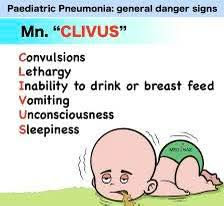
Paediatric Pneumonia: general danger signs
- Mnemonics is “CLIVUS“
- Convulsions
- Lethargy
- Inability to drink or breast feed
- Vomiting
- Unconsciousness
- Sleepiness

How many bones are there in human vertebra?
25
64
33
80
Which of the following chamber of heart pumps oxygenated blood towards the aorta?
Right atrium
Right ventricle
Left atrium
Left ventricle
The normal WBC count is……..
4000-11000
400000-900000
150000-400000
4.5-6.5 *10^6
The process of blood cells formation is called……..
Thrombocytosis
Leucocytosis
Erythropoiesis
Hemolysis
The normal intake of water per day is………
1000ml
2000ml
1500ml
2500ml
Which type of drug is mebendazole?
Antifungal
Antihelminitic
Antibactericidal
Antiviral
The safest route for injection is……..
Intravenous
Intraperitoneal
Intrapleural
Intracardinal
What is the pressure of vitreous humor in eyes?
5-10 mm of Hg
15-20 mm of Hg
10-15 mm of Hg
20-25 mm of Hg
The most important electrolyte of intracellular fluid is…….
Sodium
Calcium
Potassium
Chloride
The beta cell of islets of Langerhans secretes………hormone.
Glucagon
Glycogen
Amylase
A patient is scheduled for a urinary catheterization, in which position should the nurse place the patient…….
Dorsal recumbent position
Supine position
Trendelenburg position
Prone position
Tachycardia means pulse rate……….
Below 60
Above 100
Below 100
Above 60
A patient is scheduled for NG feeding. In which position should the nurse place the patient……..
Low Fowler’s position
Trendelenburg
Supine position
Side lying position
The fastest route to give medicine is………
IV (intravenous)
ID (intradermal)
IM (intramuscular)
SC (subcutaneous)
Nosocomial infection is the infection acquired by………
Infected person
Community
Hospital
None of the above
Nepal Nursing Council was established in……
193 BS
2053 BS
1954 BS
2054 BS
A nurse administers an intravenous solution of 0.45 sodium chloride. With respect to human blood cell, to which category of fluid does this solution belong?
Isotonic
Hypotonic
Isometric
Hypertonic
A patient is to have gastric gavage. In which position should the nurse place the client when the gavage tube is being inserted…………
Supine position
High-Fowler’s position
Mid-Fowler’s position
Trendelenburg position
Which electrolyte of intracellular fluid is the most important?
Sodium chloride
Chloride
Calcium
Potassium
Sterile urine specimen is collected from…………
From clean bedpan or urinal
The first small amount of urine voided
Urine voided at midstream
All of the above
A patient is having dyspnea. To facilitate respiration, the nurse would….
Remove pillow from under the head
Elevate the head of the body
Elevate the foot of the body
Take the blood pressure
A patient has an abnormal, unexpected response to a drug this is defined as…….
Drug tolerance
A cumulative effect
Idiosyncratic effect
Anaphylactic
You are to administer a medication using a nasogastric tube. Before giving medicine, you should…….
Crush the enteric coated pill for mixing in a liquid
Flush open the tube with 60ml of very warm water
Check for proper placement of NG tube
Take the patient’s vital sign
Vitamin K, 10mg given IM, is ordered vitamin K is available as 5mg/ml. how much would the nurse administers?
1 ml
2 ml
3 ml
4 ml
While administering a blood transfusion, when would the nurse assess the patient for a blood transfusion reaction?
Every 15 minutes after the infusion is started
After the blood is all infused
Every hour
Every 15 minutes
When assessing a patient at risk for pressure ulcer formation, which site would the nurse identify as being most common?
Occipital area
Sacrum
Sternum
Humerus
A patient is receiving 100ml of IV fluid per 24 hours. Using an IV set with drop rate of 15 drops/ml the nurse should plan to regulate the IV is………
10 drops/min
15 drops/min
20 drops/min
30 drops/min
The identification of client’s health needs occurs in nursing process step of………..
Planning
Evaluation
Assessment
Implementation
Oxygen, Food and water are which of the following need according to Maslow’s hierarchy of human needs……
Physiological needs
Safety and security need
Love and belonging
Self esteem
When you find a person lying on the ground with a cardiopulmonary arrest, what will be the immediate action to be taken?
Assess responsiveness
Assess the airway
Assess circulation
Assess breathing
ICN (International Council of Nurses) was established in………
1899 A.D
1888 A.D
1898 A.D
1889 A.D
NLEN (National Licensure Examination for Nurses) is conducted by………
NNC
ICN
NAN
INC
If heat is transferred from one object to another by direct contact, it is……
Convection
Conduction
Evaporation
Radiation
When the elevated temperature fluctuates wildly but does not reach normal levels between fluctuation is called………
Constant fever
Remittent fever
Intermittent fever
Relapsing fever
Type of abnormal breathing which is the combination of hyperpnea and apnea………
Dyspnea
Orthopnea
Cheyne-Stokes breathing
Asphyxia
A client has temperature 104⁰F. This temperature is equal to……………
38⁰C
40⁰C
41⁰C
42⁰C
A patient is receiving blood transfusion, if an allergic reaction to the blood develops on patient, the nurse’s first intervention should be…….
Call the physician
Stop the blood immediately
Slow the flow rate of blood
Administer anti-allergic drug
Which is the unfavorable factor affecting wound healing?
Young age
Hemorrhage
Intake of protein, calcium, vitamin C
Blood supply to the injured part
For safe administration of drugs, the nurse should follow right …
4 rights
5 rights
6 rights
10 rights
For safe administration of drugs, the nurse should follow right …
Gluteus medius
Deltoid muscle
Gluteus minimus
Vastus lateralis
The process which makes inanimate objects safer to be handled by health personnel before cleaning is………….
Sterilization
High level disinfection
Decontamination
Cleaning
Recommended temperature, time pressure for autoclaving (steam under pressure)
120⁰C (250⁰F), at 106kpa (15 Ibs/in 2) for 30 minutes
110⁰C at 106 kpa (15 Ibs/in 2) for 30 minutes
100⁰C at 106 kpa (15 Ibs/in 2) for 30 minutes
90⁰C 106 kpa (15 Ibs/in 2) for 30 minutes
If nurse is administering a cleansing enema to a client enema to a client with a fecal impaction. Before administering the enema the nurse places the client in which position?
Left Sims position
Right Sims position
On the left side of the body, with the head of the bed elevated at 45 degree
None
Who will be third line manager for you at PHC?
Self
Medical superintendent
Medical officer
Chief of T/OH
A nurse is preparing to insert a nasogastric tube in an adult client. To determine the measurements of the length of the tube to be inserted, the nurse should………..
Mark the tube at 10 inches
Mark the tube at 32 inches
Place the tube at the tip of the nose and measures by extending the tube to the earlobe and then down to the xiphoid process
Place the tube at the tip of the nose and measure by extending the tube earlobe and then down to the sternum
Physician prescribed a hypotonic solution (IV) for a client. Which of the following IV solutions would the nurse except to prescribe………
5% dextrose in water
0.45% sodium chloride
10% dextrose in water
0.9% sodium chloride
The nurse has obtained a unit of blood from the blood bank and has checked the blood bag properly with another nurse. Just before beginning the transfusion, the nurse assess which of the following items?
Vital sign
Skin color
Urine output
Latest hematocrit level
Best type of solution to use for the irrigation of urinary catheter…
Distilled water
Normal saline
Tap water
Warm water

The most important way to prevent the spread of infection is………….
Wearing gloves
Hand washing
Wearing mask
Wearing coat
Which instrument is used to test the client’s hearing?
Stethoscope
Tuning fork
Otoscope
Reflex hammers
When is international nurse’s day celebrated?
12th May
12th March
2nd May
31st July
A nurse is preparing a preoperative client for transfer to the operating room. The nurse should take which action in the care of this client at this time?
Ensure that the client has voided
Administer all the daily medications
Practice postoperative breathing exercises
Verify that the client has not eaten for the last 24 hours
The nurse is performing an abdominal assessment the nurse performs which assessment at first…..
Auscultation
Inspection
Palpation
Percussion
While giving an intradermal injection the needle should be held at ……
15⁰
45⁰
30⁰
90⁰
Appropriate temperature of solution prepared for sitz-bath should be………
105-110⁰ F
100-105⁰F
110-115⁰F
115-120⁰F
The nurse determines that a client is having a transfusion reaction. After the nurse stops the transfusion, which action should immediately be taken next………
Remove IV line
Run normal saline at a keep vein open rate
Run a solution of 5% dextrose in water
Obtain a culture of the tip of catheter device removed from the client
When suctioning an unconscious client, which nursing intervention should the nurse prioritize in maintaining cerebral perfusion….
Administer diuretics
Administer analgesics
Provide hygiene
Hyper oxygenate before
Savlon is……..
Cetrimide
Chlorhexidine
Chloroxylenol
A and B
Scald is a burn caused by……….
Dry heat
Radiation
Moist heat
Friction
When you perform CPR on an unresponsive adult, you should correctly assess the pulse of which location?
Over the radial artery
Over the carotid artery
Over the brachial artery
Over the temporal artery
Which of the following would the nurse use as the most reliable indicator of a patient’s fluid balance status?
Intake and output
Skin turgor
Complete blood count
Daily weight
Health policy formation in Nepal since……
1991 AD
1998 AD
1995 AD
1999 AD
Trachoma is a disease of………….
Eye lid
Cornea
Conjunctiva
Lachrymal gland
Koplik’s spot is the clinical feature of……….
Measles
Tuberculosis
Chicken pox
Leprosy
BCG vaccine is against………..
Measles
Diphtheria
Tuberculosis
Whooping cough
DOTS stand for………….
Directly observed treatment short course
Direct observed treatment short course
Direct observed treatment system
Directly observed treatment system
The vector for malaria is………….
Plasmodium vivax
Plasmodium falciparum
Plasmodium malaria
Female anopheles mosquito
HIV/AIDS is caused by a………….
Retro virus
Rhabdo virus
Rota virus
Pox virus
Which of the following is waterborne disease?
Typhoid
Malaria
Kala-azar is caused by…………vector
Malaria
Sand fly
Housefly
Bee
Syphilis is caused by………….
Salmonella Typhi
Neisseria gonorrhea
Treponema pallidum
Streptococcus
What type of vaccination is given against measles?
Live attenuated
Killed
Toxoid
Inactive
Which of the following is principle of primary health care?
Health education
Dental health
Mental health
Community participation
Oral contraceptives act by……………
Preventing ovulation
Making endometrial non-reactive to embryo
Making inactive to sperm
Inhibiting sperm penetration to the ovum
The ages of child to receive DPT vaccine are………….
6 week, 10 week, 14 week
6 week, 7 week, 8 week
6 week, 7 week, 8 week
1 week, 2 week, 3 week
When was the ALMA Ata conference held?
1972
1988
1978
1990
Which of the following comes under STDs disease?
HIV/AIDS
Typhoid
Diarrhea
Leprosy
When oral contraceptives are prescribed for a patient, the nurse should teach the client about the potential of developing……….
Cervicitis
Fibrocystic disease
Ovarian cyst
Break through bleeding
Which of the following are not the 6 killer diseases?
ARI
Diarrhea
Measles
Meningitis
When emergency contraceptive should be taken after the unprotected sexual intercourse?
Within 24 hrs
Within 48 hrs
Within 36 hrs
Within 72 hrs
What is the best method of solid waste disposal?
Composting
Incineration
Dumping
Burial
Which of the following permanent family planning method requires contraceptives at least for 20 ejaculation surgery?
Vasectomy
Laparoscopy
Minilap
Norplant
The comprehensive assessment of the health status of an entire community is called……….
Community diagnosis
Micro-teaching
Home visit
Health education
Which type of approach is used in home visit?
Individual approach
Group approach
Mass approach
Media approach
Which of following contraceptives is excluded in the outreach clinic?
Oral pills
ORS packet
Condom
Norplant
The cases occurs irregular haphazardly form time to time and generally infrequently is…………
Epidemic
Sporadic
Pandemic
None
Table of Contents(toc)

5-10 mm of HG
15-20 mm of HG
10-15 mm of HG
20-25 mm of HG
25
64
33
80
Thrombocytosis
Leucocytosis
Erythropoiesis
Hemolysis
Sodium
Calcium
Potassium
Chloride
Intravenous
Intraperitoneal
Intrapleural
Intracardial
4000-11000
400000-900000
150000-400000
4.5-6.5 *10⁶
5% dextrose in water
0.45% sodium chloride
10% dextrose in water
0.9% sodium chloride
1000 ml
2000 ml
1500 ml
2500 ml
Glucagon
Glycogen
Amylase
Right atrium
Right ventricle
Left atrium
Left ventricle
Dorsal recumbent position
Supine position
Trendelenburg position
Prone position
IV (Intravenous)
ID (Intradermal)
IM (Intramuscular)
SC (Subcutaneous)
12th May
12th March
2nd May
31st July
Wearing gloves
Hand washing
Wearing a mask
Wearing a coat
Remove the pillow from under the head
Elevate the head of the bed
Elevate the foot of the bed
Take the blood pressure
Here’s the answer key for the provided MCQs:
| Feature | Bacterial Vaginosis | Trichomonas Vaginalis |
|---|---|---|
| Cause | Overgrowth of anaerobic bacteria | Trichomonas vaginalis (protozoan parasite) |
| Discharge Characteristics | Thin, grayish-white, homogeneous, fishy odor | Green, gray, pink frothy, yellow discharge |
| Pain/Itching | Painless | Painful intercourse, burning sensation, itching |
| Microscopic Findings | Clue cells (vaginal epithelial cells covered with bacteria) | Motile pear-shaped organisms with flagella |
| pH | > 4.5 | Normal pH |
| Diagnostic Test | Amsel’s criteria, Nugent scoring (Gram stain) | NAAT (Nucleic Acid Amplification Test), Wet mount microscopy |
| Treatment | Metronidazole or Clindamycin | Metronidazole (both partners) |
| Impact on Pregnancy | Can cause early miscarriage and pre-term birth | Low birth weight, premature rupture of membranes |

.link-area {
display: flex;
justify-content: center;
align-items: center;
height: 100vh;
margin: 0;
background-color: #f0f8ff;
}
.decorated-box {
padding: 40px;
border: 3px dashed #007BFF;
border-radius: 15px;
background-color: #e6f7ff;
box-shadow: 5px 5px 15px rgba(0, 0, 0, 0.1);
}
.decorated-link {
font-size: 24px;
font-weight: bold;
color: white;
background-color: #007BFF;
padding: 15px 30px;
border-radius: 12px;
text-decoration: none;
box-shadow: 3px 6px 10px rgba(0, 0, 0, 0.2);
transition: background-color 0.3s ease, box-shadow 0.3s ease;
}
.decorated-link:hover {
background-color: #0056b3;
box-shadow: 5px 8px 12px rgba(0, 0, 0, 0.3);
}
Are you eagerly waiting for your CTEVT exam results? The process is now
easier than ever! With the online portal provided by CTEVT, you can access
your results quickly and conveniently. Here’s a step-by-step guide to help
you check your results seamlessly.
Visit the Official Website: Go to the official
result-checking page by clicking on the link:
Click here to check your results now.
Enter Your Information: Input your exam roll number and
other required credentials as prompted on the page.
Verify and Submit: Double-check your information for
accuracy and click the submit button.
View Your Results: Your results will be displayed on
the screen. You can download or print the results for future reference.
Convenience: No need to visit the CTEVT office or wait
for official notices.
Speed: Access your results immediately once they are
published.
Accuracy: The online system ensures accurate and
up-to-date information.
Incorrect Roll Number: Double-check the details you
entered.
Website Traffic: Try accessing the site during off-peak
hours.
Browser Compatibility: Use an updated browser like
Chrome or Firefox.
The online result-checking system by CTEVT is a great initiative to make the
process more efficient and accessible for students. By following the steps
above, you can easily check your exam performance without any hassle.

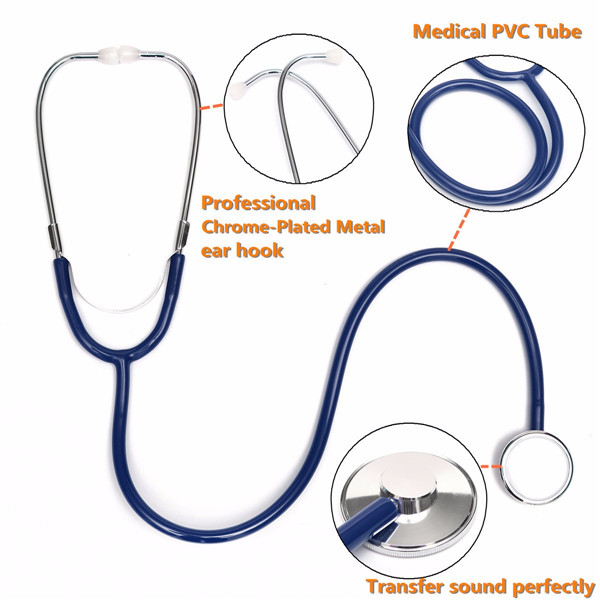
A stethoscope is an essential tool for auscultation or listening to internal
sounds of an animal or human body. It can help diagnose various conditions
related to the heart, lungs, abdomen and blood vessels. A stethoscope consists
of three main parts: a chest-piece, a headset and a tubing. This is anatomy of
stethoscope (stethoscope anatomy). Stheth is occasionally referred as steth as
well.
 |
| Parts of stethoscope |
The chest-piece is the part that contacts the patient’s body. It has a stem
that connects to the tubing and a diaphragm and/or a bell that transmits sound
waves to the earpieces. The diaphragm is a thin membrane that vibrates when
exposed to high-frequency sounds, such as heartbeats and breath sounds. The
bell is a hollow cup that resonates with low-frequency sounds, such as murmurs
and bruits. Some stethoscopes have a single-head design that can switch
between diaphragm and bell modes by applying different pressure on the
chest-piece. Others have a dual-head design that has both diaphragm and bell
on opposite sides of the chest-piece.
The headset is the part that delivers sound to the user’s ears. It consists of
two eartubes, tension springs and eartips. The eartubes are metal rods that
are angled to fit into the user’s ear canals comfortably and securely. The
tension springs are flexible wires that allow the user to adjust the pressure
on their ears by squeezing or pulling apart the eartubes. The eartips are soft
rubber or silicone caps that seal out external noise and enhance sound
quality.
They come in different sizes and shapes to suit different
preferences.
The tubing is the part that connects the chest-piece to the headset.

It is made of durable material that can withstand bending and folding without
affecting sound transmission.
The length of the tubing affects how far
you can stand from your patient while auscultating.
A longer tubing may
reduce sound quality but increase mobility, while a shorter tubing may improve
sound quality but limit mobility.
A stethoscope is not only an instrument for diagnosis but also an expression
of professionalism and identity for doctors and nurses. It is important to
choose one that suits your needs, preferences and budget. You should also take
care of your stethoscope by cleaning it regularly, storing it properly and
replacing worn-out parts when necessary.
These are traditional stethoscopes that use air columns in tubes to transmit
sound waves from chest-pieces to earpieces. They are simple, inexpensive and
widely used, but they may have low sound quality, especially for low-frequency
sounds.
These are modern stethoscopes that use electronic circuits to amplify, filter
and process sound waves from chest-pieces before sending them to earpieces or
speakers. They have high sound quality, even for low-frequency sounds, but
they may be expensive, complex and require batteries.
How to wear a stethoscope
 |
| Anatomy of the stethocope and physiology: different parts labelled |
These are unique stethoscopes that use Doppler effect.
Various companies make stethoscopes including 3m littmann, fricare, mdf,
mccoy, alimed etc.
How does a stethoscope work
{
“@context”: “http://schema.org”,
“@type”: “VideoObject”,
“name”: “Pulmonary tuberculosis w Dr Chaitanya Joshi in Nepali for medical students, paramedics, HA, CMA easy”,
“description”: “Pulmonary tuberculosis by Dr Chaitanya Joshi in Nepali for medical students, paramedics, HA, CMA easy Useful for loksewa Entrance preparation License For HA, CMA, Nursing and medical students as well All my social links here https://www.linktr.ee/cjoshi visit https://www.chaitanya.com.np for more please share and sunscribe Welcome to this comprehensive video on health exam questions that you might face in Loksewa Entrance MBBS/MD/MS and PSC exams in Nepal. This video provides you with essential tips and strategies to help you prepare efficiently and excel in these competitive exams. The video covers a wide range of topics related to health, such as anatomy, physiology, pathology, pharmacology, health policy, healthcare management, and public health. We also discuss important aspects of healthcare careers, medical education, and medical profession. The video is designed to help you build a strong foundation in health science, enhance your knowledge, and improve your chances of success in medical entrance exams. Whether you are a first-time test-taker or a repeat candidate, our expert guidance will assist you in achieving your goal. In summary, this video is a one-stop-shop for all your exam preparation needs. It equips you with valuable study tips, exam strategies, and critical concepts to ace the health exam questions in Loksewa Entrance MBBS/MD/MS and PSC exams in Nepal. Additional Keywords: Medical entrance exam, study materials, healthcare, medical schools, Lok Sewa Nepal, Public Service Commission, medical admission, MBBS, MD, MS, exam tips, Nepal. At www.chaitanya.com.np, we understand that preparing for medical entrance exams can be challenging and time-consuming. That’s why we’ve designed our platform to provide you with the resources you need to prepare efficiently and effectively. Our content is curated by medical experts who have years of experience in the field and are committed to helping you succeed. Our platform offers a user-friendly interface that is easy to navigate and allows you to access content quickly and easily. Whether you’re looking for exam-related videos, study materials, or practice tests, you’ll find everything you need on our platform. We also update our content regularly to ensure that you have access to the latest information and exam trends. In addition to exam-related content, we also offer articles and videos on various health-related topics. Our resources cover a wide range of subtopics, including human anatomy, physiology, pathology, pharmacology, healthcare management, public health, and more. With our comprehensive coverage of health science topics, you’ll be able to build a strong foundation of knowledge that will help you succeed in your medical career. At www.chaitanya.com.np, we’re committed to helping you achieve your goals. That’s why we offer high-quality content, expert guidance, and practical exam strategies to help you succeed in your medical entrance exams. So, why wait? Visit our platform today and start preparing for your future in healthcare!”,
“thumbnailUrl”: “https://i.ytimg.com/vi/Ui2T4G8eyQo/default.jpg”,
“uploadDate”: “2023-03-21T19:55:46Z”,
“duration”: “PT30M37S”,
“embedUrl”: “https://www.youtube.com/embed/Ui2T4G8eyQo”,
“interactionCount”: “573”
}

Vitamins are types of micronutrients needed for proper growth and maintainance of health. Vitamins are found in the foods we eat daily.
Vitamins are required in very small quantity for our body. The growing a children require more amount of vitamins and minerals than adults. Adults are also required to eat sufficient amount of vitamins for maintenance of their body. Vitamins are also required to boost the immune system of our body. This helps our body to fight against different kind of communicable and non communicable disease like infection of bacteria, viruses and fungus as well as cancer and heart diseses.
Generally if a person is eating healthy and nutritious balanced diet and he or she is not suffering from any disease then there is high chance that the person is already taking sufficient amount of nutrition and nutrients in his or her diet. But in some cases and if the person is suffering from disease or not able to eat properly then there might be nutrition defeciency.
Children are special population, nutrition during childhood refers to their health growth and long term health benefit. If a child suffers from nutrition deficiency in childhood the person might suffer is who life due to this. Nutrition supplement during childhood also means that the child will be healthy his whole life. Growth and development failure during his or her childhood means he/she will have problem with his/her whole life.
The answer to this question is not all the children may need nutrition supplement. But still there is possibility that your child might be having nutrition deficiency. If the nutrients are supplied in safe doors then there is no side effect of it. So basically there is no harm in supplementing nutrients to your child but this may benefit your child instead. Supplementing nutrition will treat the nutrition deficiency while not harming your baby. For the same reason you should provide supplement nutrition to your baby rather than not doing it. There is more benefit of providing supplement. There is high chance that you are baby might have nutrition deficiency so it should be advised to treat the nutrition deficiency.
There are multiple supplementary options available for our baby. There is a famous nutrition supplement which contains 16 types of micro nutrients all in one called Balvita supplied by government of nepal for free. Special nutrients supplement required for children is vitamin A.
Balvita is a type of nutritional supplement that is designed to provide essential vitamins and minerals to support the growth and development of children. Balvita is typically recommended for children who may have nutritional deficiencies or who require additional support for healthy growth and development.
Baal Vita (also spelled Balvita) is a multiple micronutrient powder (MNP) provided to young children, primarily in Nepal, to combat malnutrition, prevent anemia, and promote healthy physical and cognitive development.
It is also called multi micronutrient powder as well.
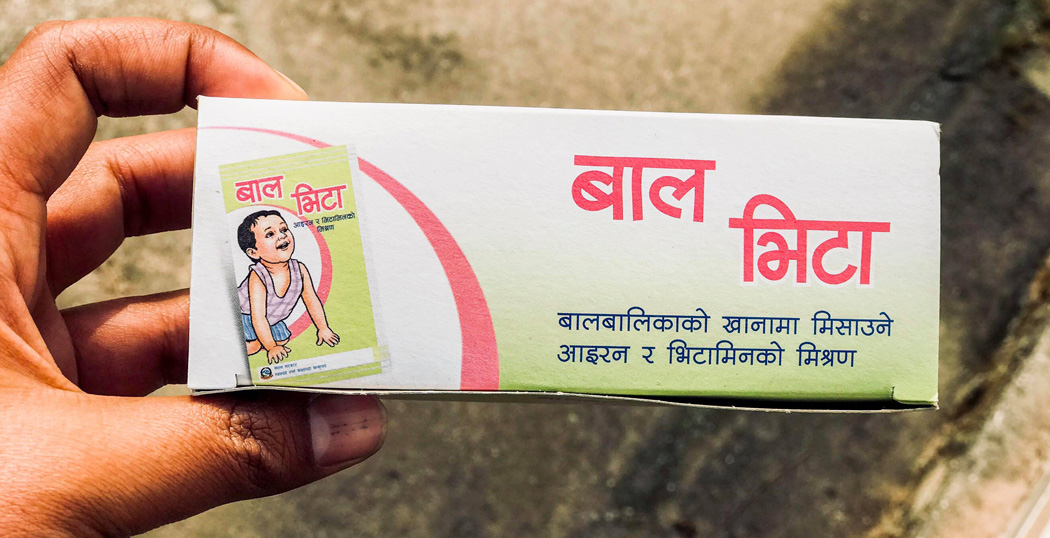
In Nepal, “Balvita” (also called Baal Vita or micronutrient powder) is usually given to babies from 6 months onward along with complementary foods. It is meant to add vitamins and minerals to homemade food. (Dr Chaitanya Joshi, MD)
Here’s the recommended way to feed it:
Important precautions:
The Nepal nutrition program commonly provides about 60 sachets every 6 months for children aged 6–24 months.
According to WHO the country in which there is more than 20 % of ppulation suffering from worm infestation then the country should deworm the population twice a year.
Neapal also has hugh prevalence of worm infestation and among children and the pregnant women the prevalence of infestatio nis more than one third.
It has been shown that one tablet of albendazole 400 mg or mebendazole 500 mg can kill almost all of the intestinal worms.
Nepal has decided to distribute albendazole for purpose of deworming. This tablet can kill various types of worms including Ancylostoma canium, Ancylostoma duodenale (Nectar americanus), Ascaris lumbricoids (intestinal worm), Enteribiasis (pinworm), Oesophagostomum bifurcum etc.
The active metabolite of albendazole is albendazole sulfoxide. It causes selective degenration if the cytoplasmic degeneration of the microtubules in intestinal and tegmental cells of intestinal helminths and larvae; glycogen is depleted, glucose uptake and cholinesterase secretion is imparired, and desecratory substance is accumulated intracellularly. ATP production decreases. This causes energy depletion and immobilization and subsequent worm death. Thus dead worm is passed down in stool.
Childres one year to less than 2 years -> 200 mg (1/2 tablet twice yearly
Children 2 years to 5 years -> one tablet of 400 mg twice yearly
Pregnant woman after first trimester -> one tablet of albendazole 400 mg
Vitamin A is a micronutrient found mostly in green leafy vegetables and animal source foods like meat, eggs and dairy products.
High dose vitamin A supplementation is done to prevent and treat many conditions among children and adults.
The dose of vitamin A in different population is summerized below
| Food Item | Vitamin A (mcg/100gm) |
|---|---|
| Stinging nettle | 12857 |
| Colocasia leaves | 12000 |
| Coriander leaves | 6918 |
| Spinach | 5580 |
| Amaranth, tender | 5520 |
| Radish leaves | 5295 |
| Carrot | 4275 |
| Goat liver | 3030 |
| Mango | 2743 |
| Mustard leaves | 2622 |
| Fenugreek leaves | 2340 |
| Pumpkin leaves | 1940 |
| Chicken liver | 1930 |
| Bethe leaves | 1740 |
| Mustard leaves | 1520 |
| Rape leaves | 1380 |
| Pumpkin | 1160 |
| Papaya | 666 |
| Onion stalk | 595 |
| Soybean | 426 |
| Eggs | 420 |
| Lentil | 270 |
| Cabbage | 120 |


