छारेरोग नेपालीमा Epilepsy: Chharerog bhaneko ke ho?

Epilepsy: Chharerog bhaneko ke ho? Nepali ma छारेरोग नेपालीमा  

(Toc) Table of Contents

Introduction : छारेरोग (Epilepsy): कारण, लक्षण, उपचार र सावधानी

छारेरोग, जसलाई एपिलेप्सी पनि भनिन्छ, मस्तिष्कको असामान्य विद्युतिय क्रियाकलापले उत्पन्न हुने एक तंत्रिका रोग हो। यस रोगका कारण व्यक्तिलाई अनियन्त्रित छारे उठ्ने समस्या हुन्छ। नेपालमा यो रोगबारे चेतना कम भएकाले मानिसहरूले यसलाई सही तरिकाले बुझ्न र समयमै उपचार गर्न पाएका छैनन्। यस लेखमा हामी छारेरोगका कारण, लक्षण, उपचार, र सावधानीबारे जानकारी दिन्छौं।

Chharerog in English

छारेरोगलाई अंग्रेजीमा Epilepsy or Seizure Disorder  भनिन्छ।

छारेरोग के हो?

छारेरोग एक दीर्घकालीन स्वास्थ्य समस्या हो, जसमा मस्तिष्कको विद्युतीय क्रियाकलापमा असन्तुलन आउने गर्छ। यसले व्यक्तिलाई एक्कासी छारे उठ्ने वा बेहोश हुने स्थिति निम्त्याउँछ। यो रोगले जीवनको गुणस्तरमा असर गर्न सक्छ, तर सही उपचारले यसलाई नियन्त्रणमा राख्न सम्भव छ।

छारेरोगका कारणहरू

छारेरोगका केही मुख्य कारणहरू निम्नानुसार छन्:
  • जन्मजात समस्या: गर्भावस्थामा मस्तिष्कको विकासमा आउने समस्याले छारेरोगको जोखिम बढाउन सक्छ।
  • मस्तिष्कको चोटपटक: दुर्घटनामा मस्तिष्कमा चोट लाग्दा वा मस्तिष्क सर्जरीपछि पनि छारेरोगको सम्भावना हुन्छ।
  • मस्तिष्कको संक्रमण: मेनिन्जाइटिस र इन्सेफेलाइटिसजस्ता मस्तिष्क संक्रमणले तंत्रिका प्रणालीमा असर पुर्याउन सक्छ।
  • अनुवांशिक कारण: परिवारमा छारेरोगको इतिहास हुने व्यक्तिमा यो रोगको सम्भावना बढी हुन्छ।

छारेरोगका लक्षणहरू

छारेरोगका लक्षणहरू व्यक्ति अनुसार फरक हुन सक्छन्। प्रमुख लक्षणहरूमा निम्न समावेश छन्:
  • शरीरको कुनै अंगमा अनियन्त्रित थर्कन
  • एकै ठाउँमा घुरेर हेर्ने
  • अचेत वा बेहोस हुने
  • कुनै शब्द नबोल्न पाउने वा बोल्ने क्रममा अवरोध हुन सक्ने
  • एक्कासी डराउनु वा चिच्याउनु
छारेरोगका यी लक्षणहरू बारम्बार देखिएमा तुरुन्तै चिकित्सकको सल्लाह लिनुपर्छ।

छारेरोगको उपचार

छारेरोगको उपचारका लागि केही प्रमाणित विधिहरू छन्:
  • औषधि: चिकित्सकले दिने औषधिले मस्तिष्कको असामान्य विद्युतिय गतिविधिलाई नियन्त्रणमा राख्न मद्दत गर्छ। नियमित औषधि सेवनले छारे आउने सम्भावना घटाउँछ।
  • सर्जरी: जटिल केसमा सर्जरीबाट मस्तिष्कको समस्या भएको भाग हटाइन्छ, जसले छारेरोगलाई नियन्त्रण गर्न सकिन्छ।
  • केटो डायट: केही केसहरूमा केटो डायटले छारेरोगलाई नियन्त्रण गर्न मद्दत गरेको देखिन्छ। यसलाई अपनाउनुअघि चिकित्सकको सल्लाह लिनु आवश्यक हुन्छ।
  • विटामिन सप्लिमेन्ट्स: केही व्यक्तिहरूमा विशेष गरी भिटामिन B6 जस्ता सप्लिमेन्ट्स लाभदायक हुन सक्छन्। तर चिकित्सकको सल्लाहविना नखानुहोस्।

छारेरोग भएका व्यक्तिका लागि सावधानी

छारेरोग भएका व्यक्तिहरूले निम्न सावधानी अपनाउनु उपयुक्त हुन्छ:
  • औषधि नियमित सेवन गर्नुहोस्: चिकित्सकको सल्लाहबिना औषधि बन्द नगर्नुहोस्।
  • तनाव व्यवस्थापन: तनावले छारे उठ्ने सम्भावना बढाउन सक्छ, त्यसैले ध्यान र योग जस्ता अभ्यास गर्नु राम्रो हुन्छ।
  • सुरक्षित गतिविधिहरू रोज्नुहोस्: पौडी खेल्दा वा यात्रा गर्दा साथी वा परिवारसँगै रहनुहोस्।
  • मादक पदार्थबाट टाढा रहनुहोस्: यसले मस्तिष्कमा नकारात्मक असर पार्न सक्छ।
  • पर्याप्त निद्रा लिने प्रयास गर्नुहोस्: निद्रा नपुग्दा पनि छारेरोग बढ्न सक्छ।

निष्कर्ष

छारेरोग गम्भीर स्वास्थ्य समस्या हो तर सही जानकारी, समयमै उपचार, र उचित सावधानीबाट यसलाई राम्रोसँग नियन्त्रण गर्न सकिन्छ। नेपाली समाजमा यसबारे सचेतना फैलाउन आवश्यक छ ताकि छारेरोग भएका व्यक्तिहरूले सही उपचार पाउन सकून् र जीवनमा सुधार ल्याउन सकून्।
स्वास्थ्यको लागि सचेत रहनुहोस्, चिकित्सकको सल्लाह लिनुहोस्, र आवश्यक जानकारी समाजमा फैलाउनुहोस्।

SUAAHARA II program- suaahara 2 program Nepal

What is suaahara ii program? know about suaahara program run by NTAG

Table of Contents(toc)

Innroduction of Suaahara program

The Suaahara II program is a government initiative in Nepal aimed at improving the nutritional status of mothers and children. Launched in 2018 and implemented by the Ministry of Health and Population with support from various international organizations, the program focuses on enhancing maternal and child health, reducing malnutrition, and promoting healthy dietary practices.
Suaahara II works through a community-based approach, engaging local health workers and volunteers to educate families about nutrition, hygiene, and health services. It targets pregnant women, lactating mothers, and children under five, providing them with essential information and support to ensure better health outcomes.
By addressing various factors influencing nutrition, such as dietary diversity, sanitation, and healthcare access, Suaahara II aims to create sustainable improvements in the health and well-being of the most vulnerable populations in Nepal. The program also emphasizes the importance of community participation and the involvement of various stakeholders to maximize its impact.
Suaahara ii program is run by donation from the USAID

PARTNERS of suaahara ii:

  • Government of Nepal – Specifically, the Ministry of Health and Population.
  • USAID (United States Agency for International Development) – The main donor agency supporting the program.
  • Helen Keller International (HKI) – Focuses on nutrition and health.
  • Save the Children – Works on improving health and nutrition outcomes for children and families.
  • World Food Program (WFP) – Supports food assistance and nutrition interventions.
  • CARE Nepal – Engages in community-based health and nutrition programs.
  • Nepal Red Cross Society – Involved in community health initiatives.
  • Local Government Bodies – Collaborate on implementing health programs at the community level.
  • Various NGOs and Community-Based Organizations – Work alongside the program to reach target populations.

Prime partner of suaahara ii:

Helen Keller International is the Prime partner of suaahara ii in nepal. It has been working with the suaahara program now with its full potential.

Consortium partner of suaahara ii:

CARE, FHI 360, NTAG, DBI Equal Access, ENPHO, VDRC are the Consortium partner of suaahara ii.

suaahara ii program

Suaahara program is implemented PROGRAM in the fllowing districts:

42 districts

  • Arghakhachi
  • Baglung
  • Baitadi
  • Banke
  • Bardiya
  • Bhojpur
  • Dang
  • Darchula
  • Dhading
  • Gorkha
  • Gulmi
  • Jajarkot
  • Kapilvastu
  • Lamjung
  • Myagdi
  • Nuwakot
  • Palpa
  • Panchthar
  • Rolpa
  • Rukum East
  • Rukum West
  • Sankhuwasabha
  • Sindhupalchok
  • Solukhumbu
  • Taplejung

NTAG’S AREAS OF INTERVENTIONS

Nutrition suaahara ii

As a consortium partner, NTAG has primary role to conduct training and capacity building to improve the maternal, infant and young child nutrition (MIYCN) related behaviors at household level.

PROGRAM DURATION SUAAHARA II

June 2016 – March 2023

STATUS SUAAHARA II

Ongoing 

PROGRAM OVERVIEW SUAAHARA II

Nepal has made significant progress to reduce maternal and child mortality by implementing strategic programs. However, malnutrition rates in is remain high. Nepal is one of the most undernourished countries in the world. In Nepal, 36 percent of children under five years of age are stunted, 10 percent suffer from wasting, and 27 percent are underweight. In addition, 40.8% women of reproductive age and 52.7% children under five are anemic.

SUAAHARA PROGRAM

The SUAAHARA II “Good Nutrition” project, funded by U.S. Agency for International Development (USAID), designed and implemented after successful completion of SUAAHARA I. Suaahara I successfully reached more than 625,000 households with its integrated nutrition programming. Suaahara II is also dedicated to improving the health and nutrition of more than 1.5 million mothers and their children in the 1000 days’ period from conception until a child reaches 2 years of age. Beyond nutrition sensitive interventions, Suaahara II also focused on multi sectorial coordination among equity, gender, social inclusion, behavior change and good governance to meet the goals of the project
SUAAHARA II primarily focused on 1000 days mothers and their family which period is recognized as a crucial timeframe during which nutritional interventions have optimal impact on child growth and development. This program will cover all households in 40 of the 75 districts of Nepal.

PROGRAM OBJECTIVES OF SUAAHARA II:

  • To improve the household nutrition and health behaviors.
  • To increase the use of quality nutrition and health services by women and children.
  • To improve access to diverse and nutrient rich food by women and children.
  • To accelerate roll-out of the multi sectoral nutrition plan (MSNP) through strengthened local governance.

follow the link to read similar articles

Source:
https://www.ntag.org.np/suaahara-ii/

7 Compelling Reasons to Choose USA as Your Study Destination Abroad

 7 Compelling Reasons to Choose USA as Your Study Destination Abroad

Table of Contents(toc)

It might be a good idea to study abroad in the United States (USA) if you’re planning to do so. International students from all over the world flock to the USA because of its world-renowned education system and endless growth opportunities. Here are seven reasons why choosing the USA for your study abroad destination could be a transformative decision.

Diverse Range of High-Quality Academic Programs


More than 4,000 universities and colleges in the USA offer undergraduate, graduate, and doctoral programs in virtually every field. From arts and humanities to STEM subjects, the USA’s higher education system can cater to any academic preference. American universities also consistently rank high in global rankings, proving their commitment to quality.

International student

Research and Innovation Opportunities

International students have the chance to get involved in cutting-edge research and innovation in the USA. There are a lot of universities that have innovative facilities and invite students to participate in groundbreaking research. This hands-on experience can be invaluable in furthering your academic career and making an impact on a global scale.

Career Opportunities and Internships

It can make a huge difference to your career prospects to study in the USA. Due to its strong economy, the USA has a lot of multinational companies and startups, so there are a lot of internships and jobs. Universities often have career services that help students find internships, co-ops, and part-time job opportunities in their field of interest.

Cultural Diversity

The USA is a melting pot of cultures, allowing international students to experience a multicultural environment firsthand. This exposure not only enriches the study abroad experience but also helps develop a global perspective, a trait highly valued by employers worldwide.

Universities in the USA have diverse student populations and frequently organize cultural events, promoting inclusivity and understanding among students.

Support for International Students

International students get a lot of help adjusting to a new educational system and culture at American universities. You can get support from English language courses to academic writing workshops to counseling services. Using these resources makes the transition smoother and enhances the study abroad experience.

Flexibility in Education System

One of the unique aspects of the USA’s education system is its flexibility. Students can often choose their major and minor subjects, tailor their course load according to their convenience, and even switch universities if required. 

Additionally, programs like double majors, minors, and electives allow students to explore a variety of interests alongside their main course of study.

Broadened Perspectives and Personal Growth

Lastly, studying in the USA can be an opportunity for immense personal growth. Living independently, navigating a new cultural landscape, and meeting people from diverse backgrounds can help students develop valuable life skills. 

Studying abroad often leads to increased self-confidence, improved problem-solving abilities, and heightened cultural awareness—skills that serve students well beyond their academic careers.

Conclusion

If you’re looking for a study abroad destination, the USA is a great choice. You’ll get a top-notch education, get to know different cultures, participate in groundbreaking research, and advance your career. Students in the USA get an education that goes beyond academics, ensuring that they leave with lifelong memories, experiences, and skills.

Why is Human chorionic gonadotropin (hCG) done for Pregnancy tests?

Human chorionic gonadotropin – The basis of pregnancy tests and Clinical
implications

a pregnant woman

Table of Contents (toc)

When is hCG first detectable?

 Detection of human chorionic gonadotropin (hCG) in blood or urine is the
basis of all pregnancy tests

hCG is secreted into the maternal circulation after implantation, which may
occur as early as 6 days after ovulation but typically occurs 8 to 10 days
after ovulation 

When Does Ovulation Occur

Ovulation occurs around day 14 of a 28-day menstrual cycle.

This is the earliest that hCG can be detected with a standard serum hCG test.
However, the ovulation-to-implantation interval has been observed to vary by
up to six days in naturally conceived pregnancies.

What delayes pregnancy test to come positive?

Late implantation delays
the time to a positive pregnancy test and has been associated with an
increased risk of pregnancy loss.

In a study of females with normal menstrual cycles who were attempting to
conceive, the median hCG concentration on the first day of expected but missed
menses (ie, approximately 4 weeks of gestation) was 239 milli-international
units/mL in serum and 49 milli-international units/mL in a spot urine, but
there was a wide range among individuals.

The range of hCG values was narrower in a study of over 4400 females who
conceived by in vitro fertilization, underwent embryo transfer two to three
days after egg retrieval, and had at least one viable embryo at 8 weeks of
gestation: the median hCG concentration on day 12 after embryo transfer/day 16
after ovulation (ie, approximately 4 weeks of gestation) was 118
milli-international units/mL (interquartile range 98 milli-international
units/mL).

Some common symptoms of pregnancy:

  • Missed Period: One of the earliest signs, especially if you have regular menstrual cycles.
  • Nausea and Vomiting: Often referred to as “morning sickness,” this can occur at any time of day.
  • Breast Changes: Tenderness, swelling, or darkening of the areolas.
  • Fatigue: Increased tiredness and a need for more sleep.
  • Frequent Urination: An increase in urination due to hormonal changes and pressure on the bladder.
  • Food Cravings or Aversions: Changes in taste preferences or aversion to certain foods.
  • Mood Swings: Emotional fluctuations due to hormonal changes.
  • Bloating: A feeling of fullness or swelling in the abdomen.

Signs of pregnancy list out for medical students

Presumptive Signs

  • Missed Period
  • Nausea and Vomiting
  • Breast Changes
  • Fatigue
  • Frequent Urination
  • Food Cravings or Aversions
  • Mood Swings
  • Bloating

Probable Signs

  • Positive Home Pregnancy Test
  • Uterine Enlargement
  • Chadwick’s Sign (bluish discoloration of cervix)
  • Hegar’s Sign (softening of the uterus)
  • Fetal Heartbeat Detected by Doppler

Positive Signs

  • Visualization of Fetus on Ultrasound
  • Detection of Fetal Heartbeat via Ultrasound
  • Blood Tests Confirming hCG Levels

How does hCG level change across pregnancy 

The hCG concentration doubles every 29 to 53 hours during the first 30 days
after implantation of a viable, intrauterine pregnancy; a slower rise is
suggestive of an abnormal pregnancy (eg, ectopic, early embryonic death).

positive pregnancytest results

The hCG concentration

The hCG concentration peaks at 8 to 10 weeks of gestation, averaging 60,000 to
90,000 milli-international units/mL at that time, but again, the range of
normal is quite wide (5000 to 150,000 milli-international units/mL or more).

Thus, hCG levels are not useful for estimating gestational age, except in the
first one to three weeks postconception

After 8 to 10 weeks of gestation, hCG levels decline, reaching a median
concentration of approximately 12,000 milli-international units/mL at 20
weeks, again with a wide range of normal: 2000 to 50,000 milli-international
units/mL or more.

hCG concentration stays relatively constant from approximately the 20th week
until term.

Variation in hCG Level

The factors accounting for the wide variation in interindividual hCG levels
have not been studied extensively in accurately dated pregnancies; maternal
weight accounts for some of the variation throughout pregnancy.

In some cases, an unrecognized vanishing twin affects the hCG level.

{
“@context”: “https://schema.org”,
“@type”: “FAQPage”,
“mainEntity”: [{
“@type”: “Question”,
“name”: “When is hCG first detectable?”,
“acceptedAnswer”: {
“@type”: “Answer”,
“text”: “hCG is secreted into the maternal circulation after implantation, which may occur as early as 6 days after ovulation but typically occurs 8 to 10 days after ovulation (ovulation occurs around day 14 of a 28-day menstrual cycle)”
}
},{
“@type”: “Question”,
“name”: “How does hCG level change across pregnancy”,
“acceptedAnswer”: {
“@type”: “Answer”,
“text”: “The hCG concentration doubles every 29 to 53 hours during the first 30 days after implantation of a viable, intrauterine pregnancy”
}
}]
}

MCQs in dentistry 2024 : Most important questions

Multiple-choice questions (MCQs) in dentistry for dental hygienists and medical students:

Table of Contenets(toc)

LINK TO ANSWERS

1. What is the primary purpose of dental prophylaxis?

   a) Tooth extraction

   b) Teeth whitening

   c) Preventive dental cleaning

   d) Orthodontic treatment

2. Which of the following oral conditions is primarily caused by bacterial plaque accumulation?

   a) Dental caries (cavities)

   b) Bruxism (teeth grinding)

   c) Dental fluorosis

   d) Enamel hypoplasia

3. What is the recommended technique for brushing a patient’s teeth with gingival recession?

   a) Horizontal scrubbing

   b) Vertical scrubbing

   c) Circular scrubbing

   d) Modified Bass technique

4. Which dental instrument is commonly used for removing calculus deposits from the crowns of teeth?

   a) Dental mirror

   b) Periodontal probe

   c) Scaler

   d) Dental excavator

5. Which of the following is a risk factor for developing periodontal disease?

   a) Frequent fluoride use

   b) Overbrushing with a hard-bristle toothbrush

   c) Regular dental check-ups

   d) Adequate saliva production

Please comment the asnwer below.

If tou have any quereies let us know. 

LINK TO ANSWERS

NID pre enrollment – 5 steps registration 2081 update

NID pre enrollment Rastriya Parichaya Patra Online Registration 2081

Table of Contents(toc)
NID pre enrollment is a process of online registration of your personal data in a government portal to get National identity card (NID) in Nepal.

राष्ट्रिय परिचयपत्र अनलाइन फारम भर्ने तरिका

The postal allows to submit you the identification information to the posrtal and lets you provide biometric from the nearby office to the portal and letss you get national identification card.
National identity card NID Nepal

What is National identification card?

NID or national identity card of Nepal is a new form of card with electronic data embeded in it which has all of the personal data as well as biometric information of a person in it.
The card is electronically readable and has biometric informations also available for verification purpose.

NID pre enrollment system

NID pre enrollment system is a givernment protal which can be accessed by visiting the Department of National identification and civil registration.

The website for DONIDCR can be accesses by clicking this link. 

How to fill NID pre enrollment form online?

In this article we will guide you through step by step process of NID pre enrollment form fill u pso please read till the end.

Step 1: Visit DONIDCR website using link above.

There will be a link called pre enrollment form fillup as shown in the image. 
NID pre enrollment form site

Step 2: Click on login fr individuals in the DONIDCR site

Step 3: Enter your phone number and enter the OTP from DONIDCR

NID OTP code

Click on new entry as shown in photo below

NID new entry

Step 4: Fill the required personal information correctly

Steps of NID preenrollment


Click next after filing up each section.


NID next button


After finishing the form fill up step by step as shown in above photo scroll down to the last page and click the submit button.
 
NID submit

अनलाईन आवेदन भर्न पूर्व ध्यान दिनु पर्ने कुराहरु

  • नेपालीमा भर्नु पर्ने फिल्डमा नेपालीमा र English मा भर्नु पर्ने फिल्डमा English मा Type हुने गरी Configure गरिएको छ।
  • नेपालीमा भर्नु पर्ने फिल्डमा Nepali Unicode Romanized को Layout अनुसार टाईप गर्नु पर्नेछ। Nepali Unicode Romanized मा कसरी टाईप गर्ने हेर्नको लागि यँहा Click गर्नुहोस्।
  • बिक्रम संबत (BS) बाट ईस्वी संवतमा (AD) Date Conversion स्वतः हुन्छ।
  • “*” चिन्ह अंकित Field हरु अनिवार्य भर्नु पर्ने (Mandatory) Fields हुन।
  • Mandatory Fields भरिसके पश्चात Save Draft गरेपछि १३ digit को आवेदन नम्बर प्राप्त हुन्छ।
  • Appointment लिदाँ आफुलाई पायक पर्ने स्थान Dropdown मा देखिए सो स्थान छनौट गर्नुहोस र आफुलाई उपयुक्त मिति र समयको Appointment लिनुहोस् अन्यथा “Others/अन्य” छनौट गरी मिति र समयको लागि नजिकको जिल्ला प्रशासन कार्यालय वा ईलाका प्रशासन कार्यालयमा सम्पर्क गर्नुहोला।

Step 5: Click on submit and choose the place you want to provide your biometrics

  1. Photo
  2. Signature
  3. Fingerprint
Original citizenship card should be brought by the person and himsself should be present to provide the Biometric information.

Important notice regarding NID pre enrollment form fillup

You do not have to know hoow to type Nepali in NID preenrollment form. The system helps automatically. Read following notice for details.
nid pre enrollment nepali typing

NID pre enrollment contact number

To contact NID pre enrollment office contact following office
nid pre enrollment contact number

Important notice regarding Contact number nid pre enrollment 

Here is given the special number dedicated for NID pre enrollment .
Please contact if you have any issues.
nid call contact

NID Card Download method

NID Card print method

Thank you if you have any query please contact us.
 
How to check SEE result here.

{
“@context”: “https://schema.org”,
“@type”: “FAQPage”,
“mainEntity”: [{
“@type”: “Question”,
“name”: “What is NID full form in Nepal?”,
“acceptedAnswer”: {
“@type”: “Answer”,
“text”: “NID means National ID or National Identification in Nepal. NID No means National Identification Number. Its unique number given as ID to every citizen in Nepal.”
}
},{
“@type”: “Question”,
“name”: “How to get NID number in Nepal?”,
“acceptedAnswer”: {
“@type”: “Answer”,
“text”: “To get NID number please visit ward office of your local body or District administration Office nearby with your Original Citizen Certificate document and get your biometric verified. If you go after filling self filling registration form your job will be done fast and easily.”
}
}]
}

What is HbA1c and what is its normal value?

What is HbA1c what are its normal values? 

Table of Contents(toc)

HbA1c, or glycated hemoglobin, is a blood test that shows the average blood sugar level over the past  3 months. It’s a way to measure how much glucose (sugar) has attached to hemoglobin, a protein in red blood cells that carries oxygen.

Introducton and definition of HbA1c

Because red blood cells live for about three months, this test gives an idea of long-term blood sugar control, especially important for monitoring diabetes. For people with diabetes, it helps check if treatment is working.

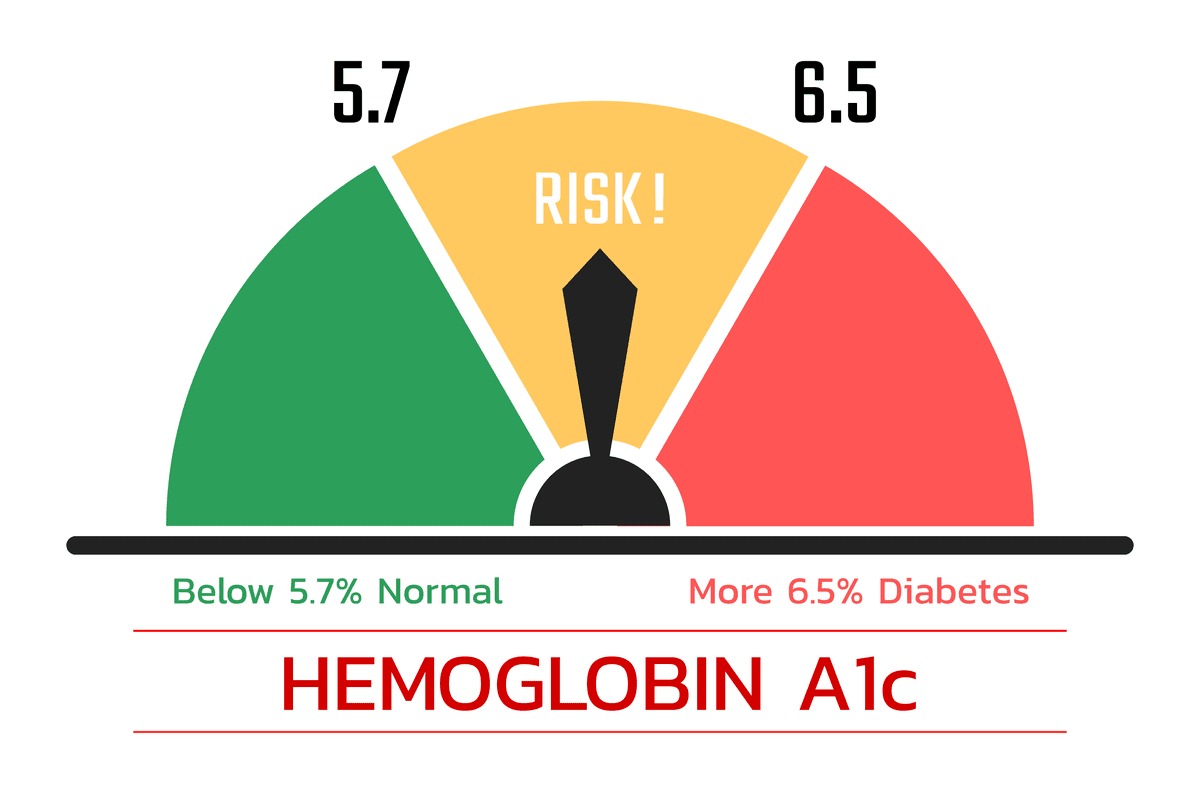
Normal range for HbA1c:

  • Non-diabetic: Less than 5.7%
  • Prediabetes: 5.7% to 6.4%
  • Diabetes: 6.5% or higher

Target HBA1C in Diabetes

T
In general, people with diabetes often aim for an HbA1c below 7%, but this can vary depending on individual goals.
Normal range of hba1c image

How is HBA1c formed(Biochemistry)?

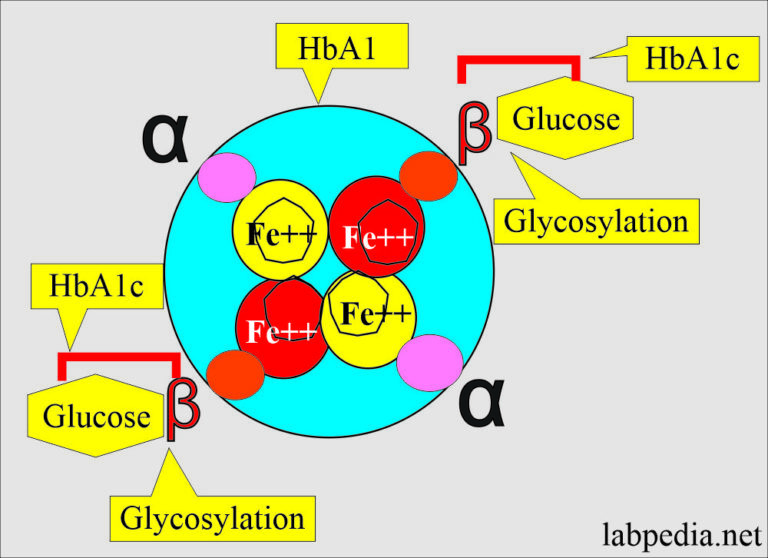
HbA1c, or glycated hemoglobin, forms when glucose (sugar) in the blood attaches to hemoglobin molecules in red blood cells. Hemoglobin is the protein that carries oxygen throughout the body, and it is found in red blood cells, which have an average lifespan of about 120 days. 
When blood sugar levels are high, more glucose binds to hemoglobin, forming HbA1c. This process, called glycation, happens gradually and is irreversible, meaning the HbA1c stays in the blood cells until they are replaced. 
Because this test reflects glucose attachment over the lifespan of the red blood cells, HbA1c levels are a useful indicator of average blood sugar over the past two to three months. 
This makes it a valuable measure in monitoring and managing conditions like diabetes, where blood sugar control is essential.

Here’s the formation of HbA1c step by step:

  • Glucose in Blood: Glucose (sugar) circulates in the bloodstream and is available to all cells in the body.
  • Interaction with Hemoglobin: In red blood cells, hemoglobin—a protein responsible for carrying oxygen—interacts with glucose.
  • Formation of Glycated Hemoglobin: When glucose attaches to hemoglobin, it forms a compound called glycated hemoglobin, or HbA1c.
  • Irreversible Bond: Once glucose binds to hemoglobin, the bond is irreversible, meaning the HbA1c stays attached until the red blood cell is replaced.
  • Lifespan of Red Blood Cells: Red blood cells live for about 120 days, so HbA1c reflects average blood sugar levels over the past 2 to 3 months.
  • Indicator of Blood Sugar Control: Because HbA1c shows long-term glucose levels, it is a key indicator in monitoring conditions like diabetes.

What increases the HbA1c?

High Blood Sugar Levels: Consistently elevated glucose levels, often due to uncontrolled diabetes or poor dietary choices, directly increase HbA1c.

What are the risk factors for high blood sugar levels?

  • Inadequate Diabetes Management: Insufficient insulin or other diabetes medications can lead to higher blood sugar, thus increasing HbA1c.
  • Lack of Physical Activity: Physical inactivity reduces the body’s ability to use glucose effectively, leading to higher blood sugar and HbA1c.
  • Poor Diet: Diets high in carbohydrates and sugary foods raise blood sugar, increasing HbA1c.
  • Stress: Physical or emotional stress can cause the body to release hormones like cortisol, which can increase blood sugar levels.
  • Illness or Infection: Acute illness or infection can temporarily raise blood sugar, contributing to higher HbA1c.
  • Hormonal Changes: Conditions like polycystic ovary syndrome (PCOS) or hormonal imbalances can impact insulin sensitivity, raising blood sugar and HbA1c.
  • Certain Medications: Drugs like steroids and some psychiatric medications can increase blood glucose levels and HbA1c.
  • Liver or Kidney Disease: These conditions can affect how the body processes glucose, potentially raising HbA1c.
  • Sleep Deprivation: Poor sleep quality or insufficient sleep can increase insulin resistance and blood sugar, leading to higher HbA1c.
normal range of hba1c image

Nepal Nursing Council License Exam Questions 2024

Model Question : Nepal Nursing Council License Exam Questions 2024

model image exam passed

Table of Content(toc)

What is the primary purpose of conducting a physical assessment during the admission process?

A) To establish a baseline for future assessments
B) To determine the financial capability of the patient
C) To prescribe medication
D) To identify social needs

Which of the following is an essential step when administering medications via intravenous (IV) route?

A) Ensure the patient drinks plenty of water
B) Check for drug allergies before administration
C) Place the patient in a semi-Fowler’s position
D) Ensure that the patient has had a meal before administration

Which vitamin is primarily synthesized by the skin when exposed to sunlight?

A) Vitamin C
C) Vitamin E
D) Vitamin K

A patient complains of chest pain and shortness of breath. What is the most appropriate initial nursing action?

A) Encourage the patient to take deep breaths
B) Notify the physician immediately
C) Administer oxygen and monitor vital signs
D) Give the patient water to drink

Which of the following vital signs is most indicative of hypovolemic shock?

A) Increased blood pressure and heart rate
B) Decreased blood pressure and increased heart rate
C) Decreased heart rate and blood pressure
D) Increased blood pressure and decreased heart rate

In Maslow’s hierarchy of needs, which of the following is considered a basic physiological need?

A) Self-esteem
B) Love and belonging
C) Safety and security
D) Food and water

What is the normal range for fasting blood glucose levels in adults?

A) 40-70 mg/dL
B) 70-100 mg/dL
C) 120-140 mg/dL
D) 140-160 mg/dL

Which of the following is a sign of hypokalemia?

A) Confusion
B) Muscle weakness
C) Hypertension
D) Diarrhea

When caring for a patient with a nasogastric (NG) tube, what is the best method to confirm tube placement before administering a feeding?

A) Check the pH of the aspirated content
B) Listen for bowel sounds
C) Check the patient’s breath sounds
D) Measure the patient’s blood pressure

A patient with tuberculosis is receiving rifampicin. Which of the following instructions should the nurse provide to the patient?

A) Expect urine and other body fluids to turn red-orange
B) Avoid all dairy products
C) Take the medication with meals
D) Limit fluid intake throughout the day

Answers: 

1. A  
2. B  
3. B  
4. C  
5. B  
6. D  
7. B  
8. B  
9. A  
10. A

Ayurvedic Medicine for Weight Loss: Lose weight in a Healthy Way Today

Ayurvedic Medicine for Weight Loss: Lets make healthy weight today (herbal)

Table of Contents(toc)
Ayurvedic Medicine for Weight Loss

What is healthy weight?

A healthy weight is the weight range where your body can function at its best, minimizing risks for chronic diseases and enhancing overall well-being. It’s determined by a mix of factors, including Body Mass Index (BMI), Waist-to-Height Ratio (WHtR), Waist-to-Hip Ratio (WHR), and body fat percentage, giving a fuller picture beyond just numbers on a scale.

BMI (Body Mass Index)

BMI is a widely used tool to categorize weight by dividing weight in kilograms by height in meters squared. A BMI of 18.5–24.9 is generally considered “healthy” for most adults. However, it doesn’t account for muscle mass or body composition, so other measures are often used alongside it.

WHtR (Waist-to-Height Ratio): 

This ratio compares waist circumference to height. A healthy WHtR is typically less than 0.5, indicating that waist circumference is less than half of your height. This can help assess abdominal fat, which has a strong link to health risks, especially heart disease and diabetes.

WHR (Waist-to-Hip Ratio): 

WHR is the ratio of waist circumference to hip circumference. A healthy WHR is generally below 0.9 for men and below 0.85 for women. Higher WHRs suggest more abdominal fat, a risk factor for various metabolic and cardiovascular conditions.

Body Fat Percentage: 

This measures the proportion of fat in the body. Healthy body fat ranges vary by age and gender but typically fall between 10–20% for men and 20–30% for women. Body fat measurement can provide more insight into body composition, as people with the same weight may have different fat and muscle distribution.
These measurements, used together, help determine if you’re at a healthy weight for your specific body type and lifestyle, offering a more accurate snapshot of your health than any single measure alone.

What ayurvedic medicines can reduce weight in healthy way?

Ayurveda offers several herbs and formulations that may support weight management in a holistic and gentle manner. These are usually meant to improve digestion, enhance metabolism, and balance the body’s internal energies without causing harsh side effects. Here are some widely recommended Ayurvedic options:

1. Triphala

  • About: A blend of three fruits—Amalaki (Amla), Bibhitaki, and Haritaki—triphala helps improve digestion, detoxifies the body, and supports regular bowel movements.
  • How It Helps: It enhances digestion and metabolism, allowing better nutrient absorption and waste elimination.
  • Use: Often taken as a powder mixed with warm water at night or as capsules.

2. Guggul (Commiphora Mukul)

  • About: Guggul is a resin from the Mukul myrrh tree known for its anti-inflammatory and metabolism-boosting properties.
  • How It Helps: It’s believed to support healthy cholesterol levels, improve thyroid function, and increase fat metabolism.
  • Use: Commonly available in tablet form or in combination with other herbs in Ayurvedic formulations like “Medohar Guggulu.”

3. Garcinia Cambogia (Vrikshamla)

  • About: This tropical fruit contains hydroxycitric acid (HCA), which may help suppress appetite.
  • How It Helps: It can reduce the body’s capacity to store fat and may help curb overeating.
  • Use: Often taken as a capsule or powdered supplement.

4. Ashwagandha (Withania Somnifera)

  • About: Known for its stress-relieving properties, ashwagandha helps regulate cortisol, the stress hormone.
  • How It Helps: By reducing stress, ashwagandha may prevent stress-induced eating and help balance weight.
  • Use: Typically taken as a powder or in capsule form.

5. Lemon and Honey in Warm Water

  • About: This classic Ayurvedic remedy helps cleanse the digestive tract and kickstart metabolism.
  • How It Helps: It stimulates digestion and acts as a natural detox, which may support weight loss.
  • Use: One teaspoon of honey and half a lemon in warm water each morning on an empty stomach.
herbal medicines

6. Vijaysar (Pterocarpus Marsupium)

  • About: Often used in diabetes management, vijaysar helps regulate blood sugar levels, which can indirectly support weight management.
  • How It Helps: Stabilizing blood sugar reduces cravings and prevents spikes in insulin.
  • Use: Available as a powder or tablet. Some people use a wooden tumbler made from vijaysar to drink water, which can further support metabolism.

7. Cinnamon (Dalchini) and Ginger (Adrak)

  • About: Both spices are known for boosting digestion and improving metabolism.
  • How They Help: Cinnamon helps stabilize blood sugar, while ginger aids digestion and can improve satiety.
  • Use: Add cinnamon powder or ginger to warm water or tea, or incorporate them into meals.

8. Mustak (Cyperus Rotundus)

  • About: Known as a digestive tonic, mustak is often used in Ayurvedic treatments for its ability to reduce fat accumulation.
  • How It Helps: It aids in breaking down excess fat tissue, improves digestion, and has mild laxative properties.
  • Use: Usually available in powder form; often taken with warm water.

Important Guidelines for Ayurvedic Weight Management

  • Follow a balanced diet and exercise:

   Ayurveda emphasizes that these herbs are most effective when used alongside a balanced diet rich in whole foods and regular physical activity.

Eating meals slowly and stopping when full is crucial for proper digestion.

  • Stay consistent

Herbal remedies typically work gradually, so consistency is key.

  • Exercise

  • Sleep

Always consult an Ayurvedic practitioner or healthcare provider before starting any new herbal regimen, as these can interact with other medications or conditions. Please consult with your ayurvedic or generalphysician before trying these regimen on your own.

Is Ayurvedic Medicine Safe?

Ayurvedic medicine has a long history of use, emphasizing a diet rich in whole foods, vegetables, whole grains, and lean proteins. This approach encourages moderation, mindful eating, and prioritizes prevention, physical activity, stress management, and balanced living, which are generally safe and beneficial for health.

However, it’s essential to approach Ayurvedic herbal preparations with caution, as they’re not regulated by the FDA. More studies are needed to confirm their safety and effectiveness.

When considering an Ayurvedic practitioner, research carefully, as most states in the U.S. don’t require a license for Ayurvedic practice, nor is there federal certification or licensure. Discuss any Ayurvedic recommendations with your doctor to ensure they’re suitable for your individual health needs.

Wounds and gangrene, general principle of management of wounds, wounds classification

Wounds and gangrene, general principle of management of wounds, wounds classification in nepali

Table of Contents(toc)
steps of wound healing

Introduction

A wound is an injury to the body’s tissue, often involving a break in the skin or damage to underlying structures.
A wound is an injury to the body’s tissue, often involving a break in the skin or damage to underlying structures. 
Wounds can result from various causes, including cuts, burns, or accidents. 
Proper care and hygiene are essential for promoting healing and preventing infection, which can complicate recovery. 
types of wounds
Depending on the severity, wounds may require medical treatment, such as stitches or antibiotics, to aid the healing process.

Types of wound

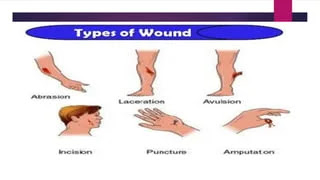
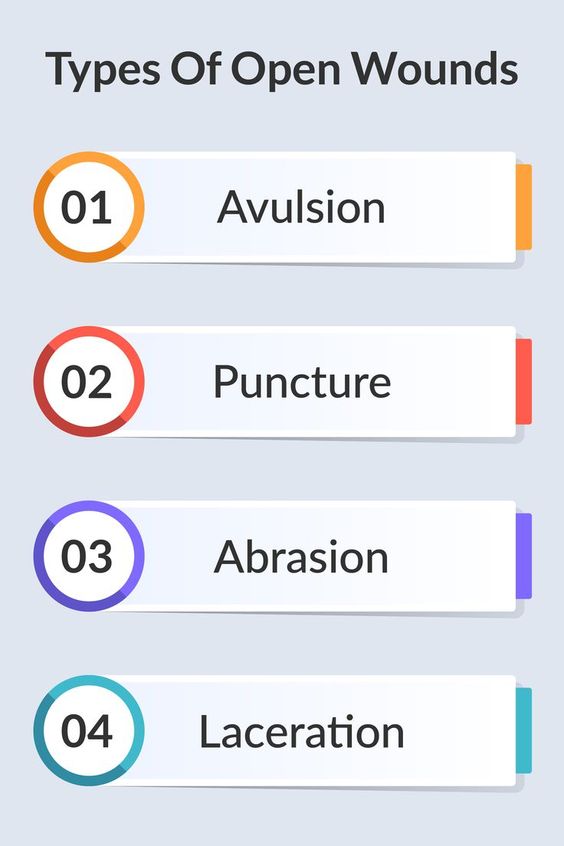
Various types of wound can be listed as below
  1. Abrasion
  2. Laceration
  3. Incision
  4. Puncture
  5. Avulsion
  6. Contusion (bruise)
  7. Penetrating wound
  8. Gunshot wound
types of wounds

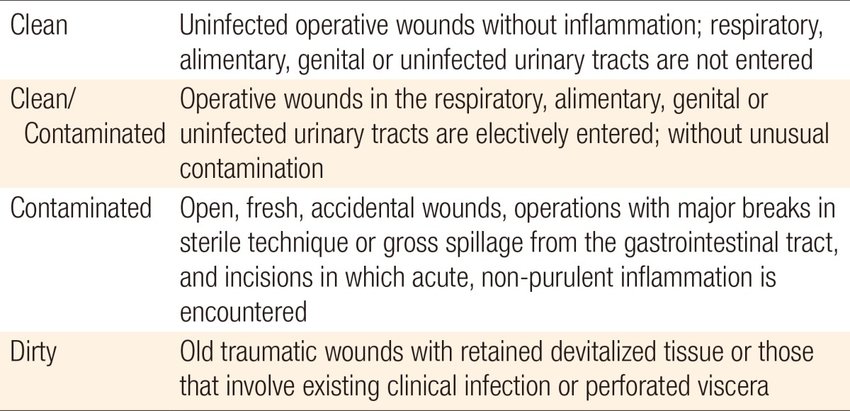
Types of surgical wound 

types of surgical wounds
  1. Clean wound
  2. Clean-contaminated wound
  3. Contaminated wound
  4. Dirty or infected wound

Steps of wound healing 

  1. Hemostasis
  2. Inflammation
  3. Proliferation
  4. Maturation (or Remodeling)

Signs of wound infection

  1. Redness
  2. Swelling
  3. Warmth
  4. Pain or tenderness
  5. Pus or discharge
  6. Foul odor
  7. Fever
  8. Delayed healing

Role of antibiotics in wound healing

Antibiotics help prevent or treat infections in wounds. They kill or stop the growth of bacteria, which can slow down healing.
By keeping the wound free from infection, antibiotics allow the body to repair the tissue more effectively and reduce the risk of complications.

Factors affecting wound healing

  1. Age
  2. Nutrition
  3. Oxygen supply
  4. Infection
  5. Chronic diseases (e.g., diabetes)
  6. Medications (e.g., steroids)
  7. Moisture balance
  8. Blood flow
  9. Wound size and depth
  10. Presence of foreign bodies
  11. Stress
  12. Smoking

Powerpoint on Wounds and gangrene, general principle of management of wounds

Exit mobile version