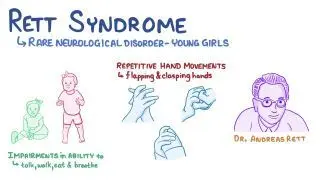
Rett Syndrome Notes for MD and DM level

Rett Syndrome

Definition

Rett syndrome is a neurodevelopmental disorder that primarily affects girls, characterized by normal early development followed by regression of acquired skills, especially speech and purposeful hand movements, with onset typically between 6–18 months of age.


Etiology

  • Genetic cause: Mutation in MECP2 gene (methyl-CpG-binding protein 2) on the X chromosome (Xq28)

  • Inheritance: Usually sporadic (de novo); rarely familial

  • Pathophysiology: Dysfunction of MECP2 protein → abnormal brain maturation and synaptic development


Epidemiology

  • Affects 1 in 10,000–15,000 female births

  • Lethal in males (most do not survive infancy unless mosaic or XXY)


Clinical Features

Phases of Disease

  1. Early Onset (6–18 months)

    • Normal development initially

    • Gradual loss of interest in surroundings

    • Loss of purposeful hand skills

    • Deceleration of head growth (acquired microcephaly)

  2. Rapid Destructive Phase (1–4 years)

    • Loss of speech and purposeful hand use

    • Stereotyped hand movements: hand-wringing, washing, clapping, or mouthing

    • Gait ataxia, truncal apraxia

    • Autistic-like behavior

  3. Plateau Phase (2–10 years)

    • Some improvement in social interaction and eye contact

    • Persistent motor problems and seizures

  4. Late Motor Deterioration (>10 years)

    • Progressive scoliosis, muscle wasting, rigidity, dystonia

    • Loss of ambulation in many cases


Other Features

  • Breathing abnormalities: hyperventilation, apnea during wakefulness

  • Seizures: common (up to 90%)

  • Bruxism, cold/purple extremities (autonomic dysfunction)

  • Sleep disturbances

  • Growth retardation


Investigations

  • Genetic testing: MECP2 mutation analysis (diagnostic)

  • EEG: slowing with epileptiform activity

  • MRI brain: may show nonspecific atrophy

  • Metabolic tests: normal (to rule out other causes)


Diagnosis

  • Clinical + confirmed MECP2 mutation

  • Diagnostic criteria include:

    • Regression after normal early development

    • Loss of purposeful hand skills and spoken language

    • Gait abnormalities

    • Stereotypic hand movements


Differential Diagnosis

  • Autism spectrum disorder

  • Angelman syndrome

  • Cerebral palsy (especially ataxic type)

  • Childhood disintegrative disorder


Management

  • No cure – supportive and multidisciplinary care

    • Physiotherapy & occupational therapy: maintain mobility

    • Speech therapy: communication support (eye-tracking devices)

    • Antiepileptics: for seizures

    • Nutritional support: adequate calories, manage feeding difficulties

    • Behavioral therapy: improve interaction

    • Orthopedic care: for scoliosis, contractures


Prognosis

  • Progressive but non-degenerative

  • Life expectancy: many survive into adulthood (40–50 years)

  • Main causes of death: sudden unexplained death, pneumonia, cardiac arrhythmias


Mnemonic (Key features)“RETT”

  • R = Regression (speech, hand skills)

  • E = Episodic breathing abnormalities

  • T = Typical hand movements (wringing, washing)

  • T = Tiny head (acquired microcephaly)

Hypothyroidism in Neonates and Children

Table of Contents(toc)

1. Definition

Hypothyroidism is a clinical state resulting from deficiency of thyroid hormone production or action, leading to a generalized slowing of metabolic processes.

It may be:

  • Congenital (Neonatal) – present at birth.

  • Acquired (Childhood) – develops later due to autoimmune, iatrogenic, or other causes.


2. Classification

A. Based on Level of Defect

Type Site of Defect TSH T4/T3
Primary Thyroid gland
Secondary Pituitary ↓/N
Tertiary Hypothalamus ↓/N
Peripheral (Resistance) Target tissue N/↑ N/↑

B. Based on Onset

  • Congenital hypothyroidism (CH)

  • Acquired hypothyroidism


3. Epidemiology

  • CH: ~1 in 2,000–4,000 live births.

  • More common in females.

  • Acquired form common in older children/adolescents, often autoimmune (Hashimoto’s).

thyroid gland


4. Etiology

A. Congenital Hypothyroidism

  1. Thyroid dysgenesis (80–85%)

    • Agenesis, ectopy, or hypoplasia.

    • Usually sporadic.

  2. Dyshormonogenesis (10–15%)

    • Inborn errors of thyroid hormone synthesis (autosomal recessive).

    • E.g. TPO, TG, Pendrin, NIS mutations.

  3. Central hypothyroidism (rare)

    • Pituitary/hypothalamic malformation, midline defects.

  4. Transient CH

    • Iodine excess/deficiency, maternal antibodies or antithyroid drugs.

  5. Thyroid hormone resistance – extremely rare.

B. Acquired Hypothyroidism

  • Autoimmune thyroiditis (Hashimoto’s) – most common.

  • Iodine deficiency/excess.

  • Post-irradiation or post-surgical.

  • Drugs: amiodarone, lithium, interferon-α.

  • Secondary causes: pituitary tumors, craniopharyngioma.


5. Pathophysiology

↓ Thyroid hormone → ↓ metabolic activity → impaired CNS myelination, growth retardation, delayed bone maturation.

  • In neonates: irreversible neurodevelopmental impairment if untreated.

  • In older children: growth failure and delayed puberty predominate.


6. Clinical Features

A. Neonatal / Congenital

Often asymptomatic at birth due to transplacental maternal T4.

Typical features (develop over weeks):

  • Prolonged jaundice

  • Lethargy, hypotonia

  • Feeding difficulty, constipation

  • Large fontanelles

  • Macroglossia

  • Umbilical hernia

  • Cold, dry skin

  • Hoarse cry

  • Poor growth

  • Delayed bone age

  • Delayed milestones (later)

B. Childhood / Acquired

  • Growth retardation, short stature

  • Weight gain with poor height velocity

  • Fatigue, cold intolerance

  • Constipation

  • Dry skin, coarse hair

  • Bradycardia

  • Delayed puberty / menstrual irregularities

  • Pseudoprecocious puberty (rare, due to high TRH → prolactin ↑)

  • Goiter (especially in Hashimoto’s)


7. Investigations

A. Screening

  • Neonatal screening: heel-prick sample at 48–72 hr.

    • Primary TSH (most programs).

    • Elevated TSH → confirm with serum free T4.

B. Diagnostic Tests

Test Interpretation
Serum TSH, Free T4 ↓T4 with ↑TSH → primary hypothyroidism
T3 less reliable in neonates
Thyroglobulin Low in agenesis, high in dyshormonogenesis
Imaging Thyroid scan (99mTc or I-123) – ectopy, agenesis, uptake defects
Ultrasound Gland location and size
Antibodies (TPO, Tg) Positive in autoimmune
Bone age X-ray Delayed
Additional: Pituitary MRI if central hypothyroidism suspected

8. Complications (if untreated)

  • Neurologic: irreversible intellectual disability, deaf-mutism, spasticity.

  • Growth: severe stunting, delayed bone age.

  • Metabolic: dyslipidemia.

  • Cardiac: bradycardia, pericardial effusion.


9. Management

A. Principles

  • Early, adequate, lifelong replacement.

  • Monitor and titrate carefully to maintain euthyroid state.

B. Drug

  • Levothyroxine (L-T4) – drug of choice.

    • Dose:

      • Neonates: 10–15 µg/kg/day.

      • Infants: 8–10 µg/kg/day.

      • Children: 4–6 µg/kg/day.

      • Adolescents: 2–4 µg/kg/day.

    • Given on empty stomach (preferably crushed with water or milk).

C. Monitoring

Age Frequency Parameters
0–6 mo Every 2 wk till T4 normal, then q1–2 mo T4, TSH
6–12 mo q2–3 mo
1–3 yr q3–4 mo
>3 yr q6–12 mo

Target: Free T4 in upper half of normal range, TSH normal.

D. Developmental Follow-up

  • Neurodevelopmental assessment

  • Hearing evaluation

  • Growth chart monitoring


10. Prognosis

  • Normal IQ if therapy started within first 2 weeks of life.

  • Delay in treatment → irreversible intellectual deficit.

  • Acquired forms usually fully reversible with treatment.


11. Key Differentials

  • Pituitary insufficiency

  • Hypothyroxinemia of prematurity

  • Chronic systemic illness (euthyroid sick syndrome)

  • Constitutional growth delay


12. Summary Table

Feature Congenital Acquired
Onset Birth Childhood/adolescence
Cause Dysgenesis > dyshormonogenesis Hashimoto’s most common
Presentation Lethargy, constipation, macroglossia Growth failure, delayed puberty
TSH High High
T4 Low Low
Rx Levothyroxine Levothyroxine
Prognosis Excellent if early Excellent

References

  1. Nelson Textbook of Pediatrics, 22nd ed.

  2. Indian Academy of Pediatrics Guidelines (2021) — Screening and management of congenital hypothyroidism.

  3. Endocrine Society Clinical Practice Guideline (2020) – Congenital Hypothyroidism.

  4. Sperling MA, Pediatric Endocrinology, 5th ed.

Exit mobile version