Top 5 MCQ for mbbs loksewa 2081: Most important MCQ Free

Here are top 5 MCQs that can be asked in MBBS medical officer exam

Top 5 MCQ for mbbs loksewa 2080

1. Which of the following is a characteristic feature of Hashimoto’s thyroiditis? 

A) Thyrotoxicosis 

B Hypocalcemia 

C) Elevated thyroid-stimulating hormone (TSH) 

D) Hyperthyroidism

2. Which of the following is the primary pharmacological treatment for essential tremor? 

A) Propranolol 

B Levodopa/carbidopa 

C) Diazepam 

D) Phenytoin

3. Which of the following is the most common cause of acute liver failure in the United States? 

A) Hepatitis A virus 

B Acetaminophen toxicity 

C) Hepatitis B virus 

D) Alcoholic liver disease

4. Which of the following is a characteristic feature of systemic lupus erythematosus (SLE)? 

A) Anti-glomerular basement membrane antibodies 

B Malar rash

C) Negative antinuclear antibodies (ANA) 

D) Thrombocytosis

5. Which of the following medications is a first-line treatment for attention deficit hyperactivity disorder (ADHD) in children? 

A) Atomoxetine 

B Clonidine 

C) Olanzapine 

D) Methylphenidate

Join health preparations facebook group

Comment your answers below.

How to see NTC number : How to see ntc number in mobile in 2024?

How  to see NTC number :How to see NTC number in mobile. 2024/2081

Table of Contents(toc)

Introduction

Nepal Telecom, as the leading telecommunication service provider in Nepal, plays a pivotal role in connecting people across the country. With its extensive network infrastructure, Nepal Telecom ensures reliable communication services, including voice, data, and internet, catering to the diverse needs of its customers. Its commitment to innovation is evident through the introduction of modern technologies and services, enhancing connectivity and accessibility nationwide. As a trusted entity, Nepal Telecom is dedicated to serving the community by offering affordable and high-quality telecommunication solutions, empowering individuals and businesses alike. With a vision to bridge the digital divide, Nepal Telecom continues to strive towards advancing the telecommunications landscape in Nepal, fostering socio-economic development and progress.

How to check own number in NTC nepal telecom sim?

To check your own number on Nepal Telecom (NTC) SIM card, you can use the following methods:
(ads1)

  • Dial USSD Code: 

Dial *9# and press the call button from your NTC SIM card. This USSD code will display your own mobile number on the screen.

  • Send SMS

You can send an SMS with any text (such as “NUM”) to 1415. Shortly after sending the message, you will receive an SMS containing your own mobile number.

  • Call Customer Service

You can also call Nepal Telecom’s customer service hotline at 1498 and inquire about your mobile number. The customer service representative will assist you in retrieving your number.

  • Call someone else’s number 

Alternatively, you cal dial someone else  whom you know and then ask them which number is it. 
As simple as that
These methods should help you easily find out your own mobile number associated with your NTC SIM card.
(ads2)

How to check own number in NTC nepal telecom sim

COnclusion

You can use any of above four methods to know your number.

MODEL Question for NMCLE license examination NEpal 2081

MODEL Question for NMCLE license examination NEpal 2081 Part 1

1. Which of the following is the primary causative organism responsible for infective endocarditis in intravenous drug users?
   A) Streptococcus pneumoniae
   B) Staphylococcus aureus
   C) Escherichia coli
   D) Pseudomonas aeruginosa
2. Which of the following is the first-line treatment for uncomplicated malaria caused by Plasmodium falciparum?
   A) Chloroquine
   B) Quinine
   C) Artemisinin-based combination therapy
   D) Doxycycline
3. Which of the following is a characteristic feature of chronic obstructive pulmonary disease (COPD)?
   A) Increased forced expiratory volume in 1 second (FEV1)
   B) Decreased residual volume
   C) Reversibility with bronchodilator therapy
   D) Pink puffer phenotype
4. Which of the following conditions is characterized by a positive Babinski reflex?
   A) Guillain-Barré syndrome
   B) Amyotrophic lateral sclerosis (ALS)
   C) Multiple sclerosis
   D) Spinal cord injury
5. Which of the following is the most common type of skin cancer?
   A) Basal cell carcinoma
   B) Squamous cell carcinoma
   C) Melanoma
   D) Kaposi sarcoma
6. Which of the following is a common side effect of angiotensin receptor blockers (ARBs)?
   A) Dry cough
   B) Hyperkalemia
   C) Bradycardia
   D) Peripheral edema
7. Which of the following is the most appropriate initial management for a patient with acute pancreatitis?
   A) Total parenteral nutrition
   B) N-acetylcysteine
   C) Bowel rest and intravenous fluids
   D) Oral metoclopramide
8. Which of the following is the primary mechanism of action of selective serotonin reuptake inhibitors (SSRIs) in the treatment of depression?
   A) Inhibition of monoamine oxidase
   B) Blockade of alpha-adrenergic receptors
   C) Enhancement of serotonin neurotransmission
   D) Inhibition of dopamine reuptake
9. Which of the following is a common side effect of long-term corticosteroid therapy?
   A) Hypotension
   B) Hypokalemia
   C) Osteoporosis
   D) Hyperglycemia
10. Which of the following is the most common cause of acute bacterial meningitis in neonates?
    A) Group B Streptococcus
    B) Escherichia coli
    C) Listeria monocytogenes
    D) Haemophilus influenzae
11. Which of the following is a key feature of sarcoidosis?
    A) Periosteal reaction on X-ray
    B) Noncaseating granulomas on biopsy
    C) Positive antinuclear antibodies (ANA)
    D) Bilateral hilar lymphadenopathy on chest X-ray
12. Which of the following medications is commonly used for the prophylaxis of migraine headaches?
    A) Gabapentin
    B) Amitriptyline
    C) Sumatriptan
    D) Propranolol
13. Which of the following is the most common etiology of acute hepatitis worldwide?
    A) Hepatitis A virus
    B) Hepatitis B virus
    C) Hepatitis C virus
    D) Hepatitis E virus
14. Which of the following is a characteristic feature of Turner syndrome?
    A) Short stature and webbed neck
    B) Tall stature and ovarian dysgenesis
    C) Polydactyly and intellectual disability
    D) Microcephaly and hypertelorism
15. Which of the following is the primary treatment for uncomplicated urinary tract infections in pregnant women?
    A) Ciprofloxacin
    B) Nitrofurantoin
    C) Gentamicin
    D) Trimethoprim-sulfamethoxazole
16. Which of the following is the most common cause of primary hyperaldosteronism?
    A) Adrenal adenoma
    B) Pituitary adenoma
    C) Renal artery stenosis
    D) Hypothalamic dysfunction
17. Which of the following is a characteristic feature of acute intermittent porphyria?
    A) Photosensitivity and bullous skin lesions
    B) Erythema migrans rash and arthritis
    C) Abdominal pain and neuropsychiatric symptoms
    D) Renal colic and hematuria
18. Which of the following is the primary pharmacological treatment for trigeminal neuralgia?
    A) Carbamazepine
    B) Gabapentin
    C) Amitriptyline
    D) Baclofen
19. Which of the following conditions is characterized by the presence of anti-cyclic citrullinated peptide (anti-CCP) antibodies?
    A) Rheumatoid arthritis
    B) Systemic lupus erythematosus
    C) Sjögren’s syndrome
    D) Ankylosing spondylitis
20. Which of the following is the primary mechanism of action of loop diuretics?
    A) Inhibition of carbonic anhydrase
    B) Inhibition of sodium-potassium-chloride cotransporter
    C) Inhibition of sodium-glucose cotransporter
    D) Inhibition of sodium reabsorption in the ascending loop of Henle
Answer Key:
1. B) Staphylococcus aureus
2. C) Artemisinin-based combination therapy
3. D) Pink puffer phenotype
4. A) Guillain-Barré syndrome
5. A) Basal cell carcinoma
6. B) Hyperkalemia
7. C) Bowel rest and intravenous fluids
8. C) Enhancement of serotonin neurotransmission
9. C) Osteoporosis
10. A) Group B Streptococcus
11. B) Noncaseating granulomas on biopsy
12. D) Propranolol
13. A) Hepatitis A virus
14. A) Short stature and webbed neck
15. B) Nitrofurantoin
16. A) Adrenal adenoma
17. C) Abdominal pain and neuropsychiatric symptoms
18. A) Carbamazepine
19. A) Rheumatoid arthritis
20. D) Inhibition of sodium reabsorption in the ascending loop of Henle

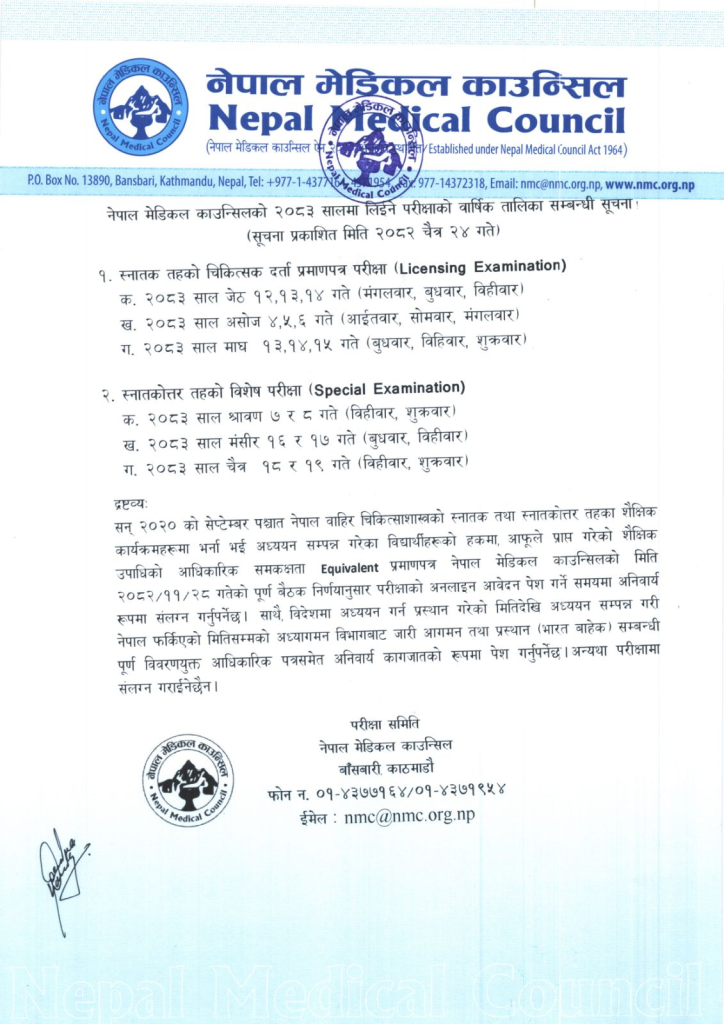
NMC license examination schedule for 2083: Nepal medical Council

Introduction

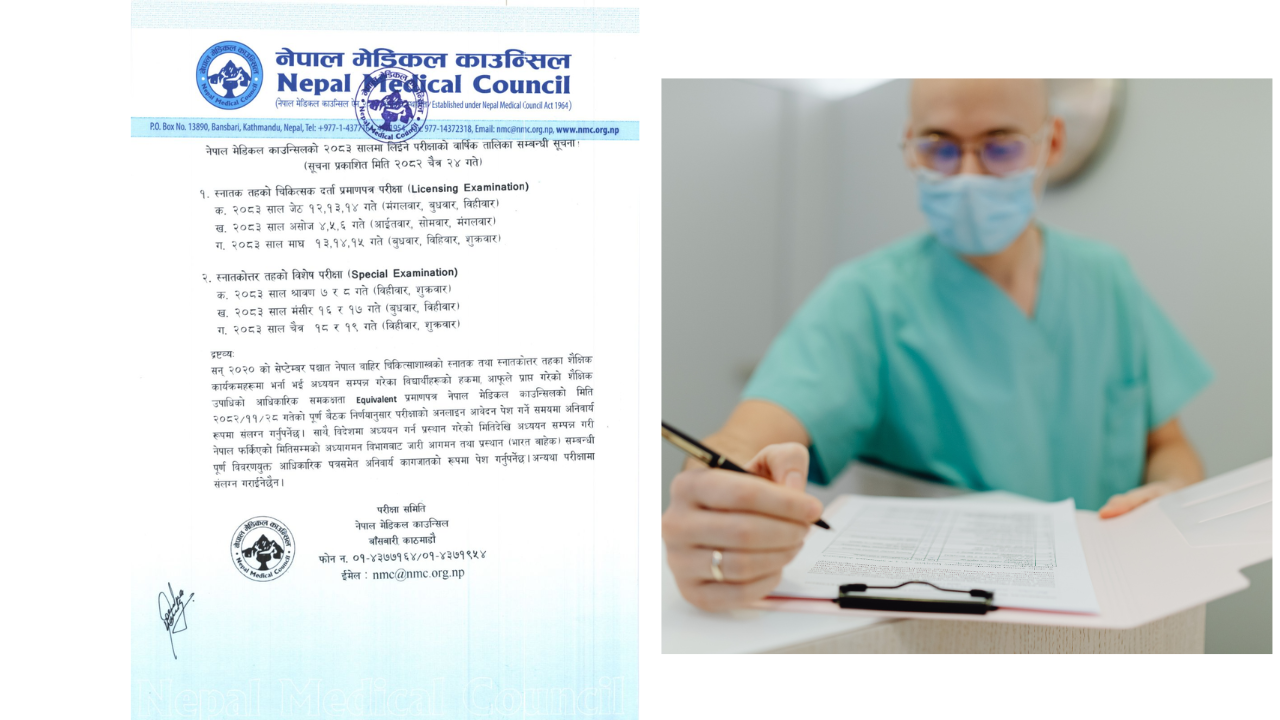
Today, Nepal medical Council has published or notice regarding schedule of Nepal medical Council license examination for doctors and dental surgeons to be registered in Nepal.

The schedule presents the three different date for doctors to be registered here in Nepal.

According to law, all of the doctors and dentist must undergo this examination and pass it to be able to practice in Nepal after they have cleared their university examination.

What is NMC?

Nepal medical Council is the governing body of Nepal to license the doctors and dentist here in Nepal.

In the notice they have also schedule for special examination wise is held for doctors who have completed their postgraduate degree.

The specialist doctors who have completed your MD or MS from different institute, including Nepal and foreign must undergo this examination and passage to be able to practice as the specialist.

Nepal medical Council also has opened the license examination notice for the 69th license examination for undergraduate level.

How is NMC examination conducted?

This examination will be held in the near future, and this examination will be based.

Nepal medical Council is conducting computer based examination who is based on MCQ For last several years.

What is the examination date for NMCE licensing examination?

This examination will be held in May 20-22 2024, also in Nepali date seventh, seventh, eighth, and ninth of Jestha 2081. 

The last date of submission of form for NMCLE licensing examination is given below

How to fill of NMCLE licensing examination form?

The student should submit the final certificate if they have passed MBBS or BDS from a foreign university.

They must also submit internship completion certificate as mandatory for the NMCLE licensing examination.

The doctors cannot submit the physical form and only online forms are acceptable.

The fee for NMCLE licensing examination is 3500 rupees.  (sunject to change)

To fill of the form for Ncell licensing examination for undergraduate level, please visit the following link or click here to go to the NMC licensing examination form Fill up portal.

If you have any question regarding NMC examination, please feel free to ask us

Please read the detailed notice below

To see and read more about NMCLE, click here

Nmc license examination result

Know more about NMC click here

To practise model question Click here

NMC Exam Model quewstion set 2 

To see syllabus of NMCLE examination, please click here.

Thank you for reading, please check my Facebook, Instagram, and YouTube channel

Feel free to like Share and subscribe

Put your thought in the comment section below

I am Dr Chaitanya Joshi doctor in Nepal.

NMCLE Model Questions : NMCLE license exam Nepal

Here are 50 multiple choice questions suitable for a medical graduate

1. Which of the following is the primary neurotransmitter involved in the pathophysiology of Alzheimer’s disease?

   A) Serotonin

   B) Dopamine

   C) Acetylcholine

   D) GABA

2. Which of the following is the drug of choice for treating acute asthma exacerbations?

   A) Albuterol

   B) Montelukast

   C) Ipratropium

   D) Fluticasone

3. In which part of the nephron does glucose reabsorption primarily occur?

   A) Proximal convoluted tubule

   B) Loop of Henle

   C) Distal convoluted tubule

   D) Collecting duct

4. Which of the following hormones is responsible for the regulation of calcium levels in the blood?

   A) Insulin

   B) Thyroxine

   C) Parathyroid hormone

   D) Aldosterone

5. Which of the following is the most common type of kidney stone?

   A) Uric acid

   B) Calcium oxalate

   C) Cystine

   D) Struvite

6. Which of the following is a characteristic of rheumatoid arthritis?

   A) Presence of HLA-B27 antigen

   B) Symmetric joint involvement

   C) Presence of tophi

   D) Joint deformities with sparing of the small joints

7. Which of the following is a first-line treatment for uncomplicated urinary tract infections?

   A) Ciprofloxacin

   B) Trimethoprim-sulfamethoxazole

   C) Ampicillin

   D) Metronidazole

8. Which of the following is the most common cause of community-acquired pneumonia?

   A) Streptococcus pneumoniae

   B) Haemophilus influenzae

   C) Legionella pneumophila

   D) Mycoplasma pneumoniae

9. Which of the following is a characteristic of Addison’s disease?

   A) Hyperpigmentation

   B) Hypertension

   C) Hypernatremia

   D) Hyperglycemia

10. Which of the following conditions is characterized by a deficiency of von Willebrand factor?

    A) Hemophilia A

    B) Hemophilia B

    C) von Willebrand disease

    D) Factor V Leiden deficiency

11. Which of the following is the most accurate method for confirming the diagnosis of peptic ulcer disease?

    A) Upper gastrointestinal endoscopy

    B) Barium swallow

    C) Serum gastrin levels

    D) Stool antigen test for H. pylori

12. Which of the following is the first-line treatment for acute otitis media in children?

    A) Amoxicillin

    B) Azithromycin

    C) Ceftriaxone

    D) Trimethoprim-sulfamethoxazole

13. Which of the following is a classic triad of symptoms seen in Parkinson’s disease?

    A) Bradykinesia, hyperreflexia, and dystonia

    B) Resting tremor, bradykinesia, and rigidity

    C) Ataxia, nystagmus, and dysarthria

    D) Hyperkinesia, chorea, and athetosis

14. Which of the following is the most appropriate initial management for a patient with status epilepticus?

    A) Intravenous lorazepam

    B) Intramuscular diazepam

    C) Oral phenytoin

    D) Subcutaneous midazolam

15. Which of the following is the primary mechanism of action of aspirin in cardiovascular disease prevention?

    A) Inhibition of platelet aggregation

    B) Decrease in LDL cholesterol levels

    C) Vasodilation of coronary arteries

    D) Enhancement of fibrinolysis

16. Which of the following is a key feature of acute tubular necrosis?

    A) Elevation of serum uric acid levels

    B) Oliguria with muddy brown casts in urine

    C) Hyperkalemia

    D) Hypoalbuminemia

17. Which of the following medications is contraindicated in patients with a sulfa allergy?

    A) Furosemide

    B) Lisinopril

    C) Metoprolol

    D) Amlodipine

18. Which of the following conditions is associated with Cushing’s syndrome?

    A) Hypocortisolism

    B) Hypertension

    C) Hyperkalemia

    D) Hypoglycemia

19. Which of the following vaccines is recommended for all adults over 65 years of age?

    A) Varicella

    B) MMR (measles, mumps, rubella)

    C) Pneumococcal polysaccharide

    D) Human papillomavirus (HPV)

20. Which of the following is the most common cause of bacterial meningitis in adults?

    A) Streptococcus pneumoniae

    B) Neisseria meningitidis

    C) Haemophilus influenzae

    D) Listeria monocytogenes

21. Which of the following is a common side effect of statin therapy?

    A) Hyperkalemia

    B) Rhabdomyolysis

    C) Hypoglycemia

    D) Hypertension

22. Which of the following is a characteristic feature of nephrotic syndrome?

    A) Hematuria

    B) Proteinuria >3.5 grams per day

    C) Hypoalbuminemia

    D) Hyperkalemia

23. Which of the following is the primary pharmacological treatment for bipolar disorder?

    A) Sertraline

    B) Lithium

    C) Fluoxetine

    D) Venlafaxine

24. Which of the following conditions is characterized by the presence of anti-glomerular basement membrane antibodies?

    A) Goodpasture syndrome

    B) Wegener’s granulomatosis

    C) Henoch-Schönlein purpura

    D) Microscopic polyangiitis

25. Which of the following is the primary treatment for uncomplicated acute appendicitis?

    A) Intravenous antibiotics

    B) Laparoscopic appendectomy

    C) Observation and supportive care

    D) Oral corticosteroids

26. Which of the following is a key feature of type 1 diabetes mellitus?

    A) Insulin resistance

    B) Ketosis-prone state

    C) Obesity

    D) Gradual onset of symptoms

27. Which of the following is a characteristic feature of multiple sclerosis?

    A) Asymmetric motor weakness

    B) Normal cerebrospinal fluid analysis

    C) Improvement of symptoms with exercise

    D) Peripheral neuropathy

28. Which of the following is the most common site for ectopic pregnancy?

    A) Fallopian tube

    B) Ovary

    C) Uterine cervix

    D) Abdominal cavity

29. Which of the following medications is commonly used for the treatment of attention deficit hyperactivity disorder (ADHD)?

    A) Risperidone

    B) Methylphenidate

    C) Lamotrigine

    D) Fluoxetine

30. Which of the following is a key feature of Kawasaki disease?

    A) Desquamation of the skin of the palms and soles

    B) Target-like lesions on the mucous membranes

    C) Pitting edema of the lower extremities

    D) Oral ulcers

31. Which of the following is the most common cause of chronic kidney disease worldwide?

    A) Diabetic nephropathy

    B) Hypertensive nephrosclerosis

    C) Glomerulonephritis

    D) Polycystic kidney disease

32. Which of the following is a first-line treatment for acute angle-closure glaucoma?

    A) Timolol eye drops

    B) Acetazolamide

    C) Pilocarpine eye drops

    D) Latanoprost eye drops

33. Which of the following is a characteristic feature of preeclampsia?

    A) Hypertension and proteinuria after 20 weeks of gestation

    B) Severe abdominal pain and vaginal bleeding

    C) Absent fetal heart sounds

    D) Excessive fetal movement

34. Which of the following is the primary mechanism of action of methotrexate in the treatment of rheumatoid arthritis?

    A) Inhibition of cyclooxygenase

    B) Suppression of T cell activation

    C) Stimulation of insulin secretion

    D) Enhancement of serotonin reuptake

35. Which of the following is a key feature of acute pancreatitis?

    A) Hypocalcemia

    B) Hypoglycemia

    C) Hypernatremia

    D) Hyperbilirubinemia

36. Which of the following is a common side effect of angiotensin-converting enzyme (ACE) inhibitors?

    A) Hyperkalemia

    B) Hypocalcemia

    C) Hypertension

    D) Hyperglycemia

37. Which of the following is the most common risk factor for developing primary open-angle glaucoma?

    A) Myopia

    B) Diabetes mellitus

    C) Hypertension

    D) Age

38. Which of the following is the first-line treatment for anaphylaxis?

    A) Epinephrine

    B) Diphenhydramine

    C) Albuterol

    D) Prednisone

39. Which of the following is the primary mechanism of action of warfarin?

    A) Inhibition of vitamin K epoxide reductase

    B) Inhibition of thromboxane A2 synthesis

    C) Inhibition of platelet aggregation

    D) Enhancement of fibrinolysis

40. Which of the following conditions is associated with an elevated erythrocyte sedimentation rate (ESR) and C-reactive protein (CRP)?

    A) Polycythemia vera

    B) Temporal arteritis

    C) Essential thrombocythemia

    D) Iron deficiency anemia

41. Which of the following is the primary mechanism of action of inhaled corticosteroids in the treatment of asthma?

    A) Inhibition of leukotriene synthesis

    B) Inhibition of mast cell degranulation

    C) Suppression of airway inflammation

    D) Relaxation of bronchial smooth muscle

42. Which of the following is a characteristic feature of Graves’ disease?

    A) Low serum T3 and T4 levels

    B) Hypotension

    C) Exophthalmos

    D) Bradycardia

43. Which of the following is the most appropriate initial management for a patient with suspected acute coronary syndrome?

    A) Aspirin and nitroglycerin

    B) Intravenous heparin

    C) Inhaled albuterol

    D) Oral metoprolol

44. Which of the following is the most common cause of bacterial meningitis in neonates?

    A) Group B Streptococcus

    B) Escherichia coli

    C) Listeria monocytogenes

    D) Haemophilus influenzae

45. Which of the following is a key feature of Guillain-Barré syndrome?

    A) Ascending muscle weakness and areflexia

    B) Progressive dementia and ataxia

    C) Fluctuating muscle weakness and fatigability

    D) Sensory loss and autonomic dysfunction

46. Which of the following is the primary mechanism of action of alendronate in the treatment of osteoporosis?

    A) Inhibition of osteoclast activity

    B) Stimulation of osteoblast activity

    C) Inhibition of vitamin D synthesis

    D) Enhancement of calcium absorption

47. Which of the following is a characteristic feature of polycystic ovary syndrome (PCOS)?

    A) Hypermenorrhea

    B) Hypogonadism

    C) Hyperglycemia

    D) Multiple ovarian cysts on ultrasound

48. Which of the following is a common side effect of selective serotonin reuptake inhibitors (SSRIs)?

    A) Weight gain

    B) Bradycardia

    C) Hypotension

    D) Sexual dysfunction

49. Which of the following is the most appropriate initial management for a patient with diabetic ketoacidosis (DKA)?

    A) Intravenous insulin and fluid replacement

    B) Oral hypoglycemic agents

    C) Intramuscular glucagon

    D) Oral sodium bicarbonate

50. Which of the following is a key feature of acute angle-closure glaucoma?

    A) Gradual onset of symptoms

    B) Blurred vision and halos around lights

    C) Normal intraocular pressure

    D) Improvement of symptoms with mydriatics

Answer Key:

1. C) Acetylcholine

2. A) Albuterol

3. A) Proximal convoluted tubule

4. C) Parathyroid hormone

5. B) Calcium oxalate

6. B) Symmetric joint involvement

7. B) Trimethoprim-sulfamethoxazole

8. A) Streptococcus pneumoniae

9. A) Hyperpigmentation

10. C) von Willebrand disease

11. A) Upper gastrointestinal endoscopy

12. A) Amoxicillin

13. B) Resting tremor, bradykinesia, and rigidity

14. A) Intravenous lorazepam

15. A) Inhibition of platelet aggregation

16. B) Oliguria with muddy brown casts in urine

17. A) Furosemide

18. B) Hypertension

19. C) Pneumococcal polysaccharide

20. A) Streptococcus pneumoniae

21. B)Rhabdomyolysis

22. B) Proteinuria >3.5 grams per day

23. B) Lithium

24. A) Goodpasture syndrome

25. B) Laparoscopic appendectomy

26. B) Ketosis-prone state

27. A) Asymmetric motor weakness

28. A) Fallopian tube

29. B) Methylphenidate

30. A) Desquamation of the skin of the palms and soles

31. A) Diabetic nephropathy

32. A) Timolol eye drops

33. A) Hypertension and proteinuria after 20 weeks of gestation

34. B) Suppression of T cell activation

35. A) Hypocalcemia

36. A) Hyperkalemia

37. D) Age

38. A) Epinephrine

39. A) Inhibition of vitamin K epoxide reductase

40. B) Temporal arteritis

41. C) Suppression of airway inflammation

42. C) Exophthalmos

43. A) Aspirin and nitroglycerin

44. A) Group B Streptococcus

45. A) Ascending muscle weakness and areflexia

46. A) Inhibition of osteoclast activity

47. D) Multiple ovarian cysts on ultrasound

48. D) Sexual dysfunction

49. A) Intravenous insulin and fluid replacement

50. B) Blurred vision and halos around lights

Nepal Medical Council (NMC) : Download NMC act 2020

Nepal Medical Council (NMC) with NMC act 2020

(toc)

Introduction

The Nepal Medical Council plays a crucial role in regulating the medical profession in Nepal. It’s like a guardian, ensuring that healthcare providers meet the standards necessary to serve the people. From doctors to nurses, it oversees their qualifications and practices to ensure quality care for all Nepali citizens.
Established by law, the Nepal Medical Council ensures that healthcare professionals are properly trained and licensed. It’s like a quality control system, making sure that those who treat patients are skilled and competent. This helps in maintaining trust between patients and healthcare providers, ensuring safety and reliability in medical services across the country.
Through its regulations and oversight, the Nepal Medical Council strives to uphold the integrity of the medical profession. It acts as a guiding hand, setting standards and guidelines for medical education and practice. This ensures that healthcare services in Nepal are delivered with professionalism, ethics, and the highest possible quality.

NMC act 2020 pdf download free

Definition & pathophysiology of stroke for medical students

Definition and pathophysiology of stroke for medical students(Video)

In the above video, you will be given the following topic
  • Definition of stroke
  • Science of stroke
  • Symptoms of stroke
  • Pathology of stroke
  • Difference between Haemorrhagic and ischemic stroke
  • Complication of stroke
  • Management of stroke
  • Most important points to know regarding stroke
Please watch the video completely and do not forget to like share and
subscribe.
Please subscribe my YouTube channel, Dr Chaitanya Health channel.

{
“@context”: “http://schema.org”,
“@type”: “VideoObject”,
“name”: “Stroke and its causes for Loksewa Entrance MBBS/MD/MS and PSC in Nepal: Preparation Tips &Tricks”,
“description”: “Welcome to this comprehensive video on health exam questions that you might face in Loksewa Entrance MBBS/MD/MS and PSC exams in Nepal. This video provides you with essential tips and strategies to help you prepare efficiently and excel in these competitive exams. Looking for a one-stop-shop for all your medical-related exam preparation needs? Look no further than www.chaitanya.com.np! Our platform offers a vast array of medical-related content, including videos and articles on exam questions, study materials, and essential concepts in the health sciences. With our expert guidance and in-depth resources, you’ll have everything you need to excel in your medical entrance exams. Whether you’re a first-time test-taker or a repeat candidate, our platform will help you build a strong foundation in health science, enhance your knowledge, and improve your chances of success. So, why wait? Visit www.chaitanya.com.np today and take the first step towards it. At www.chaitanya.com.np, we understand that preparing for medical entrance exams can be challenging and time-consuming. That’s why we’ve designed our platform to provide you with the resources you need to prepare efficiently and effectively. Our content is curated by medical experts who have years of experience in the field and are committed to helping you succeed. Our platform offers a user-friendly interface that is easy to navigate and allows you to access content quickly and easily. Whether you’re looking for exam-related videos, study materials, or practice tests, you’ll find everything you need on our platform. We also offer articles and videos on various health-related topics. Our resources cover a wide range of subtopics, including human anatomy, physiology, pathology, pharmacology, healthcare management, public health, and more. With our comprehensive coverage of health science topics, you’ll be able to build a strong foundation of knowledge that will help you succeed in your medical career. At www.chaitanya.com.np, we’re committed to helping you achieve your goals. That’s why we offer high-quality content, expert guidance, and practical exam strategies to help you succeed in your medical entrance exams. The video covers a wide range of topics related to health, such as anatomy, physiology, pathology, pharmacology, health policy, healthcare management, and public health. We also discuss important aspects of healthcare careers, medical education, and medical profession. The video is designed to help you build a strong foundation in health science, enhance your knowledge, and improve your chances of success in medical entrance exams. Whether you are a first-time test-taker or a repeat candidate, our expert guidance will assist you in achieving your goal. This video is a one-stop-shop for all your exam preparation needs. It equips you with valuable study tips, exam strategies, and critical concepts to ace the health exam questions in Loksewa Entrance MBBS/MD/MS and PSC exams in Nepal. Top channel for Medical entrance exam, study materials, healthcare, medical schools, Lok Sewa Nepal, Public Service Commission, medical admission, MBBS, MD, MS, exam tips, Nepal. This video also covers various subtopics related to health sciences that are essential for the exams. We’ll discuss the different systems of the human body, including the respiratory, cardiovascular, and nervous systems, and their functions. We’ll also delve into the various types of diseases and their causes, symptoms, and treatments. You’ll learn about infectious diseases, chronic diseases, genetic disorders, and environmental factors that can impact health. Here is the complete list of URLs related to Dr. Chaitanya Joshi : 1. Official Website: https://www.chaitanya.com.np 2. Instagram Profiles: Primary Account: https://www.instagram.com/joshi.chaitanya Secondary Account: https://www.instagram.com/dr_chaitanya_mbbs 3. Facebook: Page: https://www.facebook.com/chaitanya.com.np Personal Profile: https://www.facebook.com/theunavailableusername 4. YouTube Channel: https://www.youtube.com/@cjoshi0 5. Blogger Profile: https://www.blogger.com/profile/13974568830100355114 6. Additional Website Links: About Us: https://www.chaitanya.com.np/p/about-us.html About Dr. Chaitanya Joshi: https://www.chaitanya.com.np/2022/12/about-dr-chaitanya-joshi-mbbs.html Shop Page: https://www.chaitanya.com.np/p/shop.html”,
“thumbnailUrl”: “https://i.ytimg.com/vi/-1HLYrbaYZg/default.jpg”,
“uploadDate”: “2023-07-09T18:34:59Z”,
“duration”: “PT10M35S”,
“embedUrl”: “https://www.youtube.com/embed/-1HLYrbaYZg”,
“interactionCount”: “36”
}


medical officer previous question papers 1

medical officer previous question papers 1

medical officer previous question papers

(toc)

Introduction

Accessing previous question papers for the medical officer examination is a strategic approach to preparing for upcoming exams. These old question papers serve as invaluable resources, offering a multitude of benefits to aspiring medical officers. Firstly, they provide candidates with a clear understanding of the exam format, including the types of questions asked, the distribution of marks, and the time constraints. By familiarizing themselves with the structure of the exam, candidates can develop effective time management strategies and approach each section with confidence.

Syllabus coverage

Moreover, old question papers offer insight into the exam’s content and syllabus coverage. Candidates can identify recurring topics, important concepts, and areas of emphasis, allowing them to prioritize their study efforts accordingly. Additionally, reviewing past papers enables candidates to gauge the level of difficulty of the questions and assess their readiness for the exam. This helps in identifying weak areas that require further attention and reinforcement.

Benefits of solving old questions:

Furthermore, practicing with previous question papers is an excellent way to enhance problem-solving skills and test-taking abilities. By solving questions from different sections and topics, candidates can sharpen their analytical thinking, improve their accuracy, and build their confidence in tackling challenging problems. Additionally, repeated practice with past papers helps in refining strategies for answering questions efficiently, such as identifying key information, eliminating incorrect options, and managing time effectively during the exam.
Another significant benefit of utilizing old question papers is that they provide candidates with an opportunity for self-assessment and continuous improvement. After attempting a paper, candidates can evaluate their performance, identify mistakes, and learn from them. This process of self-assessment enables candidates to track their progress, set realistic goals, and tailor their study plan to address areas of weakness effectively. Moreover, revisiting past papers allows candidates to monitor their improvement over time and build momentum towards achieving their desired score in the medical officer examination.

Conclusion

In conclusion, old question papers are indispensable tools for candidates preparing for the medical officer examination. They offer a comprehensive overview of the exam format, content, and difficulty level, helping candidates to familiarize themselves with the exam and enhance their preparation. By practicing with past papers, candidates can refine their problem-solving skills, assess their readiness, and chart a path towards success in the medical officer examination.

Old questions series 1

1. A 12- year-old girl comes to you with severe pain in right ear since last night She is suffering form Ac. coryza for last 5 days, for which she had some treatment. On Otoscopy right eardrum is red and bulging. In which quadrant of eardrum will yoy do myringotomy ?
A) Anteriosuperior 
B) Anterioinferior
C) Posteriosuperior 
D) Posterioinferior 
Correct Answer:- (D)
2. In acute bdomen the frist imaging of importance is:
A) Plain X-ray Abdomen 
B) Barium Meal X-ray
C) CT scan of Abdomen 
D) MRI of abdomen 
Correct Answer:- (A)
3. All are true about pressure sores except
A) Occur over bony Prominence 
B) Are common in Paraplegics
C) Are caused by injury 
D) Are also called decubitus ulcers
Correct Answer:- (C)
4. Ringer lactate contains all except
A) Sodium 
B) Potassium
C) Bicarbonate 
D) Chloride 
Correct Answer:- (C)
5. Live Vaccines are usually used for active immunization against 
A) Pertussis 
B) Typhoid fever
C) Mumps, Measles and rublla 
D) Heparitis B 
Correct Answer:- (C)
A) 80% of vertically transmitted infections are transplacental
B) A child born to an infected mother has a 90% chance of cquiring HIV
C) Transmission can occur vie breast milk
D) Risk of fetal trnsmission is inaffected by pre-partum antiviral agents
Correct Answer:- (C)
Thank you for reading.

All the best.

{
“@context”: “https://schema.org”,
“@type”: “FAQPage”,
“mainEntity”: [{
“@type”: “Question”,
“name”: “1. A 12- year-old girl comes to you with severe pain in right ear since last night She is suffering form Ac. coryza for last 5 days, for which she had some treatment. On Otoscopy right eardrum is red and bulging. In which quadrant of eardrum will yoy do myringotomy ? A) Anteriosuperior B) Anterioinferior C) Posteriosuperior D) Posterioinferior”,
“acceptedAnswer”: {
“@type”: “Answer”,
“text”: “Posterioinferior”
}
},{
“@type”: “Question”,
“name”: “2. In acute bdomen the frist imaging of importance is: A) Plain X-ray Abdomen B) Barium Meal X-ray C) CT scan of Abdomen D) MRI of abdomen”,
“acceptedAnswer”: {
“@type”: “Answer”,
“text”: “Plain X-ray Abdomen”
}
},{
“@type”: “Question”,
“name”: “3. All are true about pressure sores except A) Occur over bony Prominence B) Are common in Paraplegics C) Are caused by injury D) Are also called decubitus ulcers”,
“acceptedAnswer”: {
“@type”: “Answer”,
“text”: “Are caused by injury”
}
},{
“@type”: “Question”,
“name”: “4. Ringer lactate contains all except A) Sodium B) Potassium C) Bicarbonate D) Chloride”,
“acceptedAnswer”: {
“@type”: “Answer”,
“text”: “Bicarbonate”
}
},{
“@type”: “Question”,
“name”: “5. Live Vaccines are usually used for active immunization against A) Pertussis B) Typhoid fever C) Mumps, Measles and rublla D) Heparitis B”,
“acceptedAnswer”: {
“@type”: “Answer”,
“text”: “Mumps, Measles and rublla”
}
},{
“@type”: “Question”,
“name”: “6. In HIV infection A) 80% of vertically transmitted infections are transplacental B) A child born to an infected mother has a 90% chance of cquiring HIV C) Transmission can occur vie breast miok D) Risk of fetal trnsmission is inaffected by pre-partum antiviral agents”,
“acceptedAnswer”: {
“@type”: “Answer”,
“text”: “Transmission can occur vie breast miok”
}
}]
}

Exit mobile version