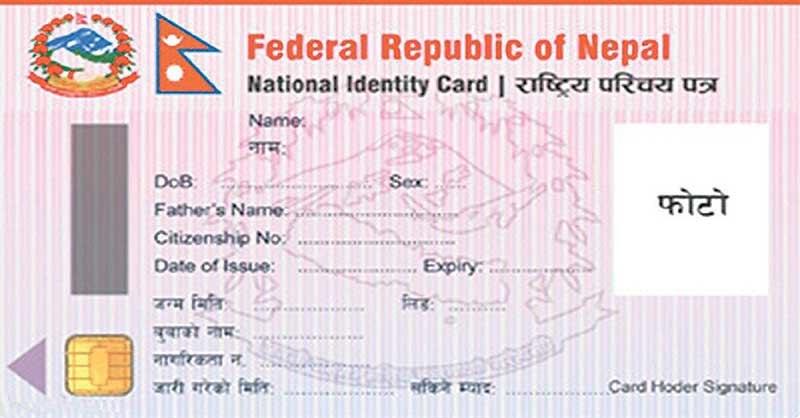
How to register for Rastriya Parichayapatra NID Online Form
Rastriya parichayapatra tatha panjikaran bibhag
राष्ट्रिय परिचयपत्र अनलाइन फारम भर्ने तरिका (👈click here)
| Rastriya parichayapatra tatha panjikaran bibhag nid pre enrollment |
| Rastriya parichayapatra tatha panjikaran bibhag nid pre enrollment |
If you have any medical queries please contact us.
Here’s the answer key along with explanations for each question:
Explanation: Tension headaches are typically characterized by bilateral tightness or pressure-like pain, mild to moderate intensity, and gradual onset. Pulsating pain is more commonly associated with migraine headaches.
Explanation: Hypovolemic shock occurs when there is a significant loss of fluids, such as in cases of severe vomiting, diarrhea, or excessive sweating, leading to decreased blood volume and inadequate perfusion to body tissues.
Explanation: Iron deficiency anemia is characterized by microcytic (small cell size) and hypochromic (pale) red blood cells. An elevated MCV would suggest a different type of anemia, not iron deficiency.
Explanation: Diuretics are considered first-line therapy for uncomplicated hypertension due to their effectiveness in reducing blood volume and lowering blood pressure.
Explanation: The oculomotor nerve controls the movement of most extraocular muscles, including the superior, inferior, and medial rectus muscles, as well as the inferior oblique muscle.
Explanation: Group A Streptococcus is the most common cause of bacterial pharyngitis (strep throat). Amoxicillin is the first-line antibiotic of choice for treating streptococcal infections.
Explanation: Meniere’s disease is characterized by episodes of vertigo, fluctuating sensorineural hearing loss, and tinnitus (ringing in the ears).
Explanation: For first-degree burns, which involve only the superficial layer of the skin, the standard treatment includes cooling the area with cold water and applying sterile, non-adhesive dressings with saline.
Explanation: The clinical presentation with sudden-onset chest pain, shortness of breath, and ST-segment elevation in ECG leads V2 to V4 is highly suggestive of a myocardial infarction (heart attack).
Explanation: Ulnar deviation of the fingers is a characteristic finding in rheumatoid arthritis, an autoimmune disease that primarily affects the synovial joints, leading to joint deformities.
Remember that the explanations provided here are brief and may not cover all aspects of each topic. It’s important to continue studying and referring to comprehensive resources to gain a deeper understanding of these topics for your licensing examination. Good luck with your preparations!
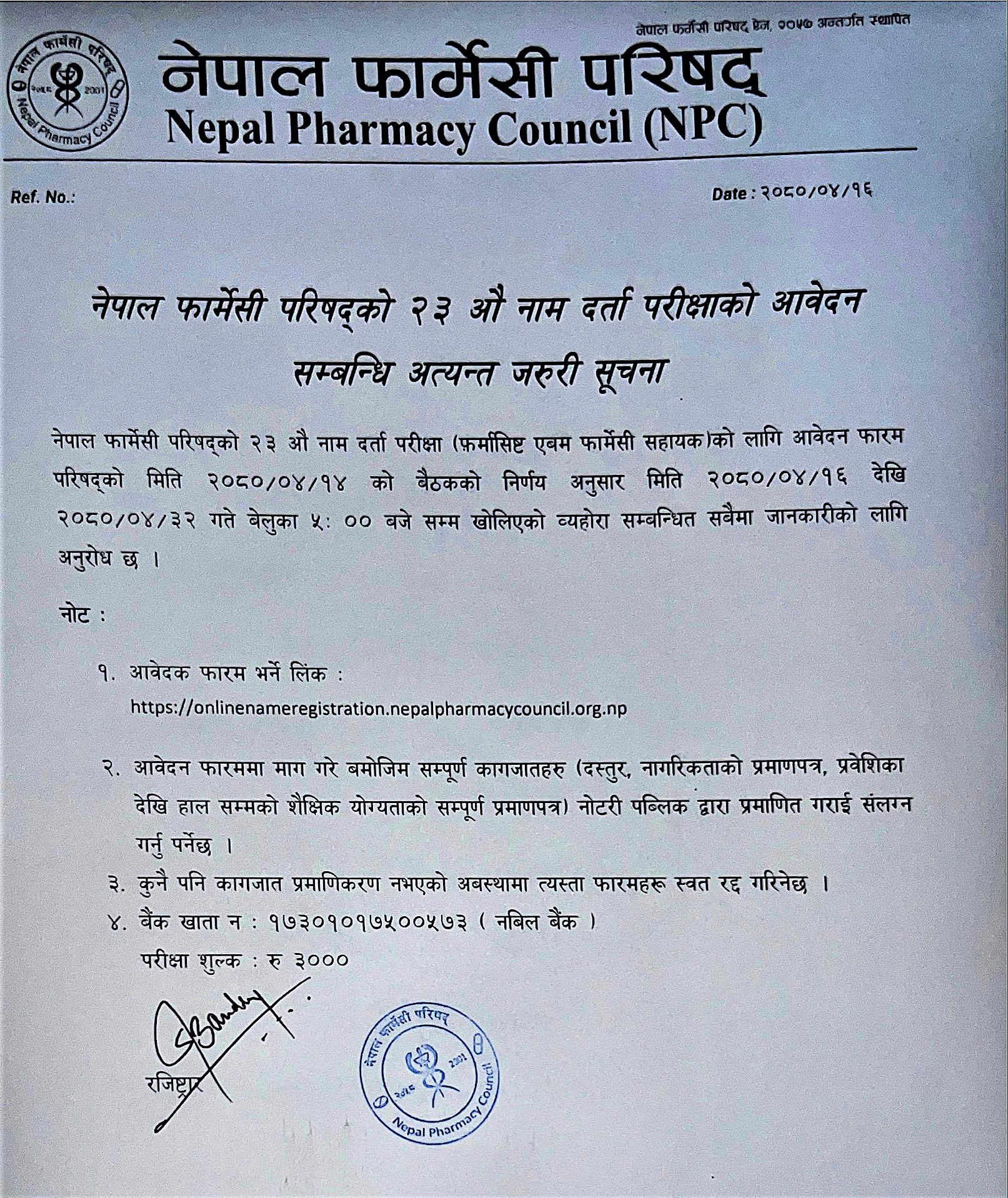
NPC has published and important notice regarding Nepal pharmacy Council notice for 23rd name registration examination 2080.
You can check the notice below.
Open this name registration 2080 link to fill up the form.
| pharmacy council nepal nepal pharmacy council .org. np notice |
If you have any queries regarding it please contact us.
| abortion law in nepal |
In Nepal, abortion is legal on request through 12 weeks of pregnancy and up to 28 weeks for health and other reasons. Abortion is available at public facilities at no cost and by trained private providers. Yet, over half of abortions are provided outside this legal system.
Preamble: Whereas, it is expedient to make necessary provisions on making motherhood and reproductive health service safe, qualitative, easily available and accessible, in order to respect, protect and fulfill the right to safe motherhood and reproductive health of the women conferred by the Constitution of Nepal,
Now, therefore be it enacted by the Federal Parliament.
(2) This Act shall come into force immediately.
(a) “Emergency obstetric care” means the service available twenty-four hours to manage any complications in case such complications appear during the condition of pregnancy, child delivery or child birth.
(b) “Basic emergency obstetric care” means the basic service such as administering antibiotic, magnesium sulfate or oxytocin, taking out entangled placenta and fetus membrane, give birth to infant with the help of vacuum and cleansing uterus in the case of occurrence of miscarriage.
(c) “Teenager” means a person who is of the age group of over ten years up to nineteen years.
(d) “Abortion” means the act of fetus coming out or taking it out of the womb or before the fetus remained in the uterus born naturally.
(e) “Contraception” means the measures to prevent pregnancy by creating obstruction in the common process of ovulation, melting over sperm and ovum or ovum implantation.
(f) “Contraceptives” means hormone-based or other means to help in the work of contraception.
(g) “Abortion service” means the abortion service performed in a licensed health institution, by the licensed health worker upon fulfilling the process under this Act.
(h) “Obstetric care” means the service referred to in Section 5.
(i) “Pregnancy” means a period from the first day of the last menstruation occurred prior to conception up to remaining of fetus in the womb of a woman.
(j) “Prescribed” or “as prescribed” means prescribed or as prescribed in the rules framed under this Act.
(k) “Newborn essential care” means the care including keeping the newborn warm, caring of navel and eyes, breast feeding, administering necessary vaccines.
(l) “Newborn emergency care” means administering antibiotic, managing including hypothermia for the newborn during the state of infection, and managing the problems relating to respiration of such a new born.
(m) “Family planning” means the plan to determine number of children or gap between pregnancies upon self interest by using or not using the contraceptives.
(n) “Reproductive health” means physical, mental and social health condition related to reproductive system, process and function.
(o) “Right to reproductive health” means the right referred to in Section 3.
(p) “Morbidity” means the state of adversely affecting reproductive system due to reproduction, pregnancy, abortion, labor and sexual behavior, and this term also includes uterus prolapse, travail cavity, infertility, pelvic caner and similar other state of such types that affects reproductive system.
(q) “Midwife” means a trained health worker to help in child birth of the pregnant woman.
(r) “Ministry” means the Ministry of the Government of Nepal looking after the matters relating to health.
(s) “Comprehensive emergency obstetric care” means blood transmission and surgery service, in addition to basic emergency obstetric care mentioned in clause (b).
(t) “Safe motherhood” means motherhood service to be provided to women pursuant to this Act during the state of pregnancy, labor and child birth.
(u) “Health institution” means a hospital, nursing home, medical college or health academy operated in governmental, non-governmental, community or private level, and the term also includes primary health center, health post or health institution operated under any other name.
(2) Every person shall have the right to obtain service, counseling and information relating to reproductive health.
(3) Every woman shall have the right to safe motherhood and reproductive health. Every woman shall have the right to determine the gap between births or the number of children.
(4) Every person shall have the right to get information regarding contraceptives and use them.
(5) Every woman shall have the right to obtain abortion service pursuant to this Act.
(6) Every woman shall have the right to nutritious, balanced diet and physical rest during the condition of pregnancy and child birth and morbidity.
(7) Every woman shall have the right to get necessary counseling, obstetric care, and postpartum contraceptive service. read: postpartum blues, depression and psychosis
(8) Every woman shall have the right to get emergency obstetric care, basic emergency obstetric care, comprehensive emergency obstetric care, essential care for the new born baby and emergency care of the new born baby.
(9) Every person shall have the right to get reproductive health service needed during different situation of his/her lifecycle, in easily available, acceptable and safe manner.
(10) Every person shall have the right to make a choice of reproductive health service.
(2) The health institution concerned shall have to provide the pregnant woman, coming to get service pursuant to sub-section (1), with the services as follows:
(a) To check health at least four times during the pregnancy in normal condition,
(b) To check health as per the advice of a physician or competent health worker during the prescribed condition except that referred to in clause (a),
(c) To receive appropriate counseling relating to health care,
(d) To obtain safety measures and minimum care to be adopted during pregnancy.
(2) The non-governmental and private health institution fulfilling the standard prescribed by the Government of Nepal shall have to provide obstetric care in a respectful manner.
(2) The non-governmental and private health institutions fulfilling the standard prescribed by the Government of Nepal shall have to provide emergency obstetric and newborn care.
(3) In case the health institutions referred to in sub-sections (1) and (2) are not able to manage the complications that arise while providing service by them, they shall have to refer to a governmental or community health institution to the extent possible and to a non-governmental and private institution if not possible.
(4) It shall be the duty of the health institution concerned to manage the health complications of the conditions related to the pregnant, childbirth or newborn who comes upon being referred pursuant to sub-section (3).
(5) The health institution providing emergency obstetric and newborn care shall have to make provision of resting place as prescribed for the pregnant women of the condition as prescribed.
(2) On the basis of the record referred to in sub-section (1), the health institution shall have to provide the father or mother with the certificate of the infant born in its health institution by stating the name of father or mother of the infant.
(3) Each health institution shall have to maintain a record revealing the number of the dead infants and the women who have undergone miscarriage or abortion.
(4) Each health institution shall have to maintain a record of dead women, if any, who come for the obstetric care.
(2) The service relating to family planning as prescribed shall have to be obtained from the health institution as prescribed.
(3) Other matters relating to family planning shall be as prescribed.
(2) In case the obstetric leave referred to in sub-section (1) is not sufficient to any pregnant woman, such a woman shall have the right to get leave without pay, for a maximum of one year upon the recommendation of the expert doctor.
(3) A governmental, non-governmental or private organization or institution shall have to make necessary arrangement for the woman working in its office for breast feeding during the office hours up to two years from the birth of the infant.
(4) Even if any pregnant woman gives birth to a dead infant or if the infant dies after birth, such a woman shall enjoy the leave referred to in sub-section (1).
(5) If the wife of a male employee working in a governmental, non-governmental or private organization or institution is going to deliver a baby, such an employee shall get the obstetric care leave with remuneration for fifteen days before or after delivering the baby.
Chapter-4 Safe Abortion
- To perform safe abortion: A pregnant woman shall have the right to get safe abortion performed in any of the following circumstances:
(a) Fetus (gestation) up to twelve weeks, with the consent of the pregnant woman,
(b) Fetus (gestation) up to twenty-eight weeks, as per the consent of such woman, after the opinion of the licensed doctor that there may be danger upon the life of the pregnant woman or her physical or mental health may deteriorate or disabled infant may be born in case the abortion is not performed,
(c) Fetus (gestation) remained due to rape or incest, fetus (gestation) up to twenty-eight weeks with the consent of the pregnant woman,
(d) Fetus (gestation) up to twenty-eight weeks with the consent of the woman who is suffering from H.I.V. or other incurable disease of such nature,
(e) Fetus (gestation) up to twenty eight weeks with the consent of the woman, as per the opinion of the health worker involved in the treatment that damage may occur in the womb due to defects occurred in the fetus (gestation), or that there is such defect in the fetus of the womb that it cannot live even after the birth, that there is condition of disability in the fetus (gestation) due to genetic defect or any other cause.
- Not to get abortion conducted forcefully: (1) Except in the circumstance as referred to in Section 15, no one shall conduct or get abortion conducted with an intention to get the abortion conducted or knowingly or having reason to believe that the abortion can occur.
(2) No one shall get the abortion conducted by coercing a pregnant woman, threatening, enticing or tempting her.
(3) If any of the following acts is committed, it shall be deemed to have got abortion performed:
(a) Getting abortion conducted pursuant to sub-section (2),
(b) Miscarriage that occurs while something is done to the pregnant woman with some enmity,
(c) Making assistance to commit acts referred to in clauses (a) and (b),
(4) While conducting abortion, in case the abortion does not occur instantly but a living infant is born, and if the infant, which is born as a result of such an act dies immediately, it shall be deemed to have got the abortion conducted for the purposes of this Section.
- Not to commit abortion upon identifying sex: (1) No one shall commit or cause to be committed an act to identify the sex of the fetus in the womb.
(2) A pregnant woman shall not be pressurized or compelled or intimidated or coerced or enticed or entrapped in undue influence to identify the sex of the fetus.
(3) Conducting abortion or causing it to be conducted, by identifying the sex pursuant to sub-sections (1) and (2), is prohibited.
- Safe abortion service: (1) The licensed health worker who has fulfilled the prescribed standards and qualification shall have to provide the pregnant woman with safe abortion service pursuant to Section 15 in the licensed health institution.
(2) Appropriate technology and process of the service to be provided as referred to in sub-section (1) shall be as prescribed.
(3) The pregnant woman who wants to obtain the safe abortion service shall have to give consent in the prescribed format to the health institution which has obtained a license, or to the health worker who has obtained a license.
(4) Notwithstanding anything contained in sub-section (3), in the case of a woman who is an insane, who is not in a condition to give consent instantly or who has not completed the age of eighteen years, her guardian or curator shall have to give consent.
(5) Notwithstanding anything contained in sub-section (4), in the case of a woman who is below the age of eighteen years, safe abortion service shall have to be provided by considering her best interests.
- To maintain confidentiality: (1) The licensed health institution or licensed health worker shall have to keep confidential all records, information, documents related to reproductive health of the pregnant woman and counseling and service provided to her.
(2) Notwithstanding anything contained in sub-section (1) the records relating to such information, document and counseling service may be made available on the following conditions:
(a) If information is demanded by the investigation authority or court in course of investigation and hearing of any lawsuit,
(b) If it is required to quote without revealing identity of the related woman for the purpose of study, research or monitoring relating to safe abortion,
(c) If the woman concerned demands herself the records thereof.
(2) It shall be the duty of the concerned health institution or health worker to provide information of the matters relating to the care to be followed on the condition of morbidity and in the condition following the surgery, and the hazards likely to be caused by it while providing service referred to in sub-section (1) in a manner that such information is understandable.
(2) The Provincial Government shall have to appropriate certain amount through its budget as grant every year, as per the Provincial law, for the Local Level for the purpose of motherhood and reproductive health service.
(3) The Local Level concerned shall have to spend the amount appropriated as per sub-sections (1) and (2) for the motherhood and reproductive health of the economically extremely destitute women as prescribed.
(2) While appropriating budget as referred to in sub-section (1), it shall have to be appropriated in such a way that governmental and community health institutions providing motherhood and reproductive health service receive it.
(a) Secretary, Ministry of Health and Population -Chairperson
(b) Joint-secretary, Ministry of Women, Children
and Senior Citizens -Member
(c) Joint-Secretary, Ministry of Education, Science and
Technology -Member
(d) Director General, Department of Health Services -Member
(e) Representative, Nepal Medical Council -Member
(f) Representative, Nepal Nursing Council -Member
(g) Representative, Nepal Health Professional Council -Member
(h) Legal Officer, Ministry of Health and Population -Member
(i) Two representatives including one woman nominated
by the Ministry from among the professional
institutions/persons conducting studies and research
or extending service in the field of reproductive health
and right to reproduction -Member
(j) One representative of Nepal Health Volunteers
Association designated by the Ministry -Member
(k) Director, Family Welfare Division, Health Service Department -Member-secretary
(2) The Coordination Committee may invite the expert engaged in the sector of reproductive health and right to reproduction to the meeting as required.
(3) The procedures relating to the meeting of the Committee shall be as determined by the Committee itself.
(a) To deprive one of receiving the obstetric care referred to in Section 5,
(b) Refusal to provide obstetric care by any health institution providing obstetric care pursuant to Section 6,
(c) Referral to other health institution deliberately even upon the treatment being possible in his or her health institution, or,
(d) Non-issuance of birth certificate by the health institution pursuant to Section 9,
(e) Forceful conduction of family planning as referred to in Section 11,
(f) Making forceful use of contraceptive as referred to in Section 12,
(g) Conduction of abortion as referred to in Section 16,
(h) Commission of any act to identify sex of the fetus in contrary with the provisions of sub-sections (1) and (2) of Section 17,
(i) Causing abortion upon identifying sex as referred to in sub-section (3) of Section 17,
(j) Breaching, or causing to be breached of, confidentiality in contravention of the provisions of sub-section (2) of Section 19,
(k) Making or causing to be made displacement in contrary to the provision of Section 21,
(l) Making discrimination contrary to the provision of Section 29.
(a) Imprisonment for a term not exceeding six months or fine not exceeding fifty thousand rupees or both the penalties for committing or getting committed the offence referred to in clauses (a), (b), (c), (d) and (l),
(b) Imprisonment for three months to six months and fine not exceeding fifty thousand rupees for committing or getting committed the offence referred to in clauses (e) and (f),
(c) Punishment referred to in Section 188 of National Criminal Code, 2074 (2017) for committing or causing to be committed the offence referred to in clauses (g), (h) and (i),
(d) Fine not exceeding fifty thousand rupees for committing or causing to be committed the offence as referred to in clause (j),
(e) Imprisonment for a term not exceeding one year and fine not exceeding one hundred thousand rupees or both the penalties for committing or causing to be committed the offence referred to in clause (k).
(2) It shall be the duty of the concerned health institution to comply with the directives received pursuant to sub-section (1).
(2) Private, non-governmental and community health institutions may take service charge as prescribed for providing reproductive health service.
(3) Notwithstanding anything contained in sub-section (2), private, non-governmental and community health institutions and health workers shall have to make the service easily available, and provide free service (quota) as prescribed for the person who is unable to pay the service charge.
(2) A person who is not satisfied with the punishment or order made by the District Court pursuant to sub-section (1) may make an appeal in the concerned High Court.
(2) The cases referred to in Section 25 shall be deemed to have been included in Schedule-1 of the National Criminal Procedure Code, 2074 (2017).
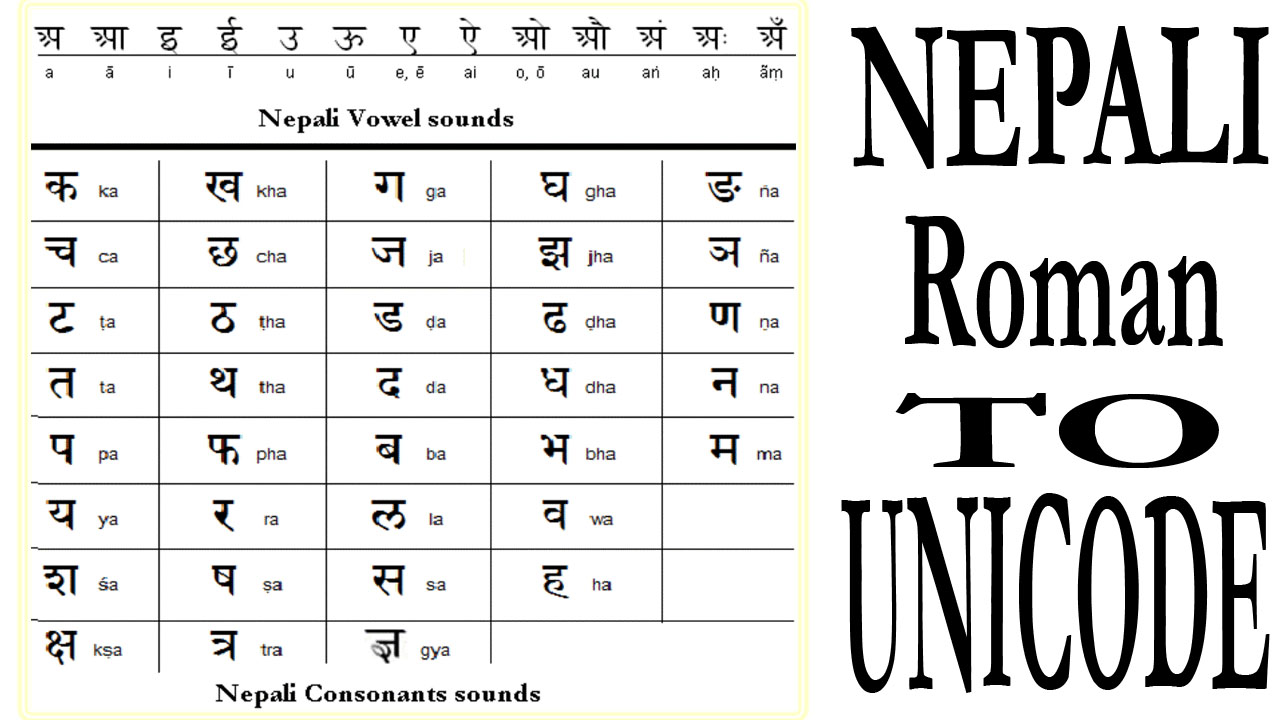
| How to Type Nepali Unicode |
To use Google Input Tools, simply install the extension on your web browser, select the Nepali keyboard, and you’re good to go!
| Nepali keyboard layout unicode and tradional |
| Nepali roman to unicode typing tool |
In this you can see Nepal Nursing Council latest notices.
Please choose the following table to view the latest NNC notices.
| Nepal Nursing Council Notice 2080 |
exam. nnc. org. np
| exam. nnc. org. np |