
MCQs on Epidemiological Triad
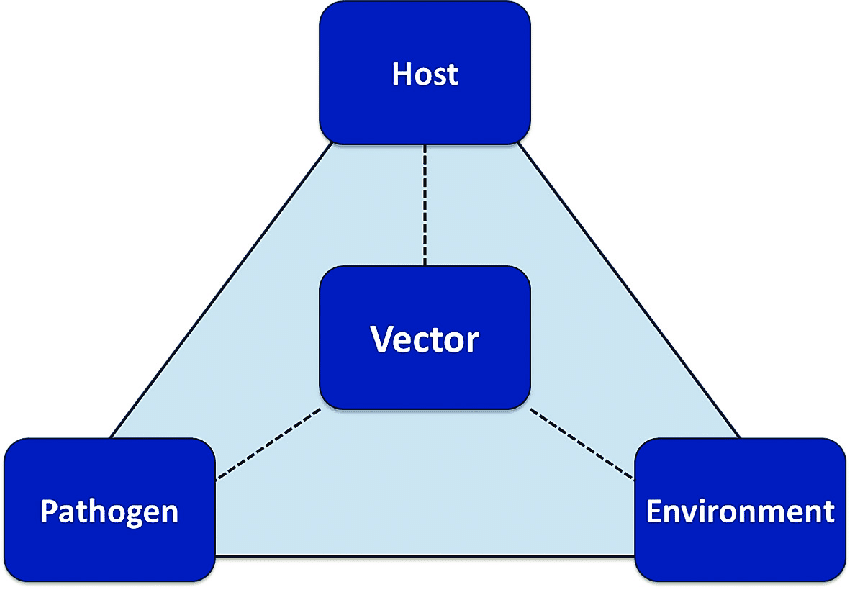
Here’s a set of multiple-choice questions (MCQs) on the Epidemiological Triad, covering basic to advanced concepts, along with an answer key at the end.
MCQs on Epidemiological Triad
Basic Level
-
The epidemiological triad consists of which three components?
a) Agent, Environment, Susceptibility
b) Host, Agent, Environment
c) Agent, Immunity, Host
d) Disease, Host, Transmission -
In the epidemiological triad, the host refers to:
a) The pathogen causing the disease
b) The external surroundings influencing disease transmission
c) The organism (human or animal) that harbors the disease
d) The vector that transmits the disease -
The agent in the epidemiological triad refers to:
a) Only bacteria and viruses
b) Any factor (biological, chemical, or physical) that causes disease
c) Only parasites
d) Environmental factors that promote disease -
Which of the following is an example of an environmental factor in the epidemiological triad?
a) Air pollution causing respiratory diseases
b) Genetic susceptibility to diabetes
c) HIV virus causing AIDS
d) White blood cells fighting infection -
A vector in disease transmission is an example of which component of the epidemiological triad?
a) Host
b) Agent
c) Environment
d) None of the above
Intermediate Level
-
Which of the following is an example of a biological agent in the epidemiological triad?
a) Cigarette smoke
b) Lead poisoning
c) Influenza virus
d) UV radiation -
The host factors that influence disease occurrence include:
a) Immunity, nutrition, and genetic predisposition
b) Population density and climate
c) Type of pathogen and its virulence
d) None of the above -
Breaking the chain of transmission in an infectious disease involves primarily targeting:
a) The agent only
b) The host only
c) Any part of the epidemiological triad
d) The environment only -
Which of the following best represents the role of environment in the epidemiological triad?
a) Contaminated water leading to cholera
b) A person’s weakened immune system
c) A virus causing an outbreak
d) Vaccination campaigns -
Which of the following measures reduces host susceptibility in disease prevention?
a) Quarantine
b) Vaccination
c) Vector control
d) Improving sanitation
Advanced Level
-
Which of the following modifies the epidemiological triad in the modern context?
a) Genetic engineering of microbes
b) Antibiotic resistance in bacteria
c) Climate change affecting disease patterns
d) All of the above -
A zoonotic disease, such as rabies, involves transmission from animals to humans. In the epidemiological triad, the animal host represents:
a) The environment
b) The agent
c) A host
d) A vector -
The best approach to controlling malaria using the epidemiological triad is:
a) Providing antimalarial drugs (Host)
b) Using insecticide-treated nets (Environment)
c) Spraying insecticides to kill mosquitoes (Agent)
d) A combination of all of the above -
Which of the following breaks the link between the agent and the host in the epidemiological triad?
a) Herd immunity
b) Reducing virulence of the agent
c) Improving sanitation
d) Treating infected individuals -
In epidemiology, the epidemiological triad model is most applicable to:
a) Chronic diseases only
b) Infectious diseases only
c) Both infectious and non-infectious diseases
d) Genetic disorders only
Answer Key
- b
- c
- b
- a
- c
- c
- a
- c
- a
- b
- d
- c
- d
- a
- c