
Table of Contents
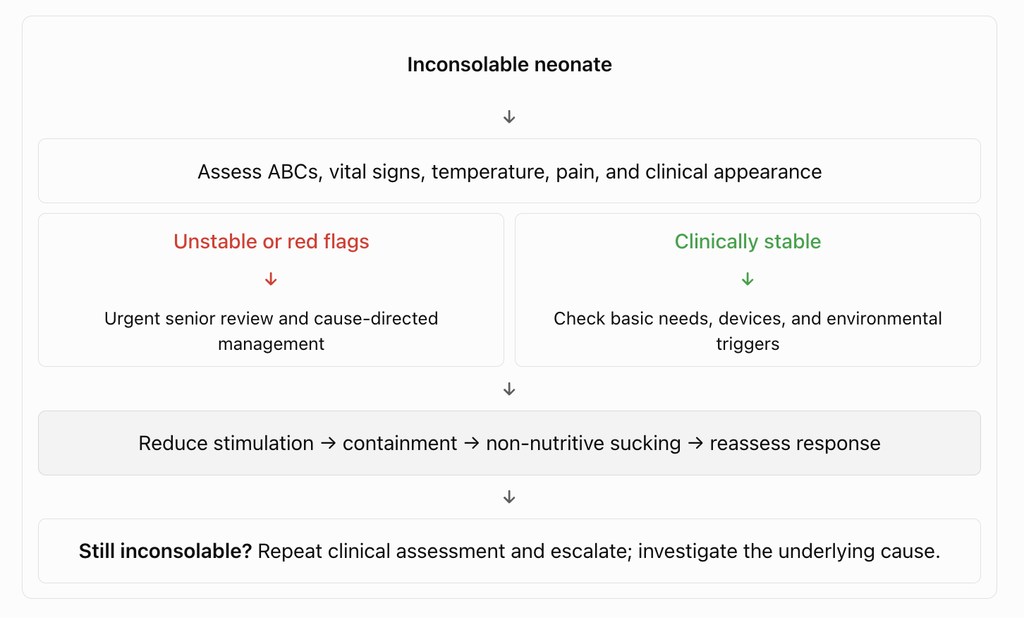
In the NICU, an inconsolable neonate should be approached as a potentially distressed or unwell baby first, and a baby needing soothing second. The key is to identify the cause, reduce stimulation, provide containment, and reassess the response.

1. First: exclude an acute clinical problem
Before spending 10–15 minutes trying to settle the baby, perform a rapid assessment.
Check immediately:
- Airway, breathing, work of breathing, and oxygen saturation.
- Heart rate, temperature, perfusion, and blood pressure if indicated.
- Blood glucose, particularly in preterm, low-birth-weight, or symptomatic neonates.
- Abdominal distension, tenderness, bilious vomiting, bloody stool, or feeding intolerance.
- IV cannula, infusion lines, CPAP interface, NG/OG tube, urinary catheter, and pressure areas.
- Signs of infection, seizures, trauma, or acute neurological deterioration.
Red flags: new high-pitched or weak cry, lethargy, apnea, cyanosis, temperature instability, poor perfusion, bulging fontanelle, seizures, a tense abdomen, or sudden unexplained persistent crying. Escalate promptly to the NICU clinician.
2. A practical bedside soothing sequence
Step 1 — Assess and identify the trigger
Step 2 — Reduce stimulation
Step 3 — Provide containment
Step 4 — Use non-nutritive sucking
Step 5 — Optimize positioning and comfort
3. If the baby is still crying: look for the common causes
| Possible cause | Clinical clues | What to do |
|---|---|---|
| Hunger or feeding cues | Rooting, hand-to-mouth movements, sucking, crying near feeding time | Assess feeding readiness, prescribed feeding intervals, and aspiration risk before feeding. |
| Pain | Crying during handling, grimacing, increased heart rate, altered oxygen saturation | Use a validated neonatal pain assessment tool and identify and treat the underlying cause. |
| Temperature disturbance | Abnormal temperature, cool or warm skin, environmental instability | Measure the temperature and correct the thermal environment. |
| Respiratory distress | Retractions, grunting, tachypnea, desaturation, apnea | Assess airway, breathing, oxygenation, and respiratory support urgently. |
| Abdominal pathology | Abdominal distension, tenderness, bilious vomiting, bloody stool, feeding intolerance | Obtain urgent medical review; consider necrotizing enterocolitis (NEC), intestinal obstruction, or other pathology. |
| Sepsis or metabolic disturbance | Temperature instability, poor feeding, lethargy, apnea, abnormal glucose | Promptly assess for infection and metabolic abnormalities and investigate as clinically indicated. |
| Neurological problems | High-pitched cry, abnormal tone, altered responsiveness, seizures, bulging fontanelle | Arrange urgent clinical and neurological assessment. |
| Withdrawal | Tremors, increased tone, irritability, disturbed sleep, relevant antenatal drug exposure | Review maternal medication and substance exposure and assess using the appropriate neonatal withdrawal protocol. |
| Skin injury or limb discomfort | Swelling, redness, tenderness, reduced limb movement, pressure marks | Inspect the skin, extremities, digits, skin folds, and pressure points. |
| Device-related discomfort | Crying after CPAP application, cannulation, adhesive placement, or tube insertion | Check the position and fit of devices, IV sites, lines, and tubing for pressure, infiltration, displacement, or injury. |
| Overstimulation | Crying after repeated handling, excessive light, noise, or procedures | Reduce sensory input, provide gentle containment, and allow recovery. |
4. Additional techniques that work well in the NICU
Skin-to-skin care: Consider kangaroo mother care when the baby is clinically stable and the team considers it safe. Monitor temperature, airway position, and respiratory support.
Gentle rocking: Only if appropriate for the baby’s condition and local protocol. Avoid vigorous rocking or shaking.
Non-nutritive sucking: Often helpful in preterm infants, especially during stressful care.
Facilitated tucking: Maintain flexion by gently supporting the infant’s limbs during procedures.
Pain relief: For procedures, use appropriate measures such as non-nutritive sucking, breastfeeding when feasible, and prescribed sucrose according to local neonatal protocols. Sucrose is not a treatment for unexplained persistent crying.
Review recent interventions: Suctioning, heel pricks, cannulation, CPAP prongs, adhesive dressings, and repeated handling can all trigger distress.
5. What if nothing works?
If the baby remains inconsolable after initial soothing, do not keep repeating the same interventions indefinitely.
- Reassess vital signs and the baby’s overall appearance.
- Check glucose if indicated and review the feeding history, urine output, stool, and recent procedures.
- Examine the abdomen, fontanelle, skin, extremities, and device interfaces.
- Review medications and possible withdrawal, infection, or other underlying illness.
- Escalate to the NICU senior or neonatologist if the crying is persistent, unusual, unexplained, or accompanied by any abnormal findings.
Do not give sedatives simply to stop crying. Opioids, benzodiazepines, and other sedatives can cause respiratory depression and may obscure clinical deterioration. Use them only for a defined indication under appropriate medical supervision.