
Cerebral and Cerebellar Circulation: Understanding the Lifeline of the Brain (+ Circle of Willis Mnemonics!)

Introduction
The human brain is incredibly dependent on a constant, uninterrupted blood supply. Without oxygen and nutrients delivered by the bloodstream, neurons begin to die within minutes. The brain has evolved an elaborate system of vessels to safeguard this supply, including the Circle of Willis — a crucial arterial network.
In this blog, we’ll cover:
-
The basics of Cerebral and Cerebellar circulation.
-
The components of the Circle of Willis.
-
Easy mnemonics to remember it all!
Cerebral Circulation: The Main Highways of the Brain
The cerebral circulation mainly involves blood flow through two pairs of arteries:
1. Internal Carotid Arteries (ICA)
-
Supplies most of the anterior brain (frontal, parietal, parts of temporal lobes).
-
Major branches include:
-
Anterior Cerebral Artery (ACA)
-
Middle Cerebral Artery (MCA)
-
Ophthalmic Artery
-
2. Vertebral Arteries
-
Travel up the cervical spine and unite to form the Basilar Artery.
-
Supply the posterior part of the brain (brainstem, cerebellum, occipital lobes).
-
Major branches include:
-
Posterior Inferior Cerebellar Artery (PICA)
-
Anterior Spinal Artery
-
Together, these arteries connect and form a protective loop at the base of the brain called the Circle of Willis.
Cerebellar Circulation: Keeping Balance and Coordination Alive
The cerebellum (responsible for balance and fine motor coordination) receives blood from three main paired arteries:
-
Superior Cerebellar Artery (SCA)
-
Anterior Inferior Cerebellar Artery (AICA)
-
Posterior Inferior Cerebellar Artery (PICA)
These branches arise from:
-
The Basilar artery (for SCA and AICA).
-
The Vertebral arteries (for PICA).
Damage to these vessels can cause severe symptoms like ataxia, vertigo, dysarthria, and nystagmus.
Circle of Willis: The Brain’s Safety Net
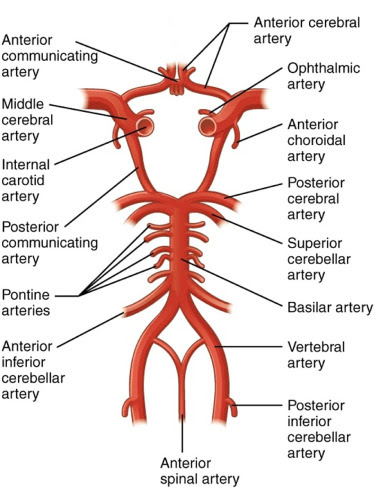
The Circle of Willis is an important circular network of arteries located at the base of the brain, connecting the anterior and posterior circulations.
Components of the Circle of Willis:
-
Anterior Cerebral Arteries (ACA) (left and right)
-
Anterior Communicating Artery (AComm)
-
Internal Carotid Arteries (ICA) (left and right)
-
Posterior Cerebral Arteries (PCA) (left and right)
-
Posterior Communicating Arteries (PComm) (left and right)
This structure allows for collateral blood flow — meaning if one part gets blocked, other vessels can compensate.
Mnemonics to Remember the Circle of Willis
Here’s a very simple and memorable mnemonic:
“Aunt Alice Is Picking Apples“
Each word corresponds to a part of the Circle:
| Word | Artery |
|---|---|
| Aunt | Anterior Cerebral Artery (ACA) |
| Alice | Anterior Communicating Artery (AComm) |
| Is | Internal Carotid Artery (ICA) |
| Picking | Posterior Communicating Artery (PComm) |
| Apples | Posterior Cerebral Artery (PCA) |
Another Detailed Mnemonic:
“All Adults In Paris Appreciate Painting“
Where:
-
All = Anterior Cerebral Artery (ACA)
-
Adults = Anterior Communicating Artery (AComm)
-
In = Internal Carotid Artery (ICA)
-
Paris = Posterior Communicating Artery (PComm)
-
Appreciate = Posterior Cerebral Artery (PCA)
-
Painting = (memory hint for cerebellar arteries connected at lower level)
Clinical Relevance
Problems in cerebral circulation can lead to:
-
Ischemic strokes (blockage)
-
Hemorrhagic strokes (rupture)
-
Transient Ischemic Attacks (TIAs)
Common pathology in the Circle of Willis:
-
Berry aneurysms, especially at the junctions of arteries, leading to subarachnoid hemorrhage if ruptured.
Early recognition of symptoms like sudden weakness, confusion, trouble speaking, or loss of balance is crucial.
Conclusion
The cerebral and cerebellar circulation ensures that every tiny neuron gets the nutrients and oxygen it needs. The Circle of Willis stands as a beautiful example of nature’s built-in backup system to preserve brain function even under threat.
By mastering the major arteries and using simple mnemonics like “Aunt Alice Is Picking Apples,” you can easily remember this critical system — whether you’re a student, a healthcare professional, or just curious about the marvels of the human body!
Would you also like me to create a diagram of the Circle of Willis with labeled parts to go with this blog? 🎨🧠
(Visuals make it even easier to understand!)