
Raised Intracranial Pressure (ICP)
1. Introduction and Definitions
-
Definition: Abnormally high pressure within the rigid, non-compliant skull cavity.
-
Normal ICP Range: to (Supine adult). Pressures are generally considered pathological and require intervention.
-
The Monro-Kellie Doctrine: States that the total volume within the cranial vault is fixed and is comprised of three components:
-
Brain Parenchyma ()
-
Cerebrospinal Fluid (CSF) ()
-
Intracranial Blood ()
-
-

Compensation: An increase in the volume of one component must be offset by a decrease in one or both of the other components to maintain a stable ICP.
-
Initial compensation primarily involves displacement of CSF into the spinal subarachnoid space and compression of cerebral veins.
-
2. Pathophysiology and Mechanisms
-
Pressure-Volume Curve (Compliance):
-
High Compliance (Initial Phase): Small increases in volume cause minimal change in ICP (flat part of the curve) due to compensatory mechanisms.
-
Low Compliance (Decompensation): Once compensation is exhausted, the curve becomes steep; a small increase in volume causes an exponential increase in ICP.
-
-
Cerebral Perfusion Pressure (CPP): The net pressure gradient causing blood flow to the brain. Maintenance is critical for preventing secondary brain injury.
-
Formula: (Mean Arterial Pressure minus Intracranial Pressure).
-
Goal: Maintain typically . If increases, decreases, leading to ischemia.
-
-
Causes of Raised ICP:
-
Mass Lesions: Tumors (primary/metastatic), hematomas (epidural, subdural, intracerebral), cerebral abscesses.
-
Cerebral Edema:
-
Vasogenic: Breakdown of the blood-brain barrier (e.g., tumors, infection, trauma).
-
Cytotoxic: Cellular swelling due to ischemia (e.g., stroke, hypoxia, DKA).
-
-
Hydrocephalus: Impaired CSF flow or absorption (e.g., subarachnoid hemorrhage, meningitis, obstruction of the aqueduct of Sylvius).
-
Increased CBV: Hypercapnia ( retention causes vasodilation), venous outflow obstruction (e.g., jugular vein thrombosis, position).
-
Idiopathic: Pseudotumor Cerebri (Idiopathic Intracranial Hypertension).
-
3. Clinical Features
|
Stage |
Signs and Symptoms |
Key Findings |
|---|---|---|
|
Early / Compensated |
Mild headache, worse in the morning or with strain (Valsalva). Transient visual obscurations. Nausea/vomiting (may be projectile). |
Diplopia (CN VI palsy). Papilledema (optic disc swelling – may be late sign). |
|
Late / Decompensated |
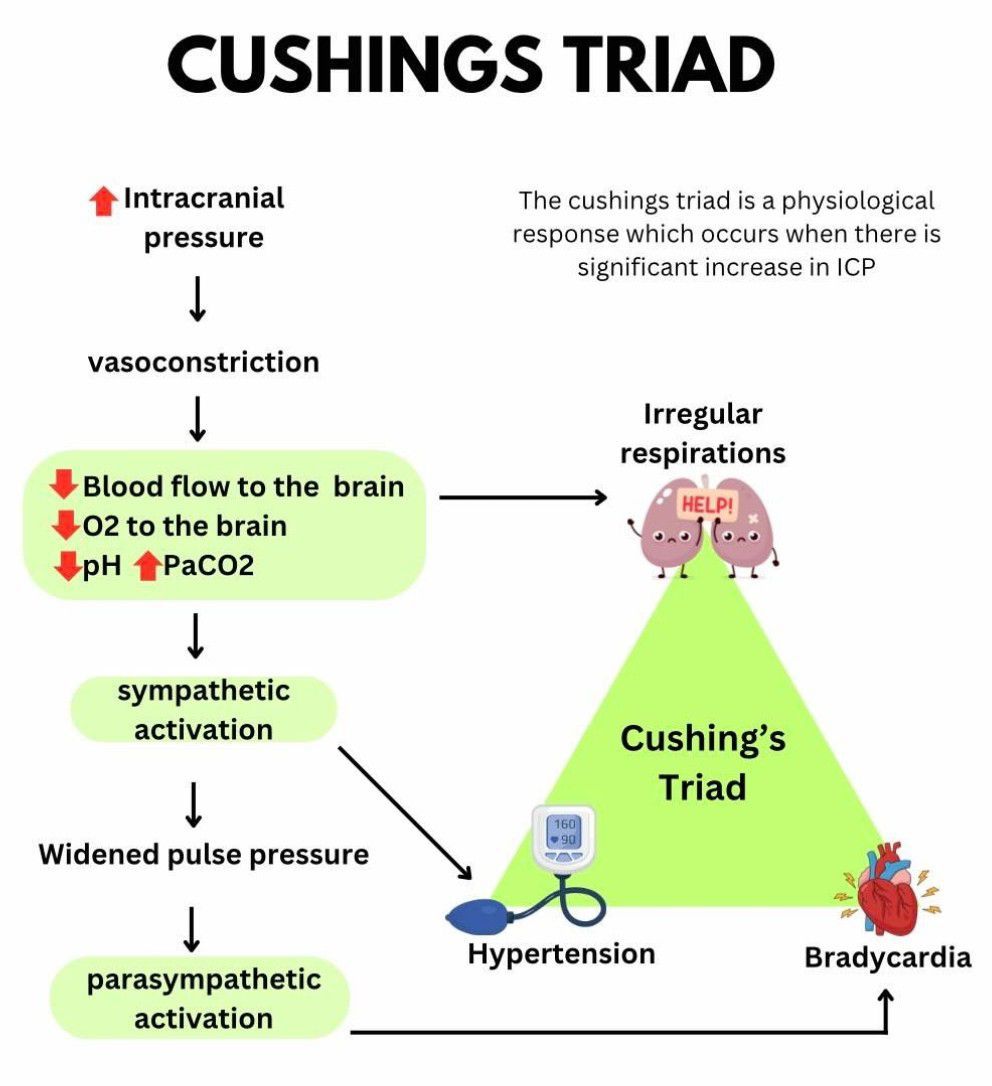
Cushing’s Triad: 1. Hypertension (often widening pulse pressure). 2. Bradycardia. 3. Irregular respirations. |
Decline in Glasgow Coma Scale (GCS). Fixed, dilated pupils (Uncal herniation). Posturing (decorticate or decerebrate). |
4. Diagnosis and Monitoring
-
Neuroimaging (Initial):
-
CT/MRI: Essential to identify underlying cause (mass lesion, hemorrhage, edema, hydrocephalus) and signs of herniation.
-
Warning: Lumbar Puncture (LP) is ABSOLUTELY CONTRAINDICATED in the presence of a known or suspected mass lesion or signs of herniation, as it can precipitate transtentorial or tonsillar herniation.
-
-
ICP Monitoring (Gold Standard):
-
External Ventricular Drain (EVD): Provides continuous ICP measurement, allows sampling of CSF, and permits therapeutic drainage of CSF to lower ICP.
-
Fiber Optic Transducers: Devices placed in the parenchyma or subdural space.
-
5. Management (Tiered Approach)
The primary goal is to maintain and .
Tier 0: General and Supportive Measures
-
Positioning: Head of bed elevation to degrees (promotes venous outflow).
-
Vitals: Maintain Normothermia (fever increases metabolism and ICP). Treat pain and agitation (sedation/analgesia).
-
Hemodynamics: Maintain normovolemia and (to support ).
Tier 1: First-Line Therapies
-
CSF Drainage: If an EVD is in place, initiate continuous or intermittent CSF drainage.
-
Hyperosmolar Therapy: Creates an osmotic gradient to draw water out of the brain parenchyma into the intravascular space.
-
Mannitol ( to IV bolus): Requires intact blood-brain barrier (BBB) and maintenance of serum osmolarity .
-
Hypertonic Saline (e.g., or ): Draws fluid from brain, increases , and avoids the rebound ICP effect sometimes seen with Mannitol.
-
Tier 2: Second-Line Therapies (If ICP remains
)
-
Ventilation: Controlled, transient hyperventilation (Target ). Causes cerebral vasoconstriction, rapidly reducing and . Use cautiously as it can cause ischemia.
-
Diuresis: Repeat hyperosmolar therapy.
Tier 3: Third-Line Therapies (Refractory ICP)
-
Barbiturate Coma (e.g., Pentobarbital): Decreases cerebral metabolic rate and (powerful vasoconstrictor). Requires continuous monitoring and full support.
-
Decompressive Craniectomy: Surgical removal of a portion of the skull to allow the edematous brain to swell outward, physically reducing pressure.
-
Hypothermia: Induced mild hypothermia (Controversial; used in select, severe cases).

6. Complications
-
Cerebral Herniation: Life-threatening displacement of brain tissue due to severe pressure gradient.
-
Uncal Herniation: Medial temporal lobe (uncus) through the tentorial notch. Causes ipsilateral fixed and dilated pupil (CN III compression) and contralateral hemiparesis.
-
Tonsillar Herniation: Cerebellar tonsils through the foramen magnum. Compresses the brainstem, leading to cardiorespiratory arrest.
-
Secondary Brain Injury: Ischemia and infarction caused by critically low .
-
Central Diabetes Insipidus/SIADH/Cerebral Salt Wasting: Endocrine/electrolyte disturbances often associated with severe brain injury.