
Table of Contents
Wimberger’s Sign
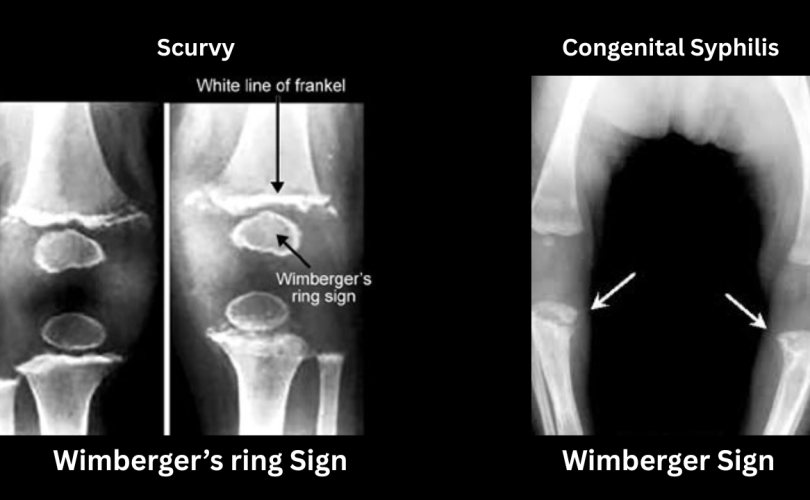
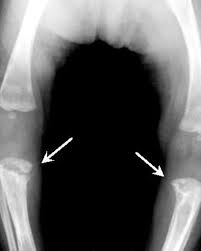
Wimberger’s sign refers to localized bone destruction or demineralization of the medial aspect of the proximal tibial metaphysis. It is often considered a radiological finding suggestive of congenital syphilis in infants. This condition occurs due to the involvement of rapidly growing bones in syphilitic periostitis or osteitis.
Key Points:
- Cause: Congenital syphilis (usually secondary to spirochetal infection transmitted from the mother to the fetus).
- Appearance: Bilateral, symmetrical defects in the medial portion of the proximal tibial metaphysis.
- Differential Diagnosis: Other conditions, such as rickets or scurvy, may cause bone deformities, but the symmetry and specific localization are more characteristic of congenital syphilis.
Wimberger Ring Sign
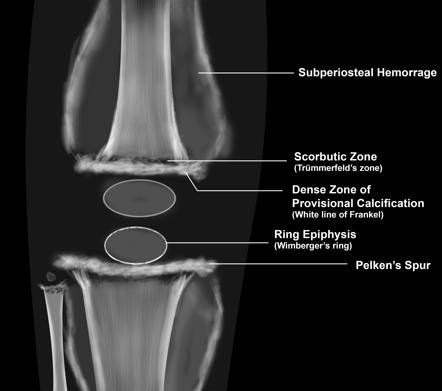
The Wimberger ring sign refers to a radiological finding characterized by a dense, sclerotic ring around the epiphysis of long bones, typically seen in cases of scurvy. This condition occurs due to subperiosteal hemorrhages and impaired collagen synthesis caused by vitamin C deficiency.
Key Features of the Wimberger Ring Sign:
- Appearance: A sharply defined, dense, sclerotic ring surrounding the epiphysis.
- Cause: Reflects disorganized bone growth due to vitamin C deficiency.
- Associated Findings in Scurvy:
- Subperiosteal hemorrhages.
- Fragility fractures.
- “Corner sign” (a small metaphyseal fracture).
- “Trümmerfeld zone” or scorbutic zone (an area of lucency in the metaphysis).
- Generalized osteopenia.
Clinical Context:
- Seen in: Malnourished children or adults with prolonged vitamin C deficiency.
- Symptoms: Bone pain, weakness, irritability, bleeding gums, and anemia.
Comparison Between Wimberger’s Sign and Wimberger Ring Sign
| Feature | Wimberger’s Sign (Congenital Syphilis) | Wimberger Ring Sign (Scurvy) |
|---|---|---|
| Definition | Destruction or demineralization of the medial proximal tibial metaphysis | Sclerotic ring surrounding the epiphysis of long bones |
| Cause | Congenital syphilis (due to Treponema pallidum infection) | Scurvy (Vitamin C deficiency) |
| Pathophysiology | Inflammatory osteitis and periostitis caused by congenital syphilis | Impaired collagen synthesis leading to defective bone formation and subperiosteal hemorrhage |
| Radiological Appearance | Bilateral, symmetrical bony defects in the medial proximal tibial metaphysis | Dense white ring around the epiphysis due to disorganized bone deposition |
| Commonly Affected Bones | Proximal tibia (pathognomonic), but also femur and other long bones | Long bones, especially around the knees, wrists, and ankles |
| Associated Radiological Signs | Periostitis, saber shins, metaphyseal destruction | Subperiosteal hemorrhages, “Trümmerfeld zone” (lucent metaphysis), corner sign |
| Clinical Symptoms | Pseudoparalysis (Parrot’s pseudoparalysis), bone pain, fever, irritability | Bone pain, swollen joints, bleeding gums, anemia, irritability |
| Age Group Affected | Infants (congenital) | Infants and adults with severe vitamin C deficiency |
| Treatment | Penicillin (antibiotics for syphilis) | Vitamin C supplementation |
Key Differences:
- Wimberger’s Sign is a destructive lesion in congenital syphilis, whereas Wimberger Ring Sign is a sclerotic epiphyseal ring due to scurvy.
- Syphilis affects metaphyses, while scurvy primarily affects the epiphysis.
- Syphilis is an infectious disease, while scurvy is a nutritional deficiency.