Most Common Complication of High Myopia
function checkAnswer(event, questionId, correctAnswer) {
event.preventDefault();
let selectedOption = document.querySelector(`input[name=”${questionId}”]:checked`);
let resultDiv = document.getElementById(`${questionId}-result`);
if (!selectedOption) {
resultDiv.innerHTML = “Please select an answer!”;
resultDiv.style.backgroundColor = “#ffdddd”;
} else if (selectedOption.value === correctAnswer) {
resultDiv.innerHTML = “Correct!”;
resultDiv.style.backgroundColor = “#d4edda”;
} else {
resultDiv.innerHTML = “Incorrect! Try again.”;
resultDiv.style.backgroundColor = “#ffdddd”;
}
resultDiv.style.display = “block”;
}
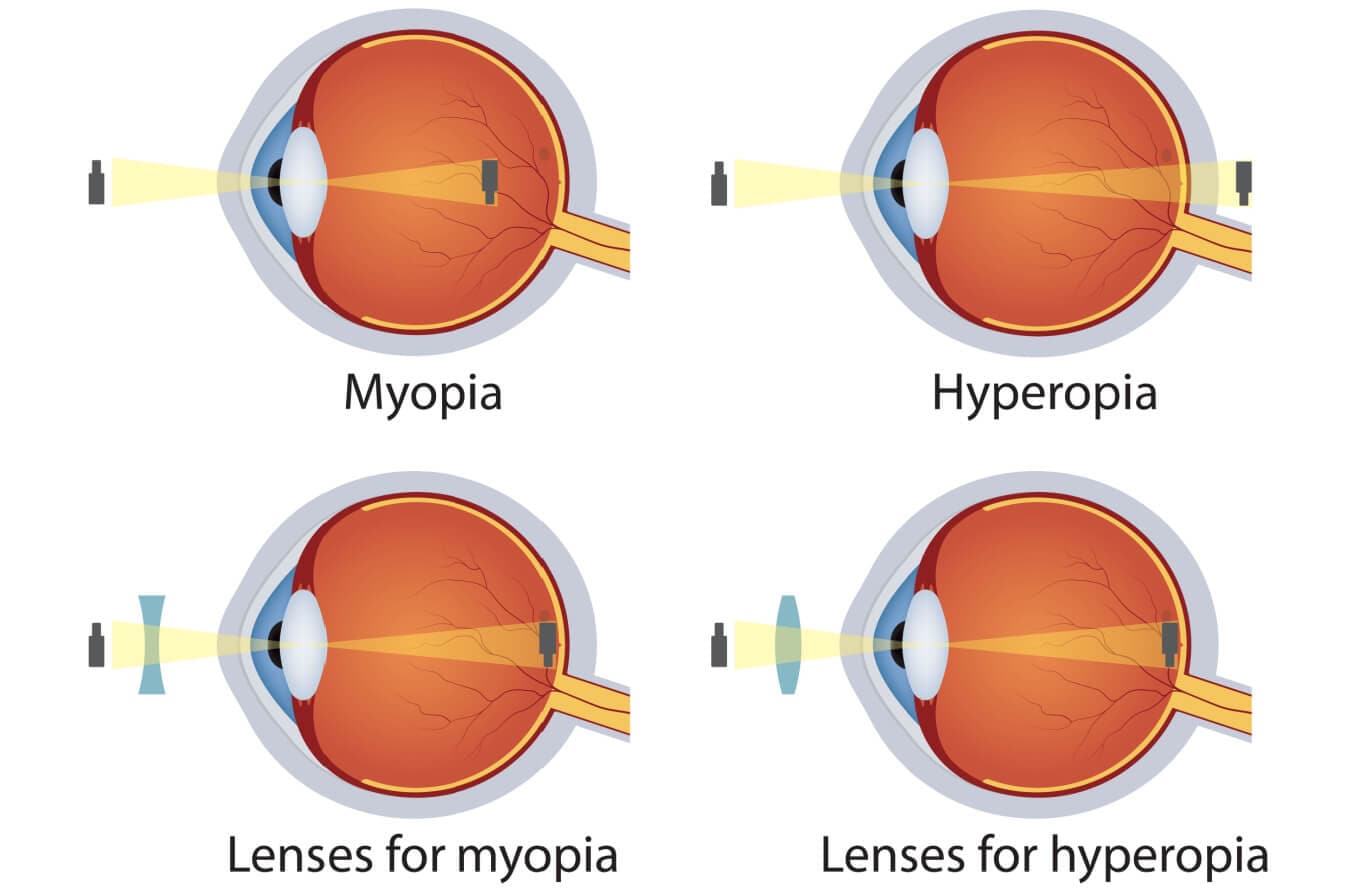
Myopia, or nearsightedness, and hyperopia, or farsightedness, are both common refractive eye conditions that blur vision.
Complications of Myopia:
- Myopic crescents (on the temporal side)
- Posterior staphyloma
- Patchy choroidal atrophy within the posterior pole
- Vitreous syneresis
-
Breaks in Bruch’s membrane with accompanying choroidal atrophy (lacquer
cracks) -
Subretinal neovascular membrane with overlying retinal pigment epithelial
hyperplasia (Foster-Fuchs spot) - Retinal detachment
Key Concepts on vision:
-
Physiological myopia is the
most common eye disorder worldwide. -
In myopia, parallel rays of
light focus
in front of the retina. -
In hypermetropia, parallel
rays of light focus
behind the retina. -
A 1 mm change in axial
length leads to a
3D change in refraction.-
Shortening causes
hypermetropia -
Lengthening causes
myopia
-
Shortening causes
-
A 1 mm change in corneal
curvature can lead to
6D hypermetropia. - At birth, the eye is normally hypermetropic.
-
Optical treatment:
- Myopia → Concave lens
-
Hypermetropia →
Convex lens
-
Presbyopia: Physiological
insufficiency of accommodation due to loss of elasticity of the lens capsule
(age-related). -
Astigmatism: Unequal
refractive error in two eyes. -
Aniseikonia: Unequal
image shape/size in the visual cortex. -
Aphakia: Absence of the
crystalline lens.
Treatment of choice →
Posterior chamber IOL implantation. - The most common eye disorder worldwide is physiological myopia, a refractive error.
- The most common cause of blindness worldwide: Cataract (more than refractive error and aphakia blindness).
- The most common cause of irreversible blindness worldwide: Glaucoma.