
Q. Erb’s Palsy:
a. Occurs typically usually after breech delivery of smaller babies
b. Is due to injury of C5 and C6 nerve roots
c. All fingers muscles are paralysed
d. There may be unilateral Horner’s syndrome
Ans: ‘b’
Solution
Explanation: Injury to upper trunk of Brachial plexus (C5, C6, C7) leads t60 Erb’s palsy.
Erb’s palsy

❖ Brachial plexus may be injured when person falls from a height on the side of head and shoulder whereby the nerves of the plexus are violently stretched. (upper trunk of the plexus injured).
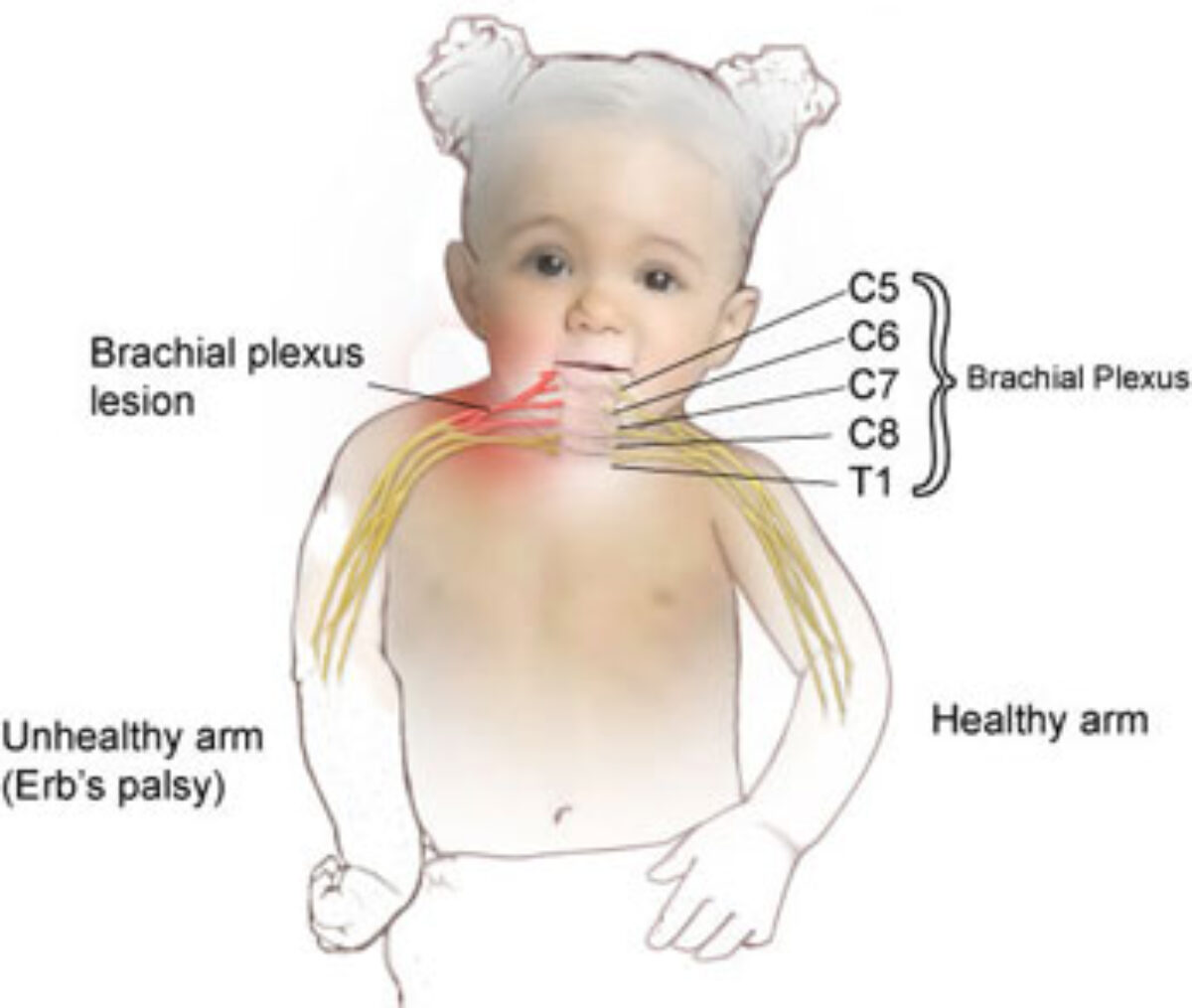
Clinical features of Erb’s Palsy
Paralysis of Ms Deltoid, biceps, brachialis, intraspinatus and spinator.
The position of limb is characteristic i.e., the arm hanges by the side medially rotated and the forearm is extended and pronated (Policeman’s tip)
- Weakness of proximal upper limb muscles
- Loss of sensation in area supplied by c5,6,7 dermatome distribution
Klumpke’s Paralysis
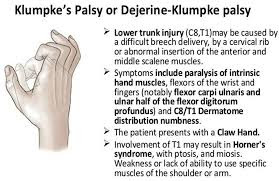
Cause (pathoanatomy) of Klumpke’s Paralysis
Klumpke’s paralysis caused by injury in lower trunk of brachial plexus (C8, T1) characterized by paralysis of intrinsic hand Ms & C8/T1 dermatome distribution numbness.
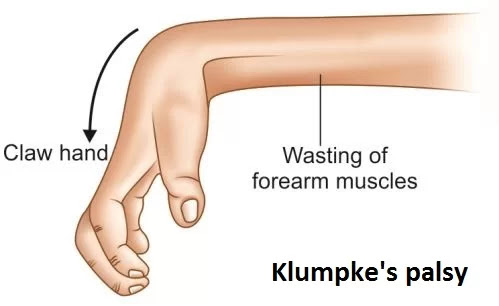
Clinical features of Klumpke’s Paralysis
Clinically Klumpke’s Paralysis has following features
- Weakness of distal muscle of upper limbs
- Wasting of forearm muscles
- Flexion of wrist (wrist drop)
- Clawing of hand
- Numbing/loss of sensation of c8 and t1 distribution