Table of Contents
Newborn care is broadly classified into three levels based on the complexity of care, monitoring, and interventions required.
1. Level I – Basic Newborn Care (Well Newborn Nursery)
Definition
Care provided to healthy term newborns and stable late preterm infants who require only routine monitoring.
Babies managed
- Term newborns (≥37 weeks)
- Birth weight ≥2500 g
- Babies with no complications
- Stable late preterm (≥35 weeks)
Services provided
- Routine neonatal examination
- Thermal care
- Early breastfeeding support
- Cord care
- Monitoring:
- Temperature
- Feeding
- Urination/stooling
- Immunization (BCG, OPV, Hep B depending on country policy)
- Screening tests
- Parent education
Procedures allowed
- Basic resuscitation
- Oxygen by hood
- IV fluids if needed briefly
Staffing
- Pediatrician or trained medical officer
- Nurses trained in newborn care
2. Level II – Special Care Newborn Unit (SCNU / Special Care Nursery)

Definition
Care for moderately ill newborns who require closer monitoring or short-term intensive support.
Babies managed
- Preterm infants ≥32 weeks
- Birth weight ≥1500 g
- Neonates recovering from severe illness
- Neonates needing short-term respiratory support
Indications
- Respiratory distress
- Neonatal jaundice requiring phototherapy
- Sepsis (suspected)
- Feeding difficulty
- Hypoglycemia
- Hypothermia
- Apnea of prematurity
Services provided
- Continuous monitoring
- Phototherapy
- IV fluids and medications
- Tube feeding
- Oxygen therapy
- CPAP (in many Level II units)
- Short-term mechanical ventilation (<24 hr)
Procedures
- Umbilical catheterization
- Lumbar puncture
- Exchange transfusion (in some units)
Staffing
- Pediatricians
- Neonatal nurses
- Access to laboratory and imaging
3. Level III – Neonatal Intensive Care Unit (NICU)
Definition
Provides comprehensive intensive care for very sick or extremely premature neonates.
Babies managed
- Gestational age <32 weeks
- Birth weight <1500 g (VLBW)
- Extremely low birth weight (<1000 g)
- Neonates requiring advanced respiratory support
Conditions managed
- Severe respiratory distress syndrome
- Birth asphyxia
- Persistent pulmonary hypertension
- Sepsis/septic shock
- Major congenital anomalies
- Surgical conditions
- Severe prematurity complications
Services provided
- Mechanical ventilation
- High frequency ventilation
- Surfactant therapy
- Total parenteral nutrition (TPN)
- Continuous cardiorespiratory monitoring
- Central lines
- Invasive procedures
- Advanced imaging
- Neonatal surgery (in Level III C)
Sub-classification (sometimes used)
- Level III A – mechanical ventilation
- Level III B – advanced ventilation + surgery
- Level III C – ECMO capable units
Staffing
- Neonatologist
- Pediatric intensivists
- Specialized neonatal nurses
- Respiratory therapists
- Full laboratory and imaging services
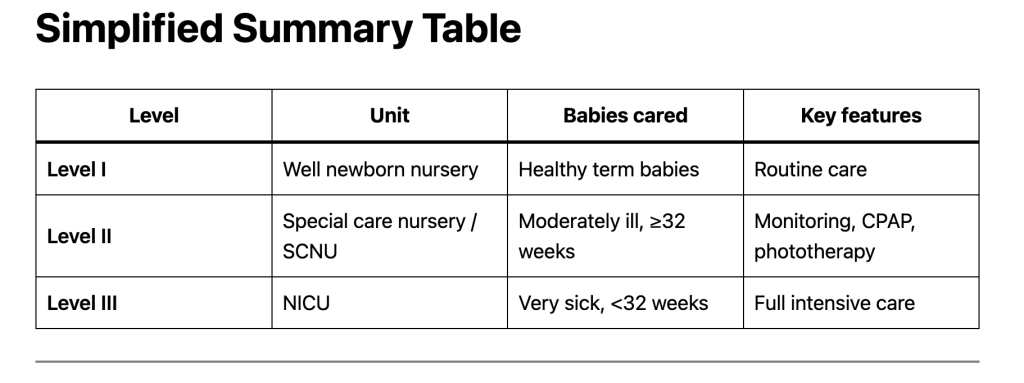
Simplified Summary Table
| Level | Unit | Babies cared | Key features |
|---|---|---|---|
| Level I | Well newborn nursery | Healthy term babies | Routine care |
| Level II | Special care nursery / SCNU | Moderately ill, ≥32 weeks | Monitoring, CPAP, phototherapy |
| Level III | NICU | Very sick, <32 weeks | Full intensive care |
Alternative Public Health Classification (Used in Many Countries)
- Home care
- Community level care
- Facility based newborn care
- NBCC (Newborn Care Corner)
- SNCU
- NICU
✅ Exam Pearls (Pediatrics / Neonatology)
- Level I → routine care
- Level II → moderate illness, ≥32 weeks
- Level III → intensive care, <32 weeks
- VLBW infants (<1500 g) should be managed in Level III NICU